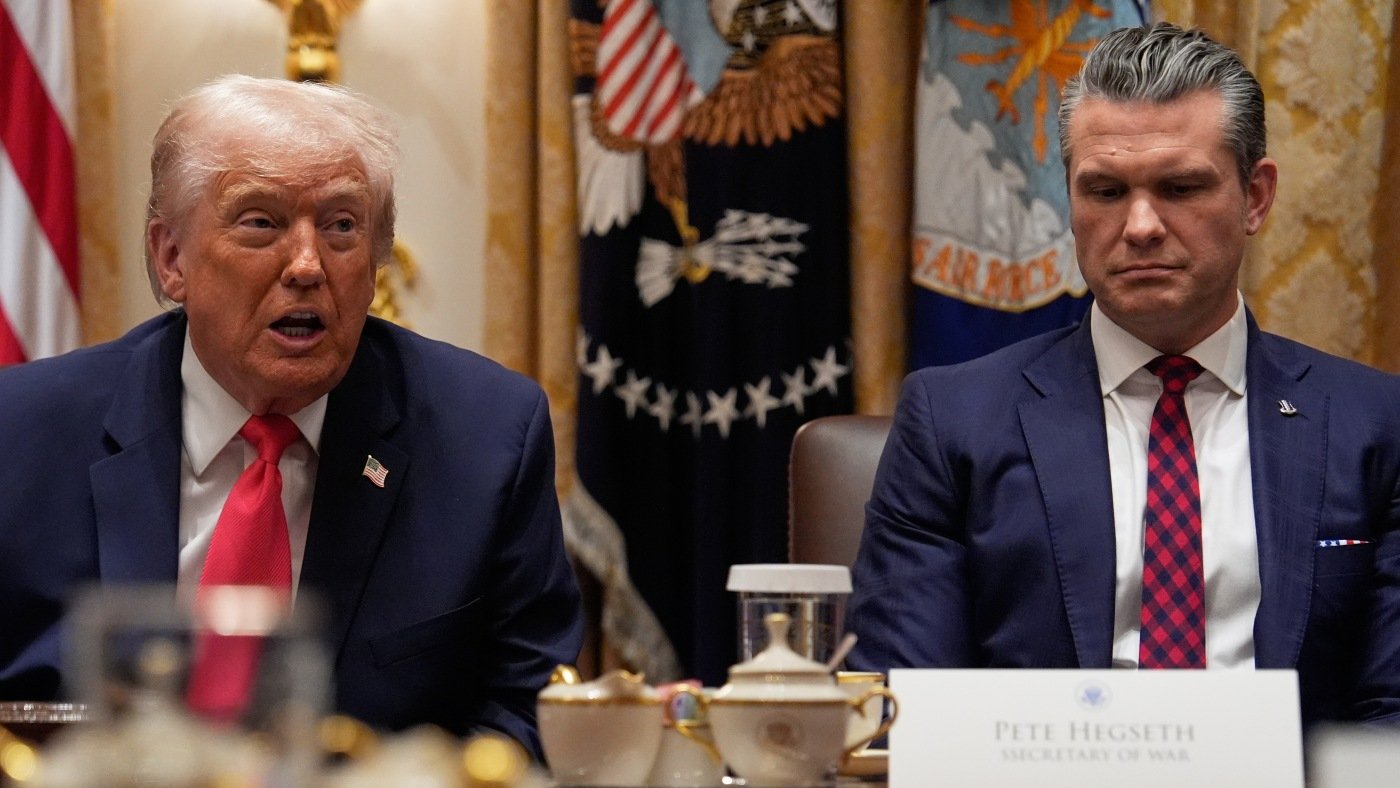

President Donald Trump speaks during a Cabinet meeting at the White House in Washington, Tuesday, Dec. 2, 2025, while Defense Secretary Pete Hegseth attends.
Julia Demery Nikhinson/AP
hide caption
toggle caption
Julia Demery Nikhinson/AP
President Donald Trump said Tuesday he does not want Somali immigrants in the United States, saying residents of the war-ravaged East African country rely too heavily on the American social safety net and have too few connections to the United States.

Trump’s derogatory description of the entire immigrant community is the latest example of him explicitly attacking the Somali diaspora in the United States. Somalis have often come to Minnesota and other states as refugees since the 1990s. The President made no distinction between citizens and non-citizens.
The president’s comments come days after his administration announced it was pausing all asylum decisions following the shooting of two National Guard soldiers in Washington. The suspect in last week’s incident is originally from Afghanistan, but Trump has used the moment to raise questions about immigrants from other countries, including Somalia.
“They don’t contribute anything. I don’t want them in our country,” Trump told reporters at the end of a lengthy Cabinet meeting. He further said, “Their country is not good for some reason. Your country stinks and we don’t want them in our country.”
Trump has for years criticized Representative Ilhan Omar, a Minnesota Democrat who immigrated from Somalia as a child in 1995. But he stepped up his attacks on Somalis on social media last week when Christopher Ruffo, a conservative activist, published unfounded allegations in the magazine City Journal, citing unnamed sources, that money stolen from Minnesota programs went to al-Shabaab, the al-Qaeda-linked terrorist group that controls parts of Somalia.
Trump vowed to “send the Somalis back out of there” in a social media post last week and alleged that Minnesota, home to the largest Somali community in the United States, is “a hotbed of fraudulent money laundering activity.” On Tuesday, the president said Somalis in the US should “go back where they came from and fix it.”
He specifically promised to end temporary legal protections for Somalis living in Minnesota, a move that is stoking fear in the state’s deeply rooted immigrant community, as well as doubts about whether the White House has the legal authority to enact the directive.
The announcement drew immediate reaction from some state leaders and immigration experts, who called Trump’s announcement a legally dubious attempt to sow suspicion toward Minnesota’s Somali community.
The move would affect only a small portion of the thousands of Somalis living in Minnesota. A report prepared for Congress in August put the number of Somalis covered under Temporary Protected Status nationwide at just 705.
Trump also repeated his criticism of Omar, whose family fled the civil war in Somalia and spent several years in a refugee camp in Kenya before coming to the US.
“We can go one way or the other, and if we keep bringing garbage into our country, we’re going the wrong way,” Trump said. “Ilhan Omar is trash. She’s trash. Her friends are trash.”
On Tuesday, Omar fired back at Trump on social media, saying, “His obsession with me is creepy. I hope he gets the help he so desperately needs.”
Trump said of Somali immigrants: “These are not people who work. These are not people who say, ‘Come on, come on. Let’s make this place great.’ These are the people who do nothing but complain.”
Minneapolis Mayor Jacob Frey called Trump’s message “wrong” and said Somali immigrants have helped improve his community.
“They’ve started businesses and created jobs. They’ve added to the cultural fabric of Minneapolis,” Frey said. “Again, it’s ridiculous to villainize an entire group under any circumstances. And the way Donald Trump continues to do that, I think it raises questions about major constitutional violations. And it certainly violates the moral fabric we stand for in this country as Americans.”
<a href