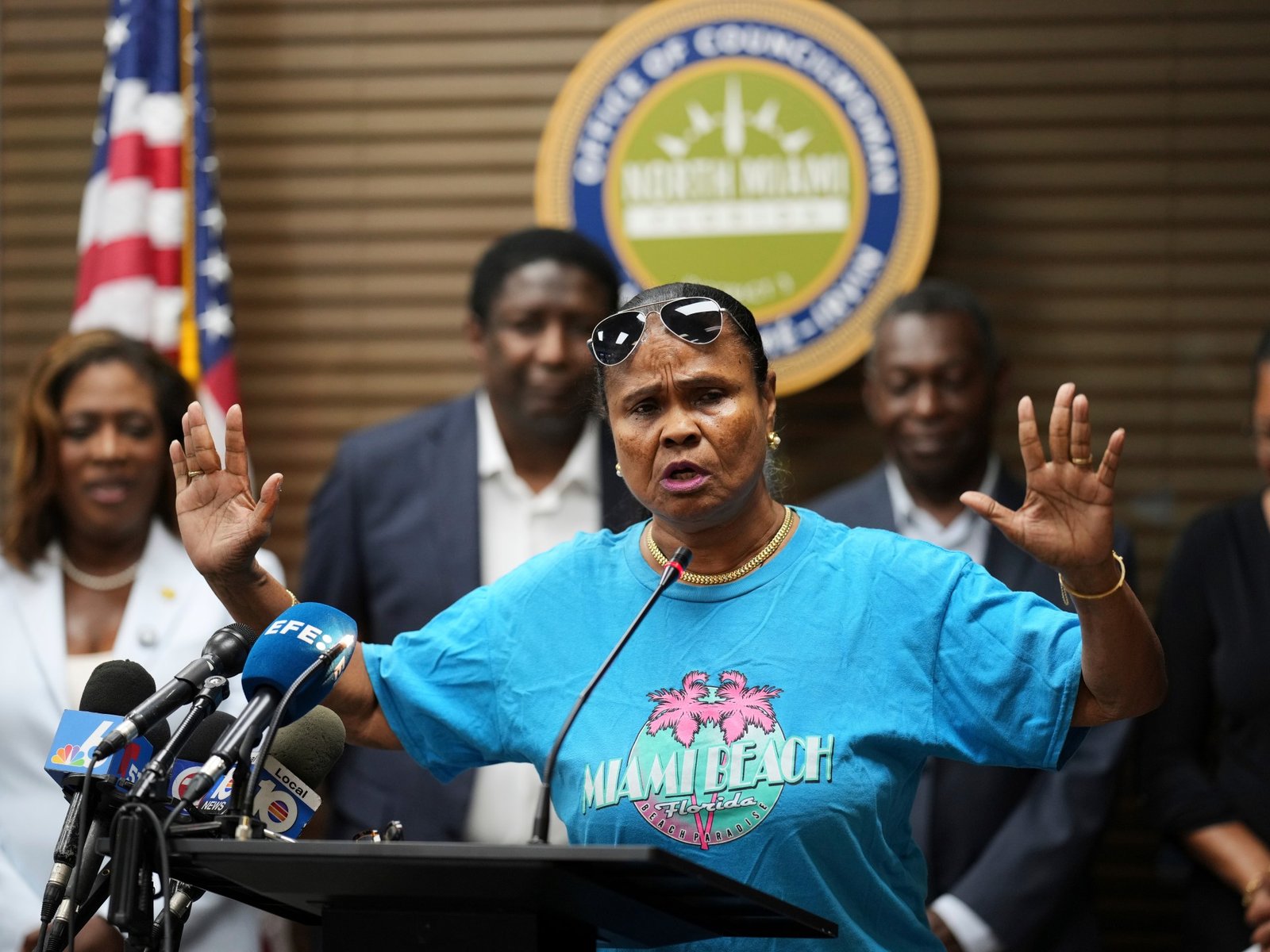
On Wednesday, the U.S. Citizenship and Immigration Services agency (USCIS) issued a notice in the Federal Register revealing its intention to eliminate Temporary Protected Status, or TPS, for Haitians on February 3.
Recommended Stories
list of 3 itemsend of list
According to government estimates, approximately 352,959 Haitian citizens and stateless persons of Haitian origin are feared to be affected.
The notice, which is currently in draft form, will become official on Friday.
In explaining its decision, the Department of Homeland Security tried to walk a safe path. On the one hand, it was argued that violent gang activity and instability in Haiti were a national security threat to the US.
On the other hand, it said that conditions in Haiti were safe enough to allow the return of Haitians currently protected by the TPS.
Ending the program for Haitians would be tantamount to a vote of confidence in Haiti’s future, the department said.
“Ending temporary protected status for Haiti represents a necessary and strategic vote of confidence in the new chapter Haiti is turning,” the notice said.
“The United States cannot call for bold change on the ground while signaling skepticism from afar.”
Temporary Protected Status is a short-term protection granted to foreign applicants who are already in the US but find that conditions in their home country have become unsafe due to conflict, disaster, or other emergency circumstances.
The program allows recipients to obtain authorization to live and work in the country legally.
At the beginning of the year, citizens of 17 countries, including Afghanistan, Sudan, Ukraine, Venezuela, and Yemen, were protected by various TPS programs.
But the Trump administration has sought to eliminate many TPS designations, arguing that they are contrary to US national interests.
The rollback is part of a larger trend to reduce immigration to the US and enact what Trump has promised to be “the largest deportation crackdown in the history of our country.”
But critics warn that repealing TPS and refusing to expand protections would drive some foreign nationals back into dangerous situations where their lives could be in danger.
a humanitarian crisis
The TPS program for Haitian citizens originally opened on January 21, 2010, when a devastating 7.0 magnitude earthquake struck the island country.
According to US government figures, about 222,570 people were killed and more than 1.3 million were displaced from their homes.
That same year, Haiti experienced its first outbreak of cholera in nearly a century. An estimated 10,000 deaths at the time were linked to the outbreak, and a new resurgence since 2022 has killed thousands.
Haiti is considered the poorest country in the Western Hemisphere, and has long struggled with inadequate housing, food shortages, and inadequate health services.
These problems are further compounded by corruption and turmoil in the Haitian government, as well as the spread of gang violence.
In 2019, national elections were postponed indefinitely, and in 2021, then-President Jovenel Moise was assassinated in his home in Petionville. No president has since replaced him, and a round of national elections was again postponed from later this year to 2026.
The terms of office of the last democratically elected officials in the Haitian National Assembly expire in 2023.
The nine-member Transitional Presidential Council currently holds governing power, but its mandate is set to expire in February.
In the absence of government leadership, gangs and other criminal organizations have spread across Haiti, taking control of 90 percent of the capital, Port-au-Prince.
As gangs have expanded their reach, human rights abuses have increased. At least 1,617 people were killed in the violence that took place from April to June this year. The death toll in 2024 was 5,600, more than in 2023.
At least 1.4 million people are currently displaced from their homes as a result of the fighting.
Court challenges
But Trump officials have argued that the previous administration under President Joe Biden overstepped its authority in repeatedly approving TPS extensions for Haitians and other foreign groups.
Trump has accused Biden of allowing unfettered immigration to the US and has sought to reverse some of his predecessor’s efforts.
In July 2024, the Biden administration approved the most recent TPS extension for Haitians, allowing protection to continue for an additional 18 months.
But in February, Homeland Security Secretary Kristi Noem, under Trump, announced she would “partially vacate” the extension, reducing it from 18 months to 12 months.
This would force Haitians with TPS to leave the country before September 2 or find alternative immigration pathways.
The US State Department currently lists Haiti under a category-four travel advisory, indicating the highest level of danger. It cites the current state of emergency in the country and notes that there are threats from “kidnapping, crime, terrorist activity, civil unrest, and limited health care.”
“Do not travel to Haiti for any reason,” the State Department advises on its website.
Pointing to this fact, the plaintiffs have argued that cutting down on expansion is not only illegal but also irresponsible.
“Revoking Haitians’ legal immigration status, which has kept them safe with their families in the United States, is cruel and dangerous,” New York Attorney General Letitia James said in a statement earlier this year.
“Haitian immigrants have contributed greatly to our communities, neighborhoods and local economies, and without them, New York and this nation would not be the same.”
Some legal challenges to the Trump administration’s decision have raised the question of racial animus.
For example, while campaigning for re-election in 2024, Trump spread baseless and racist claims about Haitian immigrants to the US, including that they eat neighborhood pets.
In July, a federal court in New York heard a case against scaling back the TPS expansion, known as Haitian Evangelical Clergy Association v. Trump.
Judge Brian Coban ruled that shortening the deadline was “arbitrary and capricious” and a “violation of plaintiffs’ due process rights.”
However, their decision left open the possibility that the Trump administration could simply let the existing extension expire, as Wednesday’s notice did.
debate for termination
The notice announcing the end of TPS protections makes several arguments as to why it is necessary to end the program, at least according to Noem.
“The Secretary has determined that the current situation in Haiti is worrying, but the United States must prioritize its national interests,” the notice said. “Allowing Haitian citizens to reside temporarily in the United States is contrary to the American national interest.”
It also described Judge Coban’s decision in July as “interference” in the work of the executive branch.
The notice claims that Noem has “determined that there are no extraordinary and temporary circumstances in Haiti” that would prevent TPS recipients from “returning to safety.”
But “even though the department found that conditions existed that were exceptional”, she said national security concerns prevented the government from expanding the TPS program.
The notice said that undocumented immigrants from Haiti are reaching America in large numbers.
It also pointed to the threat of Haitian gangs and organized crime. Earlier this year, the Trump administration labeled two Haitian groups, Viv Ansanem and Gran Griff, as “foreign terrorist organizations” as part of a larger crackdown against Latin American criminal networks.
The notice also highlighted the absence of a central government in Haiti. “This lack of government control has not only destabilized Haiti internally, but also has a direct impact on U.S. public safety,” it said.
Nevertheless, it underlined Noem’s belief that there have been “positive developments” in Haiti.
For example, in October, the United Nations Security Council approved the creation of a gang suppression force to help strengthen Haiti’s police.
The initiative would replace a Kenya-led, U.N.-backed multinational mission that has struggled to make a dent in Haiti’s gang violence.
The notice argued that offering TPS protection would undermine Haiti’s recovery goals.
“Our immigration policy must be consistent with our foreign policy vision of a secure, sovereign, and self-reliant Haiti,” the notice said.
Nonetheless, assessments of Haiti’s security were measured. “Only certain parts of the country are suitable for return,” it said.
Earlier this week, the Trump administration also announced it was withdrawing TPS protections for citizens of Myanmar, another country facing long-term instability.
<a href