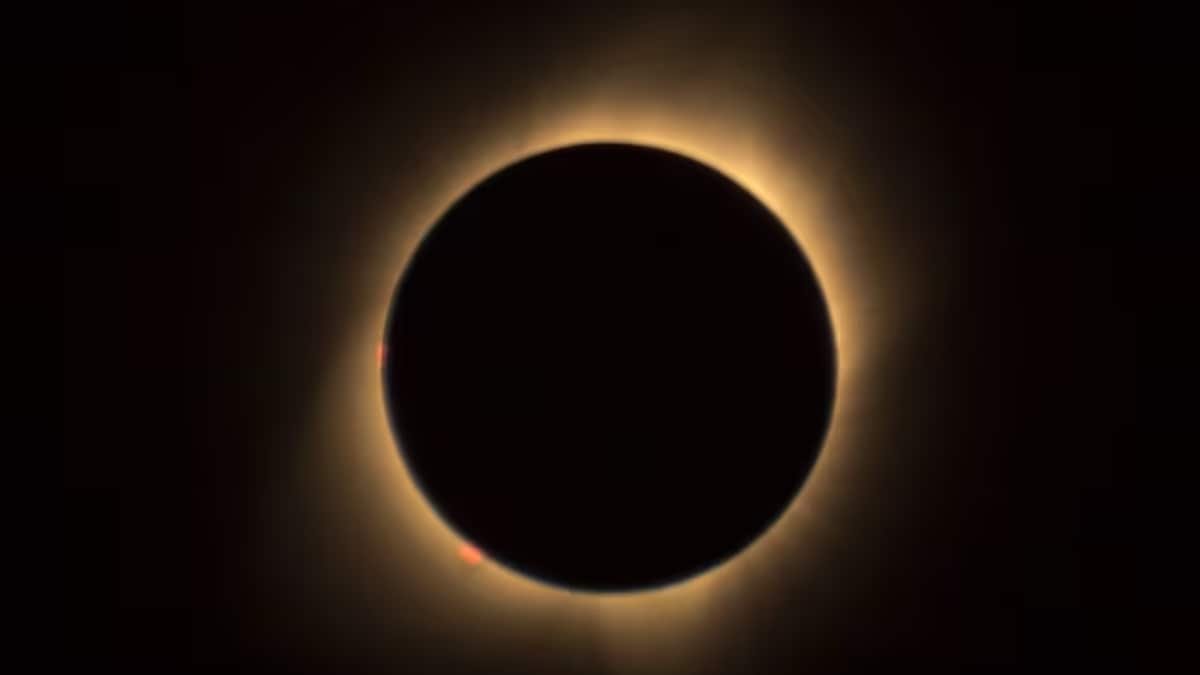
A rare cosmic event will plunge parts of the Earth into darkness for six minutes, temperatures will drop and stars will emerge in broad daylight, a sight not seen in a century.


The total solar eclipse of 2027 is being called ‘the biggest astronomical show of this generation’.
On August 2, 2027, the world will witness an event that will be remembered for generations. In many areas, daylight will suddenly fade, temperatures will drop, stars will appear in the sky and for a few minutes it will feel as if the Earth has stopped. This will cause the longest total solar eclipse of the 21st century, plunging the affected areas into pitch darkness for 6 minutes and 23 seconds. Scientists say that such a long eclipse has not been seen in the last century and it will be very rare to see it again.
During an eclipse, the Moon will completely cover the Sun, causing darkness during the day. Temperatures may drop by 5 to 10 degrees, wind direction may change, and unusual behavior may be observed in birds and other animals.
Observers will also be able to see the Sun’s yellow corona, the diamond ring effect, and bright celestial bodies such as Venus, Mercury and some stars.
Where will the darkness fall?
The eclipse will begin over the Atlantic Ocean, with the moon’s shadow first touching near the Strait of Gibraltar. After this, there will be darkness in southern Spain, Morocco, Algeria, Tunisia, Libya, Egypt and parts of the Middle East. In these areas the Sun will remain completely hidden for about six and a half minutes.
Countries like the United States and large areas of South America, including Brazil, will not see any part of this extraordinary event.
Why scientists say you shouldn’t miss it
While a total solar eclipse occurs approximately every 18 months, one of these periods is exceptionally rare. The 2027 eclipse is particularly noteworthy because it will pass through densely populated and easily accessible areas, making it an ideal event for studying astronomy, temperature fluctuations, and animal behavior.
Researchers and space agencies around the world are treating it as a living scientific laboratory, as opportunities to study the Sun’s corona so clearly and for so long may not come for decades.
minute-by-minute showdown
About 60-80 minutes before totality, the Moon will begin to touch the edge of the Sun. The sunlight will gradually fade, leaving a thin crescent of the Sun visible. Darkness will fall, temperatures will drop, stars will emerge and the Sun’s corona will shine like a milky ring.
This magical darkness will last for 6 minutes 23 seconds. Gradually, sunlight will return, restoring normalcy, while observatories around the world will capture every moment.
visibility in india
India is not on the narrow path of totality. A limited partial eclipse can be seen in some areas, but for the full experience people will have to travel to Spain, Morocco, Egypt or select cities in the Middle East.
Why does an eclipse last so long?
Such an extended total solar eclipse occurs when the Moon is closest to Earth at its closest point (perigee), and its shadow falls at exactly the right angle to Earth. These rare conditions are what make the 2027 eclipse unusually long.
safety during eclipse
It is safe to view a total eclipse with the naked eye only during a total eclipse. Observing partial steps without proper protection is dangerous.
Experts recommend solar filters, certified eclipse glasses, or other approved protective gear.
once in a lifetime event
NASA records indicate that the next eclipse of comparable duration will not occur until the 22nd century. For this reason, the 2027 event has been called ‘the biggest astronomical show this generation’.
Six minutes of darkness on August 2, 2027 will become a historic moment: daylight will disappear, the Sun will disappear, planets will brighten in the sky, and nature will react in extraordinary ways. The world is eagerly awaiting this rare sight, which many may never see again in their lifetime.
November 26, 2025, 11:45 IST
read more
<a href=