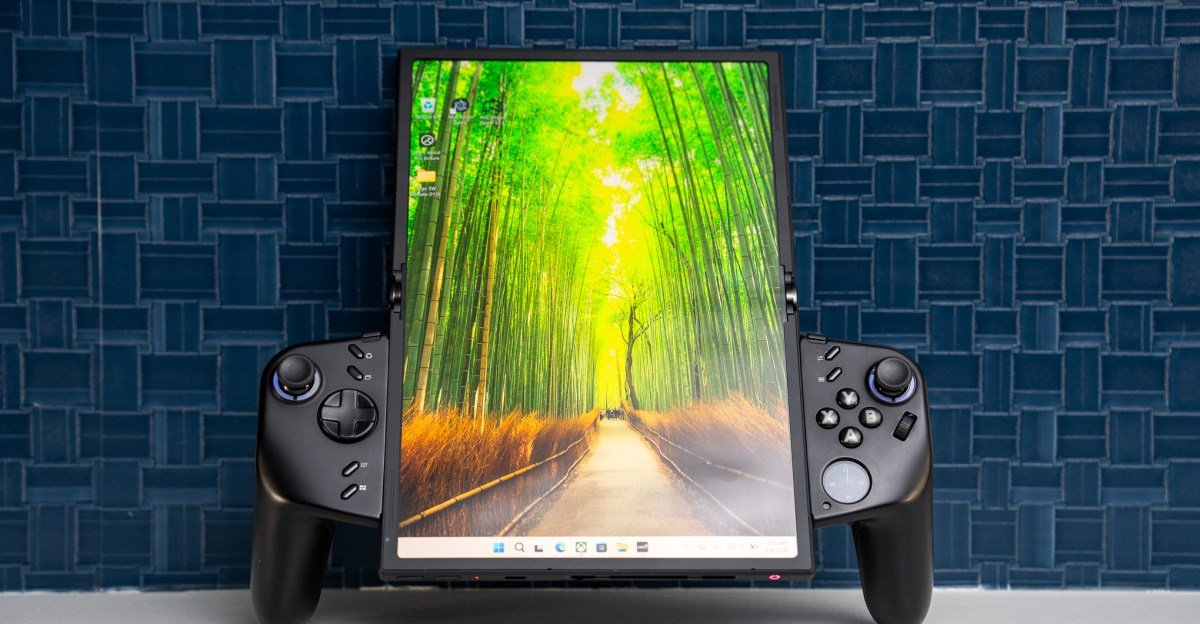
Lenovo has installed a foldable display on its gaming handheld. The Legion Go Fold concept is a Windows-based handheld with a flexible POLED display, detachable Joy-Con-like controllers, and a folio case to turn the whole thing into a mini laptop.
You can use it as a standard Steam Deck-esque handheld, with the display folded out to 7.7 inches and controllers attached to its sides, or you can open it up for a larger experience. When opened, the controllers can be repositioned on all four sides, allowing you to play with the screen in vertical or horizontal orientation.
In vertical splitscreen mode, you can have your game on one half of the screen and a second window (like your chat or game guide) on the other half. Horizontal fullscreen mode gives your game a full 11.6 inches of real estate in a 16:10 aspect ratio. To go into laptop mode, you remove the controllers and mount the handheld in a folio case with a stand, built-in keyboard, and trackpad. The controllers can be placed in a separate grip mount to integrate them as a gamepad.
There are a number of ways you can use this folding handheld, including turning one of its controllers into a vertical mouse like other Legion Go handhelds, but there’s one thing it doesn’t do: fold down to close and secure its screen. The Go Fold only folds outward, so don’t expect a clamshell like the Nintendo DS or GameBoy Advance to close for portability. Instead, it’s about being bigger and offering more than your average gaming handheld. (although we have tried Big First.)
The Legion Go Fold has some great features: an Intel Core Ultra 7 258V Lunar Lake processor, 32GB of RAM, 1TB of storage, and a 48Whr battery. The plastic-covered OLED has a resolution of 2435 x 1712 and a 165Hz refresh rate. And there’s also a second, circular touchscreen below the face buttons on the right controller. It also works as a touchpad and may have a support display, allowing you to swipe between UI elements extracted from a game (which I don’t expect to be widely supported), a clock, system monitoring, or an animated GIF (just for fun).
I didn’t get a chance to play graphically intensive games during my brief personal demo – that’s it. BalatroWho can practically play on potatoes. The screen looks sharp enough, but like any foldable there’s a crease in the middle; It’s very visible, but you learn to see through it and ignore it after a while. The build and feel of the whole thing felt a little delicate, and disassembling and reassembling the controllers was definitely risky. If this device actually hits the market the build quality will hopefully improve.
However the laptop mode was a pleasant surprise for me. I didn’t expect that a gaming handheld would double as a traditional computer that you can work on. It took a lot of fiddling with the Legion Go Fold case before you got it set up correctly, but it won’t take long to get used to if you really live with it.
Then again, I don’t know if anyone could ever live with this thing. I’d love to see the Legion Go Fold go from concept to actual product like other Lenovo ideas, but I shudder to think what it might cost. The Legion Go 2 already costs more than $1,000. And with the ongoing Ramageddon crisis we’re living through, there’s no telling how expensive the actual Legion Go Fold will be if it comes out in a year or more.
But even if it’s not the kind of foldable I expected, and even if it will never unfold, it sure is cool. Now please make a folding PC handheld that ranges from a little big to really small. I think this would be the one for me.
Photography Antonio G. By Di Benedetto/The Verge
<a href