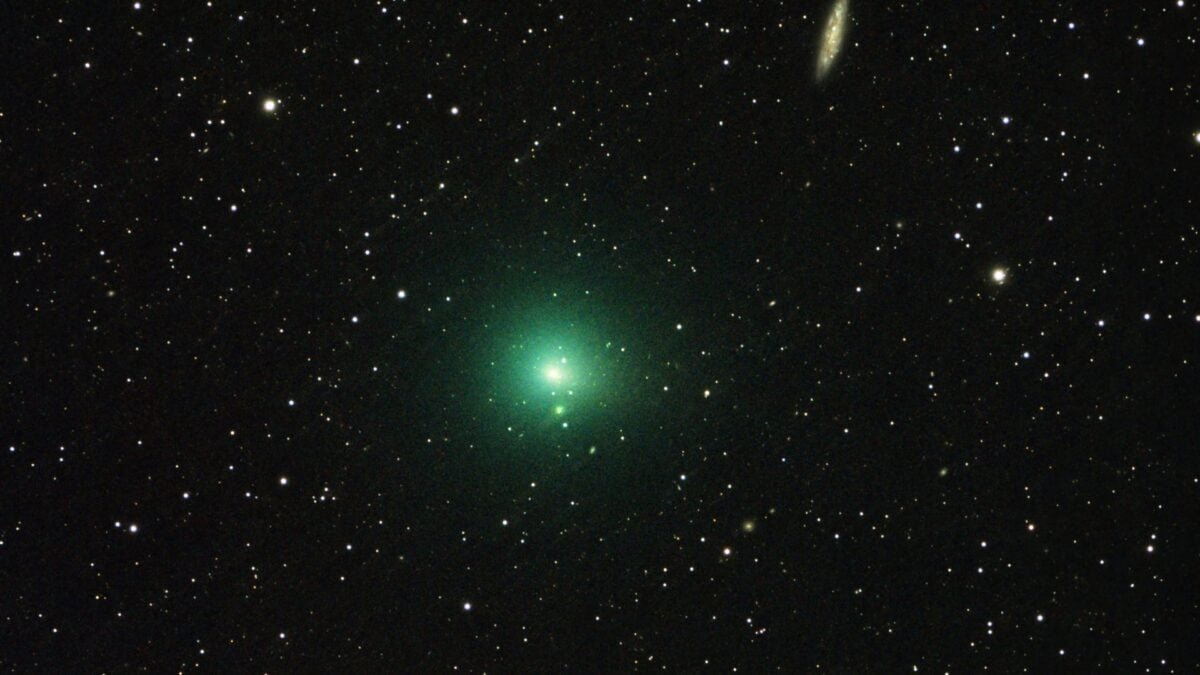

It is not unusual for a comet to change its speed and direction of rotation, but this was the most dramatic deceleration ever observed. Now, an astronomer has taken a closer look at Hubble Space Telescope images of 41P taken in December 2017, when it made its closest approach to the Sun. This new analysis shows that the comet’s orbit is actually completely reversed.
“We saw a change in spin,” David Jewitt, author of the study posted Feb. 6 on the preprint server arXiv, told The New York Times. “But not this big and this early.”
Small comet, big spin change
Astronomers around the world observed 41P as it passed Earth nine years ago. A team from the University of Maryland later determined that its rotation rate decreased from one rotation every 20 hours in March to one every 46 hours by May.
“The previous record for comet spindown was held by 103P/Hartley 2, which slowed its rotation by 17 to 19 hours over 90 days,” Dennis Bodewitz, an associate research scientist in the UMD astronomy department and lead author of the 2018 study, said at the time. “In contrast, 41P went down more than 10x in just 60 days, so both the extent and rate of this change are something we have never seen before.”
More recently, Jewitt’s Hubble data analysis sought to measure the size of 41P’s nucleus – its solid-ice core – and study how the comet’s light curve changed after its closest approach to the Sun.
Based on measurements of the comet’s brightness and non-gravitational acceleration, Jewitt determined that 41P has a small nucleus, with a radius of about 0.3 miles (0.5 kilometers). Javitt’s lightcurve analysis further revealed that the nucleus’ spin reversed between the comet’s closest approach to the Sun in April 2017 and December 2017 as a result of “outgassing torque”.
When a comet approaches the Sun, solar heat causes the unstable ices within its nucleus to sublimate, or directly change from a solid to a gaseous state. Outgassing – the release of this gas – does not occur evenly over the surface of the nucleus, and research published by Jewitt in 2021 shows that areas of increased ventilation can exert a torque strong enough to alter the comet’s spin. But 41P marks the first time this phenomenon has been observed directly.
Possible answer to a comic mystery
When observing the Solar System, astronomers see fewer comets of 41P size than models suggest, and Jewitt’s findings may help explain why.
Sub-kilometer comets, or comets less than 0.6 miles wide, can dramatically change their spin as gas escapes, according to a 2021 study by Jewitt. 41P demonstrated this in 2017, when its rotation reversed within a few months of its closest approach to the Sun. This strengthens Jew’s belief that comets of this size can generate jets of gas that rapidly increase their rate of rotation and tear them “to pieces with their own spin,” he told the NYT.
“The evidence is that comets don’t live that long,” he said. “There is some other process that destroys comets, and I think it’s rotation.”
Astronomers will get another chance to observe 41P in 2028 when it comes closer to the Sun again. It will be interesting to see if this comet undergoes another major transformation, offering a rare glimpse of how small comets evolve over time.
<a href