Last summer, astronomers examined candidates for so-called dark galaxies, or a rare class of galaxies with remarkably low surface brightness. The paper on the findings, published in The Astrophysical Journal Letters, predicted that so-called “dark galaxies” should have “some of the most extreme properties among all known galaxies.”
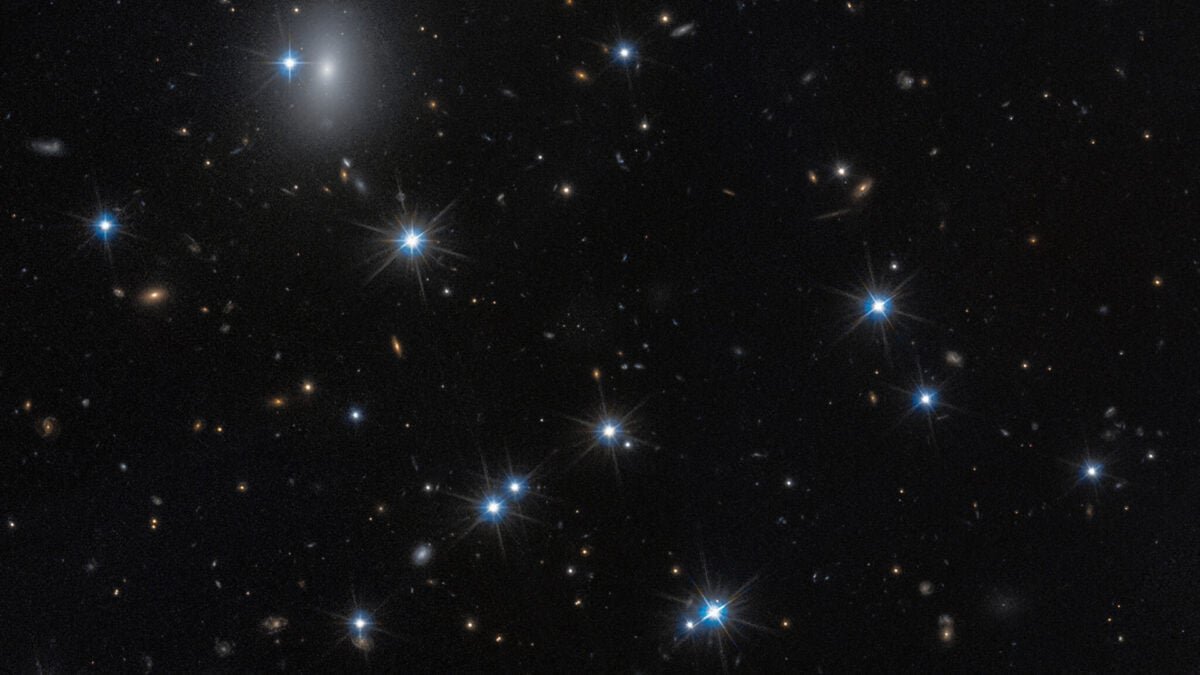
And today, NASA shared high-resolution images of one such galaxy, CDG-2. If the astronomers’ hypothesis is correct, CDG-2 would be one of the most heavily dark matter-filled galaxies ever identified.
“Seeing” the invisible.
Again, dark matter does not interact with light. However, astronomers infer its presence from the gravitational effects of dark matter on nearby objects. Often, it refers to the invisible mass that appears to cause galaxies, planets, stars and supernovae – you name it – to appear a certain way.
Simply put, if dark matter is was not In existence, many of the models scientists use to understand the universe would break down. Although scientists have not yet directly detected dark matter, even dissidents have yet to find an alternative that might explain things better. So, at least for now, the consensus is that dark matter exists.
Signs of an invisible galaxy
CDG-2 is located within the Perseus galaxy cluster, a section of the universe filled with globular clusters, or tightly packed units filled with millions of stars. Accordingly, this neighborhood is known to have a particularly rich population of dense stars.
Then, Hubble spotted a close collection of four globular clusters among the swarm. When Hubble, ESA’s Euclid and the Subaru Telescope in Hawaii collectively took a closer look, astronomers spotted a faint glow circling the area – leading them to wonder if the whole thing was really just one galaxy.

The researchers behind the study conducted a statistical analysis of the galaxy, finding that the four clusters are likely part of the same galaxy – and a dark one at that.
“This is the first galaxy to be discovered solely through its globular cluster population,” study lead author David Lee, an astronomer at the University of Toronto, said in a NASA release.
crowded area
According to the researchers, the luminosity of CDG-2 is equivalent to that of about 6 million Sun-like stars, with globular clusters contributing about 16%. However, in terms of mass, 99% of the galaxy’s mass appears to be dark matter.
Scientists said the “normal” matter in CDG-2 – primarily hydrogen gas for star formation – was likely stripped away by the dense population of galaxies inside the Perseus cluster. But even though CDG-2 is not necessarily a dark galaxy, it is still a strange galaxy, the researchers said, and would be an ideal candidate to study and test theories on cluster star formation and its potential effects, according to the paper.
Either way, it seems that astronomers have no shortage of things they are counting on to prove that dark matter is true.
<a href