
really, really ancient sailor
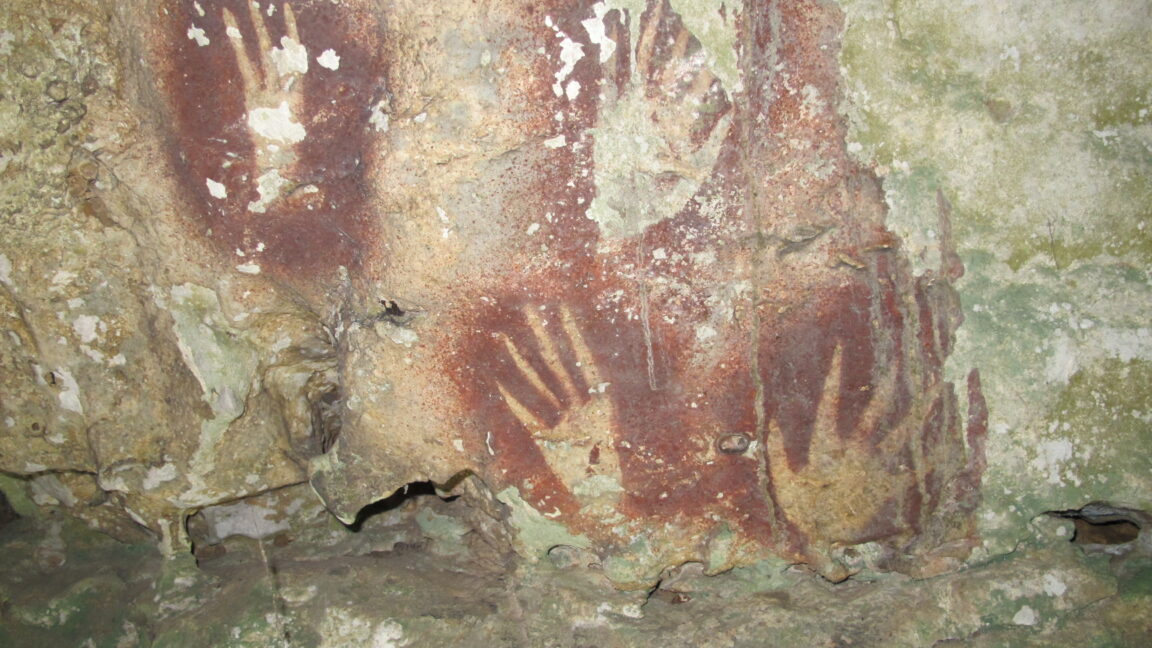
The hand stencil on the wall of Liang Metanduno is, to date, the oldest evidence of our presence in Wallacea, a group of islands strung between the continental shelf of Asia and Australia. “The colonization of these islands is widely considered to have involved the first planned, long-distance sea voyage undertaken by our species,” Octaviana and her colleagues wrote.
When the long-vanished artist placed his hand on the wall, sea level was about 100 meters lower than today. Mainland Asia, Sumatra and Borneo may have been high points in a single landmass, connected by a wide area of low-lying land that lies beneath shallow seas today. The east coast of Borneo would have been a jumping-off point, with several dozen kilometers of water beyond and (out of view on the horizon) Sulawesi.
Some people may have previously been washed up on the coast of Sulawesi due to some misadventure: maybe lost fishermen or tsunami survivors. But at some point, people must have started making deliberate crossings, meaning they knew how to build rafts or boats, how to sail them, and that there was land waiting for them on the other side.
Liang Metanduno pushed back the time of that crossing by about 10,000 years. It also gives strong support to arguments that people arrived in Australia earlier than archaeologists believe. Archaeological evidence from a rock shelter called Madjedbebe in northern Australia shows that people were living there as early as 65,000 years ago. But that evidence is still debated (such is the nature of archaeology), and some archaeologists argue that humans did not reach the continent until about 50,000 years ago.
“With the discovery of rock art dating back at least 67,800 years in Sulawesi, a large island on Australia’s most likely colonization route, it is increasingly likely that the controversial 65,000-year date for Australia’s earliest peoples is correct,” Griffith University archaeologist Adam Broom, co-author of the recent study, told Ars.
<a href