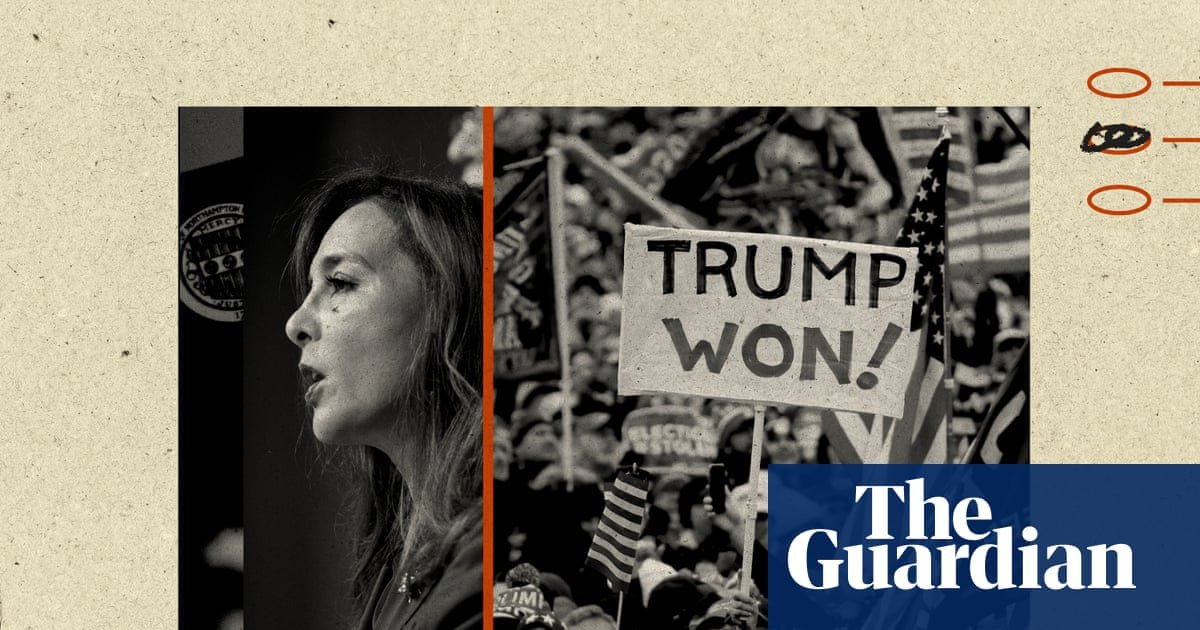
Those who tried to overturn the 2020 election have more power than ever – and they plan to use it.
With the support of the President, they have leading roles in major parts of the federal government. Harmeet Dhillon, a lawyer who helped pursue Donald Trump’s claims of a stolen election in 2020, now leads the Justice Department’s civil rights division. The election denialist, Heather Haney, now serves as Deputy Assistant Secretary for Election Integrity at the Department of Homeland Security. Kurt Olsen, a lawyer involved in the “Stop the Steal” movement, is now a special government employee investigating the 2020 election.
A movement that once pressured elected officials to bend to its will is now part of the government.
“The calls are literally coming from inside the house,” said Joanna Lydgate, co-founder and CEO of the States United Democracy Center. “Now it has influence in the White House, in Congress and federal agencies, and outside groups are actually working into that infrastructure.”
The Trump administration is going after states with questionable requests for voter data that could ensnare eligible voters and serve as the basis for future claims of fraud. They are working to establish rules that limit voter access or sow seeds of distrust over who can vote and how. Trump has deployed federal agents to cities across the country, raising fears that the authorities could be used for election purposes.
David Baker, executive director of the Center for Election Innovation and Research, said, “All of this, despite focusing on past elections, is a misdirection about what the real intent may be, which is to interfere in the 2026 elections and try to delegitimize them if the president’s party doesn’t do well.” The results of the 2025 off-year elections, which saw Democrats win big, likely “reinforce the administration’s resolve to interfere in state elections and sow doubt about the results,” he said.
Some state and local election officials say they no longer have a working relationship with the federal government and no longer trust the expertise they used to provide for election security.
Jenna Griswold, the Democratic secretary of state in Colorado, told the Guardian, “The federal government is no longer a reliable partner in democracy.”
Arizona Secretary of State Adrian Fontes said: “Before I open my door and say, ‘Yes, you guys, come in, there has to be a significant change in the rhetoric and attitude of senior leadership in the administration.’ It would be foolish of me to let the fox into the henhouse.”
Asked for comment, the White House did not answer questions about what authority Trump believes he has over the elections or whether he would use emergency powers to take control of the elections, as election experts fear might happen.
What has he done with his power?
Trump’s 2024 victory fueled election denialism, both in the ranks of a president who is known for rewarding loyalty and in outside groups that have long lobbied for new laws and policies that fit with his false claims of massive election fraud.
On Trump’s first day in office, he granted pardons to all those who attacked the Capitol in the January 6 insurrection. By November, he issued dozens of pre-emptive pardons for people involved in the fraudulent voter scheme and other efforts to overturn the 2020 election results. Anti-theft activist Ed Martin helped secure the pardon.
States United’s Lydgate said the administration’s strategy on elections is “death by 1,000 cuts”, aimed at ensuring that this group of election-denied voters can get the results they want.
The three main pillars of the strategy, he said, are to usurp power from non-partisan election officials, to pressure election administrators with menial tasks and threats, and to try to sway voters to their side by removing them from the rolls.
“There have always been political leaders who complain about election results, but not in a way where you’re trying to denigrate the entire system and you’re using the resources of the federal government to remedy that,” said Derek Tischler, a lawyer and manager of the Brennan Center’s Elections and Government program.
Election workers helped draft a bill that would require people to prove their citizenship in order to vote. When the US House passed the Safeguard American Voter Eligibility (SAVE) Act, Cleta Mitchell, leader of an influential “election integrity” group, was presented with vote count cards.
When Trump issued an executive order in March about “preserving and protecting the integrity of American elections,” it appeared similar to the “American Civil Rights Bill of Rights” that Mitchell promoted, which demanded documentary proof of citizenship to register to vote. Most of the executive orders have been blocked by the courts.
The discovery of widespread citizenship verification among election workers convinced that large numbers of non-citizens were voting resulted in the expanded, controversial use of a system intended to check citizenship for the public benefit, not for voting. The Trump administration has said it has expanded the service to search more databases and allow election officials to search people in large batches rather than individually. Officials reportedly briefed Mitchell’s group about the new uses. Voting rights groups have sued over this expansion.
Mitchell declined to comment.
Another obsession of election deniers—allegations of having large numbers of invalid voters in the “cleaned” rolls, despite regular and careful maintenance by election officials—has the force of the federal government behind it. The Justice Department has sought voter rolls from dozens of states in an effort to assemble a national voter roll, the purpose of which is unclear.
Some states have refused to change it, citing voter privacy concerns and a lack of clarity. Voting rights experts and election officials fear the administration will use the database, which is almost certain to be incomplete, to launch a fishing expedition on claims of past or future fraud.
A Justice Department spokesperson said the agency has the authority to ensure that states have “appropriate voter registration processes and programs to maintain clean voter rolls containing only eligible voters in federal elections”. The data sent to the department as part of the request for voter rolls is “being examined for ineligible voter entries,” the spokesperson said.
“Clean voter rolls and basic election security measures are essential for free, fair and transparent elections,” Dhillon said in a statement. “The DOJ Civil Rights Division has a statutory mandate to enforce our federal voting rights laws, and ensuring the voting public’s confidence in the integrity of our elections is a top priority of this Administration.”
damaging relations with states
This isn’t just the proactive steps the Trump administration has taken to empower those refusing to vote. The administration has weakened its expertise on cybersecurity and elections even compared to the first Trump administration. Election disinformation research and foreign interference work has been abolished. The Cybersecurity and Infrastructure Security Agency (CISA) has seen huge cuts.
Baker, of the Center for Election Innovation and Research, said he has spoken to election officials from both parties who, in “stark contrast” to the first Trump administration, do not trust the federal government as a partner in elections right now.
He said, “In addition to the positive action of appointing conspiracy theorists to the federal government, this is the additional negative action of dismantling positive things the federal government has done in the past.”
The Department of Homeland Security, in response to concerns about CISA’s diminished role, said: “Unlike the previous administration, CISA is solely focused on executing its statutory mission: serving as the national coordinator to secure and protect the nation’s critical infrastructure and providing timely, actionable cyber threat intelligence, supporting federal, state, and local partners, and defending against both nation-state and criminal cyber threats.”
States are beginning to take on more roles that assist the federal government. Fontes said the federal government provided intelligence and technical advice, and he had direct lines to the former head of CISA for any concerns. This year, his office has had “almost no interactions” with the federal government.
“It’s like playing regular football, but you only have an eight-man team,” he said. “We no longer have any partners. It feels like we have an adversary and that is not a healthy way to govern.”
Samantha Terazi, co-founder and CEO of the Voting Rights Lab, said because Trump does not have authority over election administration, he will rely on his allies in state and local election roles to carry out his marching orders.
“Just as you’re seeing more high-profile election deniers taking positions in the federal government, you also have to take into account that more grassroots deniers are currently being stacked up on county boards and state election boards as well,” Terazi said.
In some places — including the Georgia State Elections Board and county boards in Arizona — workers are already in election monitoring positions. And a high-profile election challenge in North Carolina, where a Republican who lost a judicial election tried to disqualify electors after the fact, served as a test case for how elections might be challenged going forward.
What does this mean for the medium term?
By the midterms, these efforts to undermine the elections will intensify, and claims will heat up that Democrats or the courts are trying to block the Trump administration from making rules to protect elections — all part of a plan to undermine the results if Republicans lose. Efforts to limit voting access and remove voters from the rolls will extend into 2026.
There will be a pressure campaign to pressure local officials to implement policies that Trump cannot legally establish himself. If his candidate loses, he and his allies will pressure local officials not to certify the results or issue voter challenges. In short, 2026 could look a lot like 2020, depending on who wins.
Election denial activists want Trump to go further: Some have called on him to declare a national emergency to claim the election. Mitchell acknowledged on a podcast earlier this year that the president’s authority over elections is limited – “except where the national sovereignty of the United States is threatened”.
US senators have warned of the risk of a national emergency over the vote, citing Trump’s appointment of election denialists to key roles and their ability to influence the administration.
“From day one, Donald Trump has worked to undermine our free and fair elections. He has added to his team election deniers like Ed Martin, Kurt Olsen and Heather Haney, whose extremist strategy is clear: Pressure Trump to declare a fake ‘national emergency’ to interfere in state elections because they know Republicans can’t win on their record,” Alex Padilla, a California Democratic senator, said in a statement. I said.
Baker said the courts serve as a “significant limiting factor” to Trump’s ability to steal the election, as he did in 2020. The decentralized nature of elections in the US also makes it difficult to overturn the results. But the chaos already being sown is more extreme than last time.
“There is no question in my mind that there is a possibility of political pressure being exerted against election administrators,” Fontes said. “And my call to election administrators, not only here in Arizona but across the country, is to stay strong. Just do your job.”
<a href