If you want to feel truly invincible when driving in the snow, you’ll need a set of studded snow tires. They are illegal in some places, in other places generally restricted to the colder months of the year. Spring for a set, however, and they’ll see you through the worst, slipperiest, snowiest driving conditions you can imagine.
However, they tend to cost quite a bit, and I’m not just talking about the financial cost. Yes, quality tires with embedded tungsten tips are generally much more expensive than your average cheap rubber with snowflakes on the sidewall. However, the bigger issue is that they can be extremely loud and are significantly worse for the roads and even your lungs than regular rubber.
Finnish company Nokian, which has been making high-grip, Nordic-spec tires since the 1930s, has a new solution that’s taken straight from a James Bond movie – or two. The company’s new Hakkapeliitta 01 tire has studs that retract when not needed. Can they reduce the headaches of other studded snow tires enough to make them worth the investment? Sadly, my Aston is in the shop, so I put a set on my Subaru, a 2004 Impreza WRX STI, to find out.
Chances are you’re more familiar with another, similar-sounding Finnish company: Nokia. This is not a coincidence. Both originated from the same business, Nokia Corporation, whose roots go back to the late 19th century.
Tire company Nokian has been making the Hakkapeliitta series of snow tires for 90 years. The most recent was called Hakkapeliitta 10, which was released in 2021, but now resets the Hakkapeliitta 01 numbering scheme.
This makes sense because, while Hakkas have seen gradual improvements from one generation to the next, this latest marks a major shift. I can say this with confidence because I’ve personally been running and racing Nokian tires for over a decade, since the Hakkapeliitta 7, doing my best to ignore the snide comments from friends and family about how incredibly fast they are.
If you’ve never driven on studded snow tires, the sound at low speeds is a bit like popcorn kernels popping into your fenders as you drive through a parking lot. It’s loud and obnoxious, turning into a more subtle roar at highway speeds, but never goes away.
For its electric-minded Hakkapeliitta EV tyres, Nokian mitigated this with some success by placing a foam insulating liner inside the tire and reducing the number of studs. However, for Hakkapeliitta 01, it is a completely different ball game.

Image: Tim Stevens/The Verge
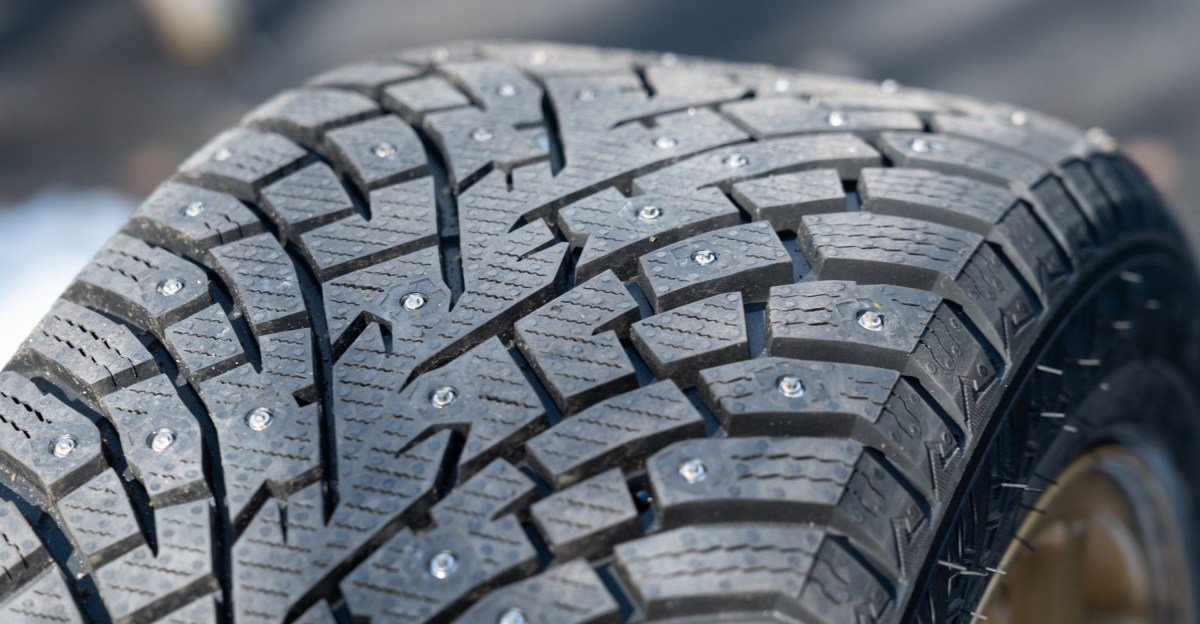
Of course, the hallmark of the new Hakkapeliitta 01 are its studs. Or, more specifically, what Nokian calls an “adaptive base” that sits beneath the studs. It is designed to allow the stud to be pulled back into the tire tread when temperatures are hot and out when it is cool.
However, interestingly, it’s not actually about the ambient temperature. “The studs pop out when the vehicle is standing still,” Mikko Liukkula, Nokian’s development manager, told me. “When the tire runs on bare roads at medium to high speeds, repeated contact between the stud and the road heats the adaptive base. Even in cold temperatures, this motion softens the adaptive base and pulls the stud back into the tread.”
If you’re driving on frozen surfaces like ice or snow, Liukkula says the cold temperatures will harden the base, keeping those studs from expanding.
The point of all this is partly noise reduction, up to one decibel according to Nokian’s tests, but it’s also about reduced road wear. Nokian says the Hakkapeliitta 01 provides 30 percent less wear on dry roads than a typical studded tyre. This may not seem an insignificant factor for tires used only in winter, but even in Minnesota, a study showed that drivers do about 70 percent of their winter driving on dry asphalt.
Reducing road wear significantly reduces your vehicle’s overall emissions. Airborne particles are a major factor in lung cancer rates globally, and this airborne particle produced when a metal stud hits dry asphalt is particularly bad. Countries like Japan have banned studded tires altogether, not because of the damage they cause to roads, but because of the harm they cause to the lungs.
From the outside, the new studs look quite different from the studs found in the Hakkapeliitta 10 tires I was recently driving on my Subaru. Those studs are also positioned slightly differently, with placement in the tires determined algorithmically to reduce noise according to Liukkula.
Where the Hakkapeliitta 10 studs are small and self-contained, you can see a sort of pad behind the studs in the 01, which facilitates their magical disappearance into the tire tread. Tyre-speak features finely sliced, siped treads to increase the surface area of the tire tread and take maximum advantage of the grip available on slippery surfaces.
But Hakkapeliitta tires have always performed excellently on slippery surfaces. For this test, I was more interested in finding out if they lived up to their billing on dry asphalt.

Before I hit the road, I left a Hakkapeliitta outside on an 18 degree evening to make sure it was nice and cool. I took the other inside, where it maintained a 65-degree environment. In the morning, I took a force gauge to each and measured the force required to compress the stud flush with the tire tread.
Certainly, compared to the cold tyre, the studs of the hot tire presented about half the resistance. And, once compressed, they were in no hurry to get out again.
So, the early signs pointed towards the science being valid, and it was confirmed when I put the wheels and tires on the car and drove away. That ubiquitous popcorn sound that characterizes the studded snow tire experience wasn’t completely eliminated, but it was reduced dramatically. I could still hear the studs on dry asphalt, but only if I listened to them.
As I picked up the pace, the improvement became noticeable. Before installing the Hakkapeliitta 01s, I did a few laps of one of my test routes on a set of Hakkapeliitta 10s, and I could immediately hear the difference in the new tires.
Additionally, on wet roads, the new Hukkas felt more secure and planted, and while these tires came too late to get me out on slick snow, sadly I did get a few late-season bursts of speed, and they made my car feel as invincible as ever.
So the technique really works. Far from silent, Nokian’s new studded Hakkapeliitta tires are significantly quieter than tires previously released by the company. But they will have to pay the price for it. Nokian hasn’t set a price for the Hakkapeliitta 01 tires, but they’ll certainly cost as much as the Hakkapeliitta 10 tires, which cost about $200 per corner in the 17-inch fitment demanded by my Subaru.
Unstudded snow tires from brands like Dunlop or Falcon can be available for less than half this price. Worth the premium? You’ll have to weigh the quality of life and environmental improvements against your tire budget, but whatever Nokian will charge for them, it will certainly be much less than what Q Branch is demanding for a set.
<a href