
 Ed Habershon/BBC
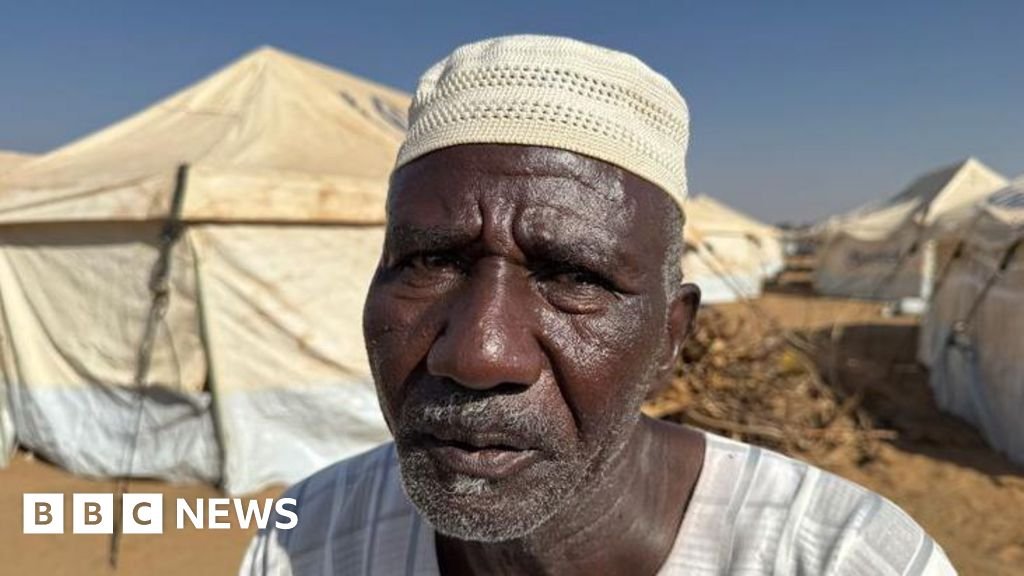
Abdulkadir Abdullah Ali suffered severe nerve damage to his leg during the long siege of the Sudanese city of al-Fashar because he could not get medicine for diabetes.
The 62-year-old man walks with a heavy limp, but when fighters from the paramilitary Rapid Support Forces (RSF) finally captured the town in the West Darfur region, he was so terrified that he felt no pain while running.
“The morning the RSF arrived, there was gunfire, a lot of bullets and explosives,” he says.
“People went out of control (out of fear), they ran out of their houses, and everyone ran in different directions, father, son, daughter – running away.”
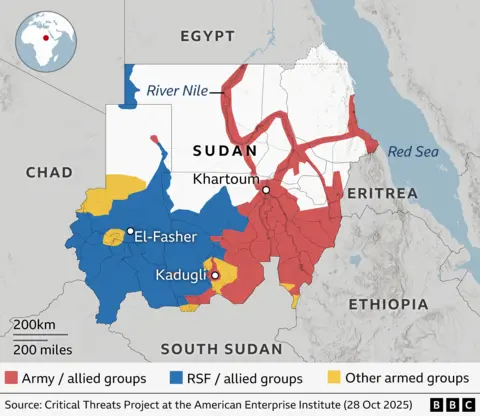
The fall of al-Fashar after an 18-month siege is a particularly brutal chapter in Sudan’s civil war.
The BBC has traveled to a tent camp set up in army-controlled territory in northern Sudan to hear first-hand the stories of those fleeing. The team was monitored by officials throughout the tour.
The RSF has been fighting the regular army since April 2023 when a power struggle between them escalated into a war.
The capture of al-Fashar was a major victory for the paramilitary group, pushing the army out of its last stronghold in Darfur.
But evidence of large-scale atrocities has drawn international condemnation and greater American focus on trying to end the conflict.
WARNING: This report contains details that some readers may find disturbing.
 reuters
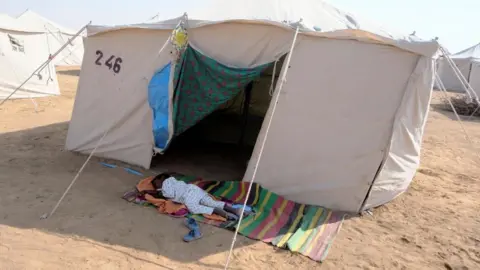
We found Mr Ali walking around the camp, which was located in the desert near the town of al-Dabbah, about 770 km (480 miles) north-east of al-Fashar.
He was trying to register his family for a tent.
“They (RSF fighters) were firing live ammunition at people – elderly people, civilians, they would empty their guns at them,” he told us.
“Some RSF men came with their cars. If they saw someone was still breathing, they ran over them.”
Mr Ali said he ran when he could, crawling on the ground or hiding when danger got too close. He managed to reach the village of Gurni, a few kilometers from al-Fashar.
Gurni was the first stop for many who fled the city, including Mohammed Abbakar Adam, a local official from the nearby Zamzam camp for displaced people.
When the RSF captured Zamzam in April, Mr. Adam retreated towards al-Fashar, and fled there the day before the city was captured in October.
He grew a white beard to make himself look older, hoping that this would allow him to be treated more leniently.
“The road here was full of death,” he said.
“They shot some people right in front of us and then took them away and threw them away. And on the road, we saw unburied bodies in the open. Some people lay there for two or three days.”
“There are so many people scattered here and there,” he said. “We don’t know where they are.”
Some of those who could not make the long journey to al-Dabbah reached a humanitarian center in Tawila, about 70 km from al-Fashar.
Others moved to Chad. But the United Nations says less than half of the estimated 260,000 people killed before the city collapsed have not been located.
Aid agencies believe that many people did not get very far – unable to escape because of danger, or detention, or the cost of buying their way out.
Mr. Adam said fighters also raped women, confirming widespread incidents of sexual violence.
“They would take a woman behind a tree, or take her away from us, out of sight, so you couldn’t see with your eyes,” he said.
“But you will hear her screaming: ‘Help me, help me.’ And she would come and say, ‘They raped me.'”
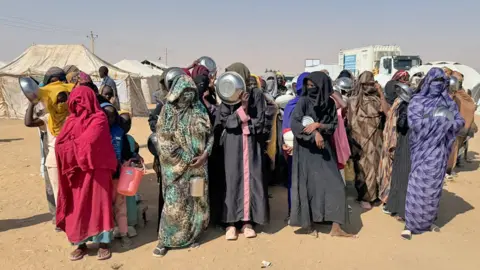
The camp is mostly women, and many do not want to reveal their identities for the safety of those left behind.
A 19-year-old woman told us that at a checkpoint RSF fighters took a girl from the group she was traveling with, and they had to leave her behind.
“I was scared,” she said. “When they took her out of the car at the checkpoint, I was afraid that at every checkpoint they would take a girl. But they just took her, and it was like that until we got here.”
She had reached here with her younger sister and brother. His father, a soldier, was killed in the war. His mother was not in Al-Fashar when it fell.
So the three siblings fled the city on foot with their grandmother, but she died before they reached Gurney, and they had to proceed alone.
“We didn’t carry enough water because we didn’t know the distance was that far,” the young woman said.
“We kept walking and walking and my grandmother died. I thought it might have been lack of food or water.
“I checked her pulse, but she didn’t wake up, so I found a doctor in a nearby village. He came and said, ‘Your grandmother has given you her soul.’ “I was trying to keep myself together because of my sister and brother, but I didn’t know how to tell my mom.”
 Ed Habershon/BBC
They were all particularly concerned about his 15-year-old brother as the RSF suspected that the fleeing men had fought with the army.
The boy narrated his ordeal at a checkpoint when all the youths were taken out of the vehicles.
“The RSF interrogated us for hours in the sun,” he said. “They said we were soldiers – some veterans maybe.
“The RSF fighters stood over us and were circling around us, hitting us and threatening us with their guns. I lost hope and told them, ‘Do whatever you want to do with me.’
They finally let him go – when his 13-year-old sister told them that their father was dead, and he was her only brother. He reunited with his mother in the camp of al-Dabbah.
Many describe the RSF’s separation of older men and women from men of fighting age.
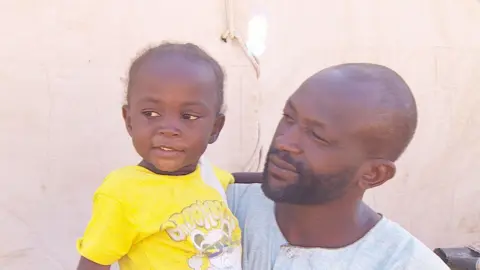
This is what happened to Abdullah Adam Mohammed in Gurnee, leaving him away from his three little girls aged two, four and six. The perfume seller had been taking care of his wife since his death in shelling four months ago.
“I gave my daughters to the women (travelling with us),” he told the BBC. “Then the RSF came with big vehicles, and we (people) got scared that they were going to forcibly recruit us. So some of us ran away and ran into the neighborhood.
“The whole night, I was wondering, how will I get my children back? I’ve already lost so many people – I was afraid I’d lose them too.”
 Ed Habershon/BBC
Mr Mohammed escaped, but the others did not. Mr Ali said he saw the RSF from a distance open fire on a group of people.
“They killed the men, they didn’t kill the women, but all the men were shot,” he told the BBC. “A lot of people died there and we fled.”
Mr Ali and Mr Adam set out from Gurni on donkeys at night towards the next village, Turrah.
Mr Mohammed also reached Turrah, where he met his girls. From there they took vehicles for the long drive to Al-Dabbah.
Many people reached the camp empty handed. They left the city with almost nothing and had to pay to pass through checkpoints.
“RSF fighters took away everything we had: money, phones, even our nice clothes,” Mr Adam said. “At each stop they will call your relatives to transfer money to your mobile phone account before letting you go to the next checkpoint.”
The RSF told the BBC that it rejected allegations of systematic abuses against civilians.
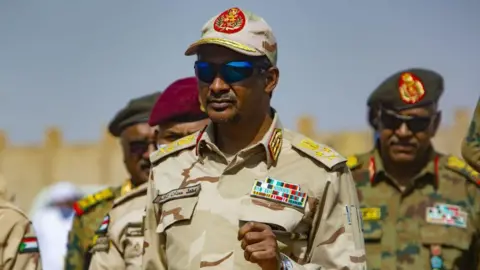
Dr. Ibrahim Mukhyer, an adviser to RSF leader General Mohammed Hamdan Dagalo, said, “The specific allegations raised – looting, killing, sexual violence, or ill-treatment of civilians – do not reflect our instructions.”
“Any RSF member proven responsible for wrongdoing will be held fully accountable.”
He said the group believed the allegations of mass atrocities were part of a politically motivated media campaign against them, which they said was perpetrated by Islamist elements within Sudan’s military-led administration.
RSF has published videos to try to reframe the narrative, showing its officers greeting people fleeing al-Fashar, trucks bringing humanitarian aid and medical centers being reopened.
 Anadolu via Getty Images
Mr Mohammed told the BBC that RSF foot soldiers were more brutal when their officers were not present, while Mr Adam rejected attempts by the paramilitary group to improve its image.
“They have this strategy,” he said. “They would gather 10 or 15 people, give us water and film us like they were treating us well.
“Once the cameras are out, they will start beating us, treating us very badly and taking away everything we have.”
Earlier this year the US determined that the RSF had committed genocide in Darfur.
But the Sudanese armed forces and its allied militias have also been accused of atrocities, including targeting civilians suspected of supporting RSF and indiscriminately shelling residential areas.
This particularly brutal chapter of Sudan’s devastating war has drawn the attention of US President Donald Trump. He has promised to be directly involved in the ongoing US efforts for a ceasefire.
For those who escaped al-Fashar, this seems a distant possibility. They have been torn apart by this struggle again and again and do not know what will happen next.
But they are flexible. Mr Ali, who had not heard of Trump’s sudden interest, had been chasing officials to get permission to stay at the camp in a tent, saying, “we can stay and rest”.
More BBC stories on Sudan’s civil war:
 Getty Images/BBC
<a href