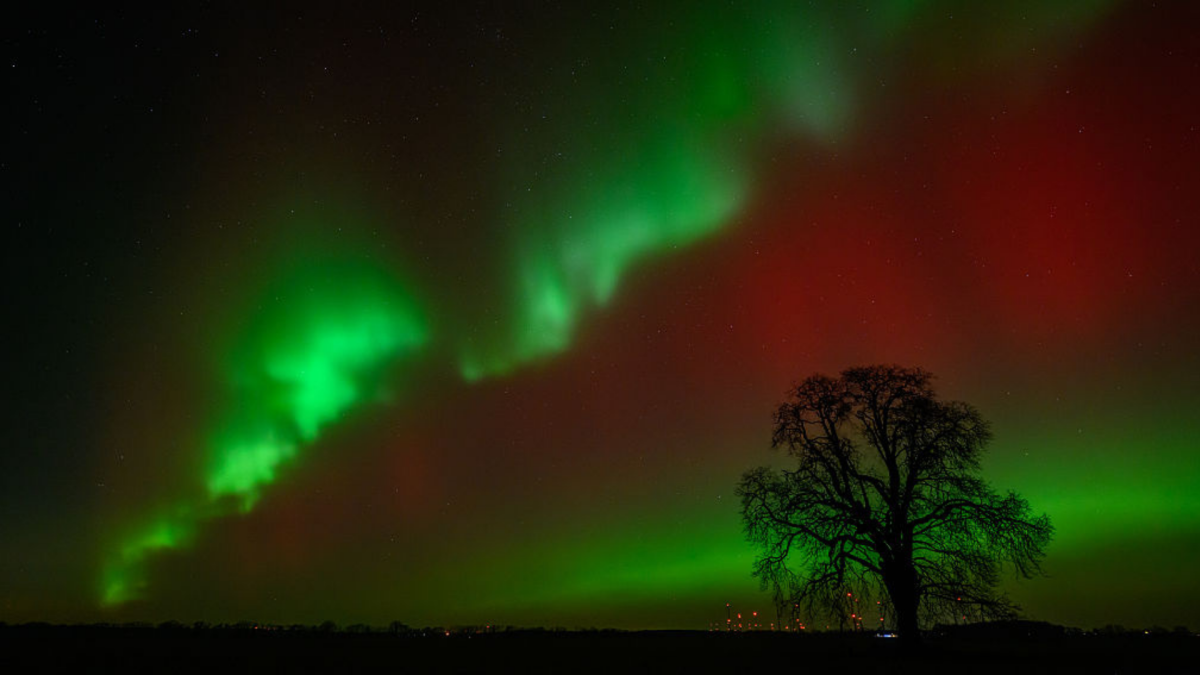
According to the US National Oceanic and Atmospheric Administration (NOAA) Space Weather Prediction Center (SWPC), this week’s Northern Lights will be visible on January 19 and last through the next day in some areas. Still, if you’re able to, you’ll be best off seeing the aurora on Monday, as it will be much less prominent later in the week. Those living at higher latitudes will have a better chance of seeing the auroras, although the remarkable strength of this week’s display means the northern lights may be visible as low as Alabama and northern California.
This wide range of visibility is because Monday’s northern lights were caused by the largest solar radiation storm in 20 years, resulting in particularly strong auroras. SWPC has issued a severe G4 geomagnetic storm warning in response, warning that it could cause widespread problems in the power grid, and could also render GPS navigation and high frequency radios inoperable for hours. Infrastructure operators and authorities have been informed of expected disruptions.
Fortunately, the SWPC says there isn’t much the general public needs to do in response to geomagnetic storms. All that is required is that you stay informed and, if the weather permits, search for the aurora.

Credit: US National Oceanic and Atmospheric Administration’s Space Weather Prediction Center
How to Get the Best View of the Northern Lights
The easiest way to see the Northern Lights is to go outside at night and look up. In the right conditions the aurora can be seen from more than 600 miles away, so it’s worth checking out, even if you’re a little outside the predicted area of visibility. However, if you want to give yourself the best possible conditions for aurora viewing, there are some factors to keep in mind.
mashable light speed
According to SWPC, the best time to view the Northern Lights is between 10 pm and 2 am, as geomagnetic activity levels increase during this period. This is also the darkest time of night, providing the strongest contrast with the bright northern lights making them even more visible.
Choosing a viewing area with as little light pollution as possible will also improve your experience. A certified dark sky place close to the US-Canadian border would be an optimal choice, as they have all been assessed and accredited for minimal light pollution. If you can’t do this, try to reduce light pollution where you are.
What causes the Northern Lights?
While auroras occur in Earth’s atmosphere, they are actually the result of solar activity.
When a solar flare or coronal mass ejection occurs on the Sun’s surface, large amounts of plasma and magnetic fields are expelled from the outermost layer of its atmosphere. This creates a high-speed solar wind, or solar storm, which can travel through space and reach Earth. Depending on the nature of solar activity, the journey to Earth may take a few minutes or up to a few days.
Once a solar storm reaches Earth, much of it is reflected back into space by Earth’s magnetic field. However, it is not all gone. Some charged ion particles enter the magnetic field, then move to the Earth’s polar regions where said field is the weakest.
The charged ions then collide with oxygen and nitrogen atoms, causing chemical reactions that emit light: an aurora. Both the northern and southern lights are created in a similar manner. The only difference is that the Aurora Borealis is in the Northern Hemisphere, while the Aurora Australis is in the Southern Hemisphere.
<a href