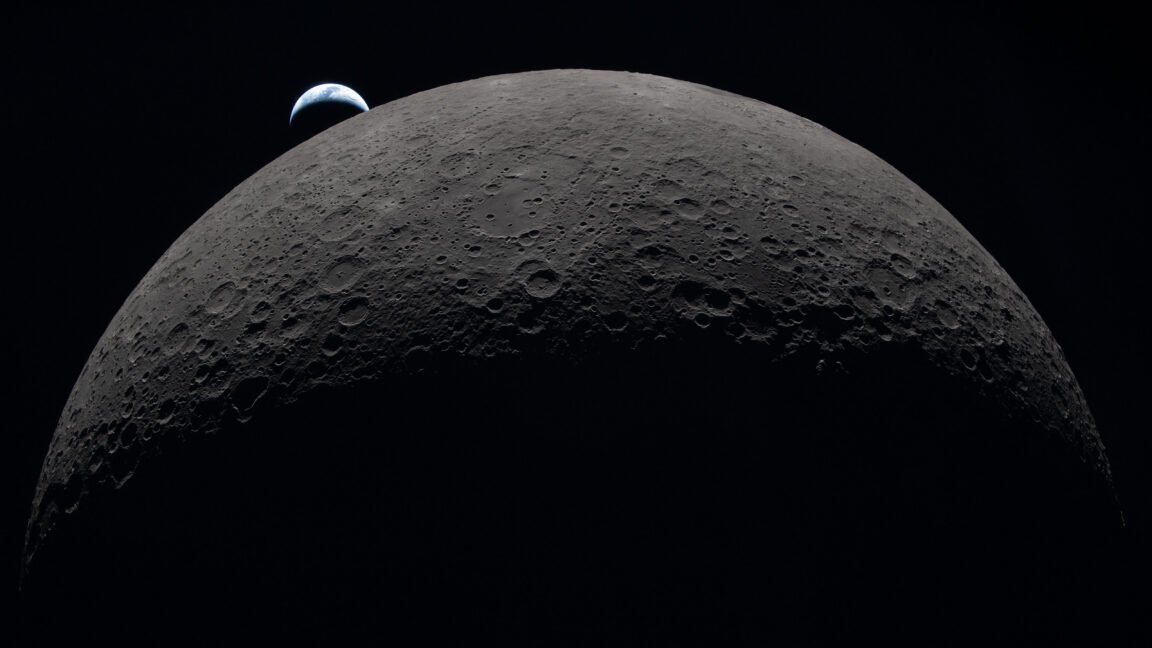
“The only source of light on the Moon will be Earthshine, which is a different spectrum,” Deutsch said in a presentation at the Lunar and Planetary Science Conference last month. “How does it affect the perception of color and tone?”
Crew members summarized their observations in a periodic update broadcast to Mission Control on Monday. He also recorded more detailed verbal descriptions on the spacecraft, and was tasked with creating drawings and annotations to accompany his photographs. This data will be returned to Earth when Orion returns on Friday.
“We tell the crew that their verbal descriptions are really going to be the monumental scientific dataset from this mission, and that’s because, as humans, the crew provides important perceptual context that can’t be replicated with robotic sensors,” Deutsch said. “The crew has perception and spatial awareness and the ability to react and adapt quickly to what they are seeing.”
This quick perception allowed the astronauts to see several brief flashes of light on the dark side of the Moon, each lasting a fraction of a second. The flashes occurred when small pieces of cosmic material, or micrometeoroids, impacted the moon’s surface.
“It’s a pinprick of light,” Hansen said. “I suspect there were a lot of them… It’s just a momentary flash, no color, about the size of a star, and it really only lasts milliseconds, half a second at most.”
This was no surprise to Neil. “It’s a reminder that the surface is constantly being bombed, and it’s something we’ve tried to monitor,” he said.
The glow of lunar impacts is regularly visible through telescopes on Earth. Astronomers were watching the moon as Artemis II approached the moon on Monday, and if scientists can correlate their own observations with the astronauts’ observations, they can get a better handle on how many impacts are missed by ground-based telescopes. Limiting the number of impact events will be important as engineers design shielding for future moon bases.
<a href