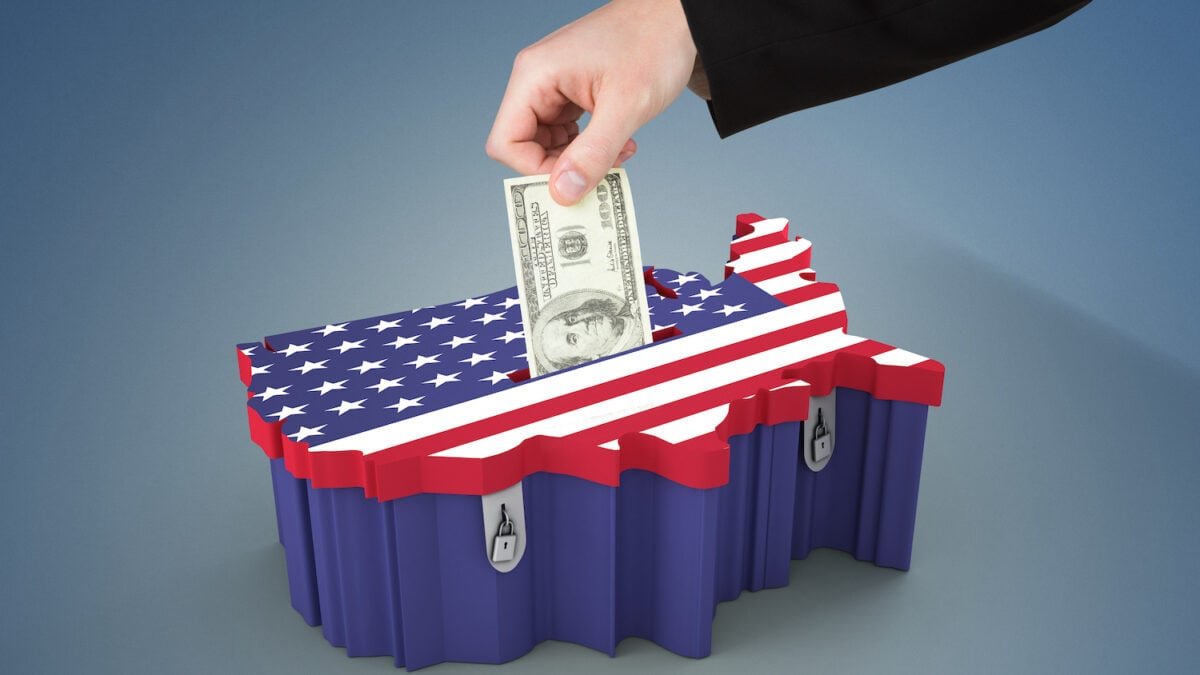

According to the New York Times, a brand new 501(c)(4) group has arisen to combat pro-AI PAC money with anti-AI PAC money, and according to The Times’ sources, the plan is to raise $50 million. The entity calls itself Public First, and it’s about to start funneling money from anonymous donors to a Democratic anti-AI super PAC called Jobs & Democracy PAC, and a Republican twin called Defending Our Values PAC.
According to the Times, the personalities who appear to be involved in Public First are billionaire Anthropic co-founder Jack Clark, billionaire eBay founder Pierre Omidyar and billionaire Facebook co-founder Dustin Moskowitz.
A “PAC” or “political action committee” raises legally limited contributions to influence election outcomes. A super PAC is an independent PAC that is allowed to raise unlimited funds because it does not coordinate directly with campaigns. So super PACs have been known to run negative ads denigrating the candidates they are up against, which does not require coordination to benefit friendly candidates.
According to The New York Times, which learned about these new PACs from unnamed sources, this is a not-so-secret response to the pro-AI PAC Leading the Future. Leading Future, which had $100 million raised when news of its existence broke earlier this month, is backed by OpenAI co-founder Greg Brockman, Andreessen Horowitz’s Marc Andreessen and Palantir co-founder Joe Lonsdale. Leading the Future intends to support candidates who oppose AI regulation.
The amount of money these groups are throwing around is enormous, and far exceeds the normal spending levels for businesses and “special interests” in America. For context, the United Auto Workers PAC, which is considered quite influential, raised $15,259,386 for the 2024 election cycle, according to OpenSecrets. Meanwhile, according to Sludge, the oil and gas industry gave $13,895,000 to super PACs for the same cycle.
According to the New York Times, the kind of economic power these AI PACs are gaining (or hoping to gain) is close to the scale of President Trump’s super PAC, which had secured $177 million as of August this year, mostly from crypto donors. Crypto’s Fairshake Super PAC similarly has $140 million, which puts it right next to AI, reimagining politics for the strange technological age.
For an example of what AI PAC money looks like in action, look at its hostility earlier this month toward obscure New York Assembly member Alex Borsch, who is running for a House seat. Borsch is the lead sponsor of a New York law that requires AI companies to work on preventing “serious harm” from AI models, but he suddenly found himself and his bill becoming the target of billionaires on the other side of the country, in California. Leading the Future vowed to spend millions to keep this one random guy out of Congress.
Bors told the San Francisco Examiner that he came under fire from “a specific, small part of Silicon Valley, where it’s overwhelmingly minority.” [viewpoint] That there shouldn’t be any regulation of AI,” and that “the fact that they’re so forthright about it is something I’m grateful for.” Among politicos, Bors is now famous.
This kind of weirdness is about to accelerate. The Times says that among the groups helping to realize Public First’s vision are “collaborative donors who are deeply engaged with the effective philanthropy movement.”
Effective altruism is not on the map politically. EA is a modified form of utilitarianism, which aims to collect the largest possible amount of money, and then use it to try to minimize the most probable losses. The list of the movement’s most prominent members would include imprisoned crypto king Sam Bankman-Fried, and extremely weird philosophers like Peter Singer and Nick Bostrom.
In short, these groups are not cleanly partisan. The pro-AI side, Leading the Future, so far appears only to be pandering to the Trump administration, even though the Republican Party is more amenable to its agenda. Public First, meanwhile, with its separate Democratic and Republican parties, is soon bound to endorse candidates with deeply contradictory agendas.
Many will find the lack of obvious partisanship to be a relief, but instead of being a bipartisan dream, two politically incompatible funding titans are coming true, and they’re about to try to decimate crypto as well as the rest of the political picture next year.
Elections in America are always painful. What’s coming may be something worse: a high-level public competition between anonymous factions, seemingly composed largely of billionaires, using AI as an excuse for a food fight over what’s left of the American political process. I can’t wait.
<a href