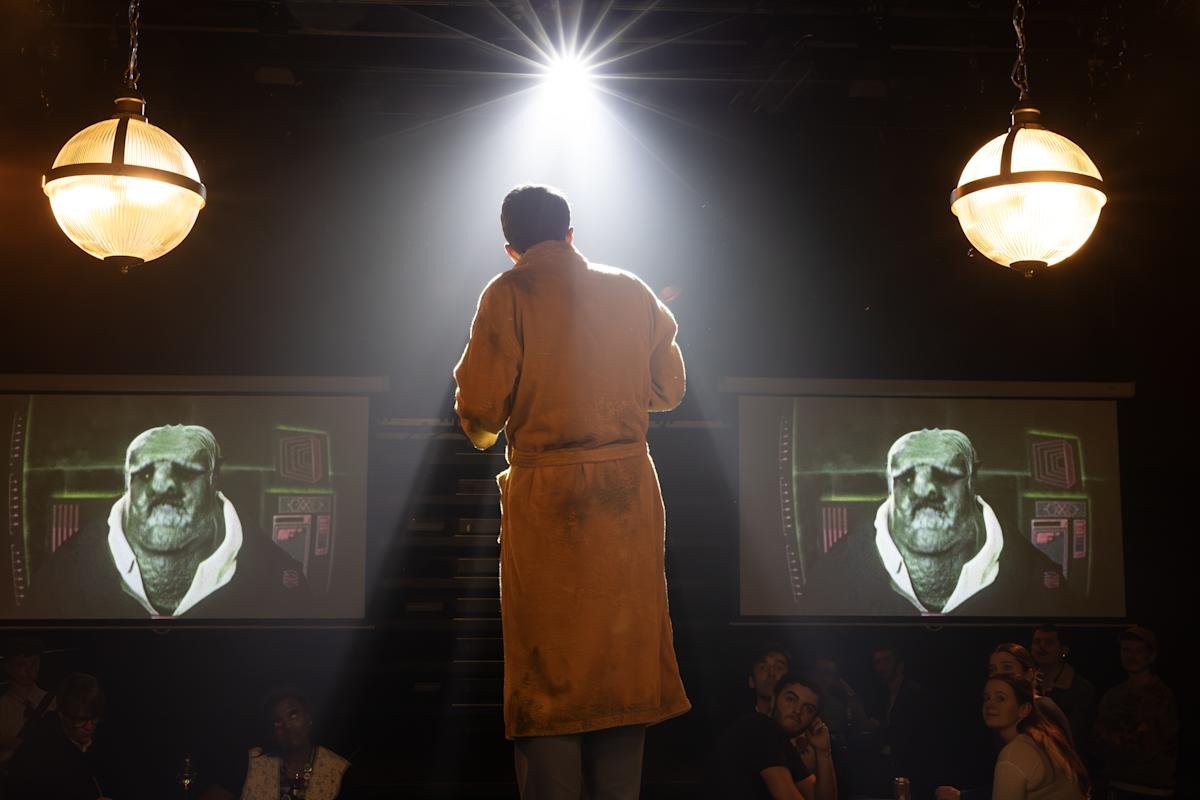
The following contains mild spoilers for The Hitchhiker’s Guide to the Galaxy.
After its birth as a BBC radio sitcom in 1978 through its many and varied adaptations, Douglas Adams’ The Hitchhiker’s Guide to the Galaxy Has become a permanent part of our culture. Despite the fact that its satire focuses on the concerns of Britain in the late 70s, its unique wit and surrealism have brought it worldwide fame. It’s a rite of passage for at least a subset of British teenagers and their English-loving cousins, as well as a tech culture shibboleth that has embedded itself in the broader culture. Now, it has been reborn at London’s Riverside Studios as a live immersive theater production that retains the series’ most singular quality: its messiness.
Given that it originated as a half-hour radio comedy, the plot of Hitchhikers is surreal, episodic, and prone to (what appears to be) digressions. But in the broader shape of each version of the story, Arthur Dent wakes up to find that bulldozers are about to demolish his house to make way for a new highway. He is distracted by the protests of his friend Ford, who reveals that he is not an out-of-work actor, but an alien researcher for a book called The Hitchhiker’s Guide to the Galaxy. A few minutes later, Earth itself is demolished to make way for a new interstellar highway, but Ford and Arthur board one of the ships demolishing the planet.
The “book” is actually a small tablet containing a Wikipedia-style repository of knowledge that serves as the series’ narrator. Still wearing his pajamas, Arthur is dragged into various adventures across the universe, culminating in a meeting with a group of multidimensional aliens who wish to discover the ultimate meaning of life, the universe, and everything. Subsequent radio series and novels take the same characters back and forth and sideways with diminishing returns. Adams’ love of the long shaggy dog joke means that the final question and the final answer is… “What do you get if you multiply six by nine?” “forty-two.” (God’s final message to his creation is a similar story, expressed as “We apologize for the inconvenience”.)

Each adaptation is bent and changed to suit its new format, so there are only a few essentials. Arthur, Ford, The Book, 42 and Eagles’ Journey of the Sorcerer (the chorus of which is the theme) are the only mainstays. It should come as no surprise that generous liberties have been taken here to compress the sprawling travelogue into a format suitable for a live immersive theater show. [If you’re unfamiliar, rather than sit and watch the action unfold on a stage, you’re instead walking around an environment with the story taking place in front of you. You can even engage with the actors directly at points, although only if you want to.] Here, you’ll be hanging out in the bar of the Horse and Groom pub, the cargo hold of the Heart of Gold, the cargo hold of the Vogon Destructor ship, and the factory floor of Magrathea.

Fenchurch and Arthur have their eyes on the horse and groom. (Jason Ardizzone West/Hitchhikers Live)
Attempting to impose a somewhat traditional narrative on the story, hitchhiker’s live takes the tone of the romance from the first story (in all its forms) and the fourth novel, So long and thanks for all the fishWe spend most of our time with Ford (Oliver Britton), while Arthur (Robert Thompson) wanders in and out of the narrative as part of his universe-spanning quest to reunite with his beloved Fenchurch (Kat Johns-Burke), We get a chance to spend a little time with Zaphod Beeblebrox (Lee Weegee) and Slartibartfast (Richard Costello), while (one appearance) Trisha McMillan (Lenora Critchlow) appears only as a recorded voice identified with a photo that looks a lot like a publicity shot, avenue 5 Instead of one taken afresh for this show.

Slartibartfast (Richard Costello) holds court on Magrathea’s factory floor. (Jason Ardizzone West/Hitchhikers Live)
The regressive surrealism of Hitchhikers means that it struggles against the limitations imposed on it by any and every medium. As someone who grew up with the novel version, I consider it definitive, but even later works struggled to stay on the page. Sometimes, the immersive theater format is detrimental to the story, meaning that if you’re not able to get to every corner of each scene fast enough, you may miss a beat or two. For example, there were so many spectators gathered around the Jatravertids area that I thought I’d check out the empty areas first. Which was a mistake, because Hamma Kavula was then busy taking center stage in a big song and dance number for which I had missed the preparation. Similarly, until I read the cast list while writing this review, I didn’t realize that the show also included Wowbagger the Infinitely Prolonged (Tom Bowen).
The condensed nature of the story means you often miss not only the connective tissue but also a lot of the meat from the original. Some of the emotional weight of the set pieces feels unearned because the producers left out so many of the essentials. When you get to the big finale, it’s hard not to wish we’d seen some effort made by a character beyond growing out their hair to mark the passing of time. The more I watched the show and its many musical numbers, the more I wished its creators had made it a more traditional stage musical. Especially given the thematic and narrative complexity of the source material, this could have made for a smoother, more cohesive show.

Marvin the Paranoid Android (Andrew Evans) is feeling very depressed. (Jason Ardizzone West/Hitchhikers Live)
The immersive format has its own merits, including the ability to spice up the set with little visual jokes. The Vogon Grievous office is full of things hidden in boxes and filing cabinets, as are the small references on screen in the Horse and Groom set. But the best part is that you can spend time with Marvin the Paranoid Android (Andrew Evans), an excellent blend of design, acting and puppetry. Instead of cramming Evans into a suit, the actor has the handsome Marvin puppet on a chest harness, giving it a fluidity of movement and expression that previous versions could only dream of. It also helps that Marvin’s constant sadness beautifully undercuts the more solemn parts of the story.
I also need to give praise for both the animation style of the guide segments and Tamsin Grigg’s narration. I would say Grieg (black books, episodes) The original voice is the true heir to Peter Jones’ crown, bringing a perfect blend of voice-of-God exposition and dry undercutting. In fact, you’d be hard-pressed to find a bad element in the entire production, especially in the well-choreographed set pieces where the actors work against pre-recorded footage. It’s a technical marvel in many ways and it’s clear that everyone involved in its creation acted with immense love for the source material and Adams. It’s just that all these elements don’t mesh well enough to take the show from good and entertaining to a must-watch.
As a result, I’d say that if you’re a London local and even vaguely familiar with Adams’s work, you should go and enjoy. But I can warn Adams devotees that if they’re making the big trip to see it they may find the production lacking. Like every other Hitchhikers adaptation, it’s a mess, but then the mess has always been at least half the point.
<a href