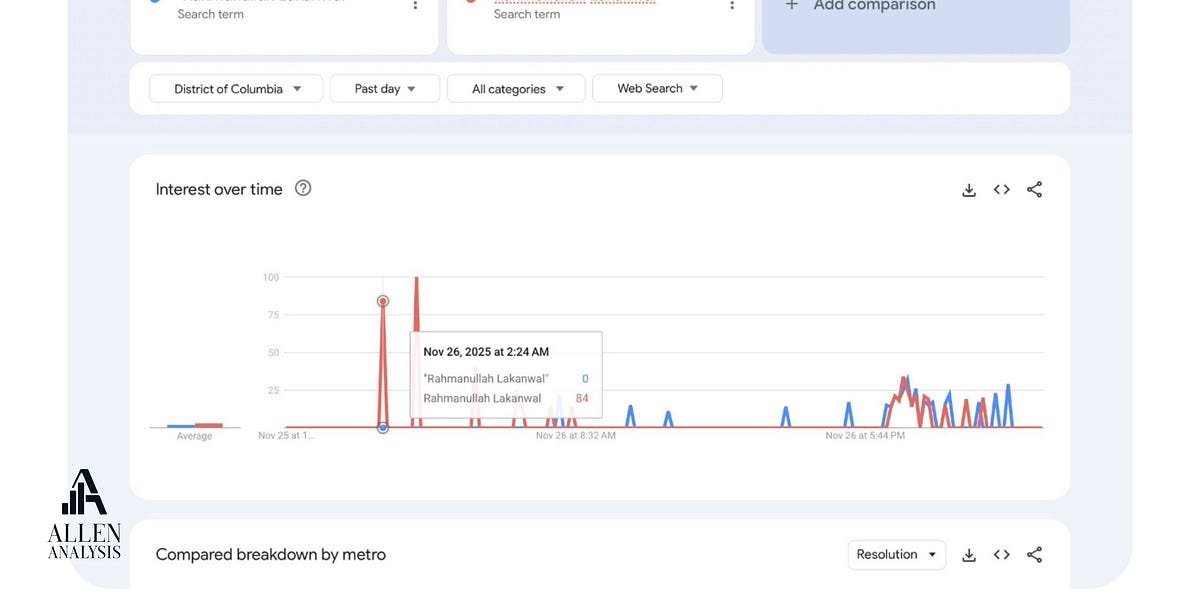

A new claim about the shooting of a DC National Guardsman is circulating and it’s gaining momentum. According to posts now being shared on Political This claim suggests possible foreknowledge by unknown actors who discovered his name long before the first shot was fired. This requires careful investigation rather than immediate dismissal, as making allegations in volatile moments requires accuracy rather than assumptions.
The circulated screenshots show three distinct spikes in DC Google search interest for the name Rahmanullah Lakanwal on November 26 at approximately 2:24 am, 3:28 am and 8:00 am. The shooting occurred at approximately 2:15 that afternoon. If these timestamps are accurate, it means that someone in the district had repeatedly searched for the suspect’s name long before the incident became public. The claim immediately sparked speculation that the shooter’s identity may have been known before the incident occurred. At the very least, it raises questions about whether the data are being interpreted correctly or whether an unrelated pattern was imposed on a breaking news story.

Google Trends collects generalized search interest rather than absolute numbers. The numerical value of 100 reflects peak relative interest within the selected time frame and location, not the volume of searches. It’s possible that one or two people searching for rare names could produce a visually dramatic spike. This is especially true in the case of unusual words, foreign language names, or queries from institutional networks. However, the fact that the spikes appeared in Washington, DC, rather than a random assortment of regions, requires follow-up investigation, given that federal agencies, journalists, think tanks, and contractors with access to privileged information operate overwhelmingly within that geography.

Another claim circulating is that Lakanwal had previous ties to US-involved units in Afghanistan, particularly the Kandahar Strike Force, which was monitored by the CIA for several years. The Fox News commentary referenced this connection based on interviews and alleged ID records. If confirmed, it raises a separate set of questions unrelated to the Google Trends issue. This would indicate that the suspect was not just a casual asylum seeker, but someone who may have interacted with US intelligence structures before resettlement. That possibility cannot be accepted or rejected without official confirmation. However, it underlines the importance of understanding who issued their approval, when, and under what conditions.
According to CNN reporting and immigration case documents confirmed through DHS sources, public records show Lakanwal applied for asylum in December 2024 and approval in April 2025 during the Trump administration. This places the decision squarely within the tenure of the current President and contradicts public actors who attempted to attribute the approval to the prior administration. It is common to make false allegations in moments of crisis, but here the facts are straight. The approval occurred under Trump’s watch, and his officials monitored the decision.

The central question remains the Google Trends spike. There are several plausible explanations. A social media post featuring his name may have circulated before mainstream news outlets learned of the shooting. Early journalists or local community members may have guessed or shared details before verification, which then generated search traffic. Search interest may also come from internal networks involving immigration lawyers, former colleagues, or individuals who recognized the name before law enforcement publicly identified the suspect. It is also possible that the trend data is inaccurate for extremely low-volume names, which is a known phenomenon in low-frequency datasets.
There is one final possibility that requires careful and responsible management. If federal agencies, contractors, or analysts had inside information about someone who was already flagged for risk or past conduct, the name could theoretically appear in searches before an incident came to light. There is currently no evidence of this, but it is a hypothesis that only subpoenaed logs or investigative reporting can confirm or deny. The demand for IP subpoenas broadcast online is premature, but the underlying concern is not unreasonable. Transparency is the only solution to speculation.
Moments like this are charged. They create opportunities for opportunists who want to weaponize tragedy for political gain, and they also expose cracks in the informational ecosystem where genuine anomalies cannot be investigated because they are immediately dismissed as a conspiracy. The responsible approach is neither to panic nor to blindly accept any claims. It is systematic verification, patient questioning, and a refusal to let political actors define the narrative through misdirection or distraction.
This story is still unfolding, and the data deserves investigation. Readers should expect clarity, not slogans. AllenAnalysis Google Trends will continue to track the issue, the asylum timeline, and the shooter’s background as more information becomes available. If you value investigations that take the facts seriously, subscribe to support the work. Each subscription helps with the evidence-based reporting needed to navigate FOIA requests, data validation, and moments like this.
Let’s keep going.
What to read:
<a href