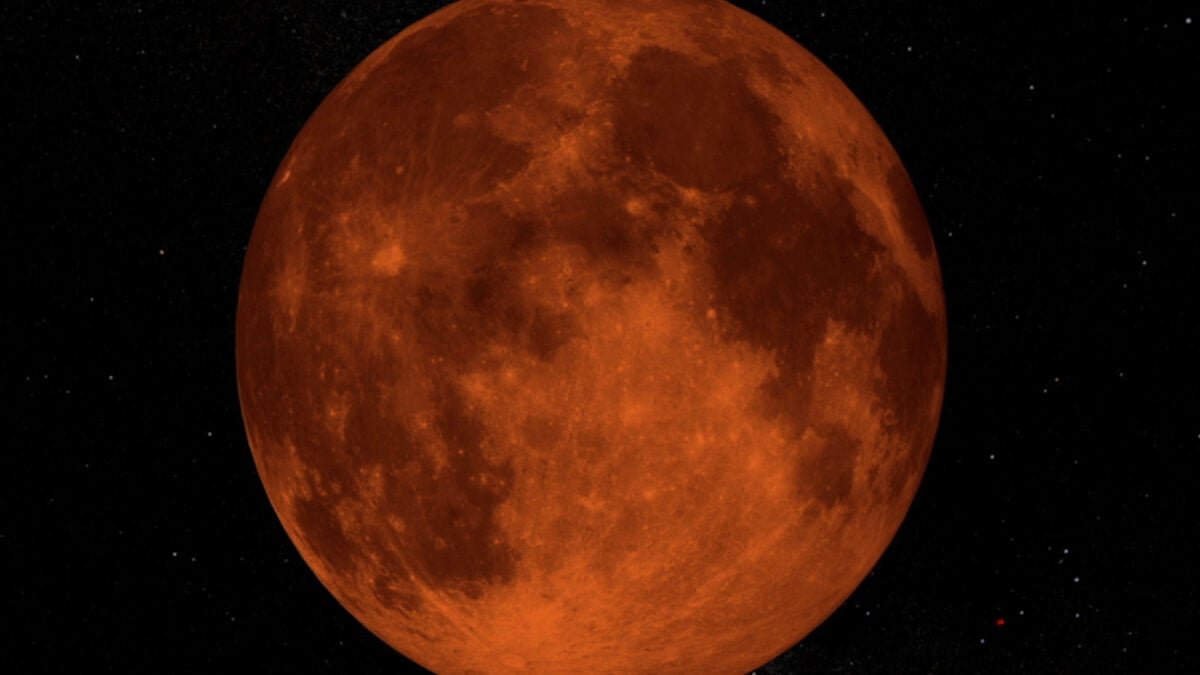
Next week, the moon will enter behind Earth’s shadow and be illuminated by sunlight as it passes through the planet’s atmosphere. Filtered sunlight will cast a warm glow on the moon’s disk, giving it a temporary deep orange to red color.
Where can I see a total lunar eclipse?
The full blood moon will be visible over North America and is the last moon we will see for about three years, until December 2028. According to NASA, the full blood moon will be visible to viewers in eastern Asia and Australia in the evening and throughout the night in the Pacific. It will be visible in the morning in North and Central America and far western South America.
The Moon will begin to enter Earth’s shadow at 3:44 AM ET, and a partial eclipse will occur at 4:50 AM ET. During a partial eclipse, it will appear as if a piece of the Moon has been cut off because a portion of the lunar disk appears very dark.
Totality, when the entire Moon is in Earth’s shadow, begins at 6:04 a.m. ET and lasts about an hour. Then the moon turns a bloody, coppery red color.

For skywatchers in eastern North America, the blood moon will not appear as dramatic as it will on the West Coast or other parts of the world. This is because totality will occur around the same time as sunrise, and the sky will not be dark enough to see the blood moon in its full glory. The blood moon will set in the west just before dawn. This presents another challenge for skywatchers in the Eastern Time Zone, as the Moon will set before the eclipse reaches maximum.
The partial lunar eclipse will also be visible in parts of Central Asia and South America.
How to see a total lunar eclipse
Despite these challenges, you can still try to catch a glimpse of the blood moon. A total lunar eclipse does not require any special equipment – you can see it with the naked eye. For the best view, go to a dark place and give your eyes time to adjust to the night sky.
At the time of the eclipse, the Moon will be in Leo. As the Moon’s light is dimmed by Earth’s shadow, this is also an opportune time to look at other celestial objects in the sky, as constellations appear brighter when they are not competing with the natural satellite.
The next total lunar eclipse will occur on New Year’s Eve in 2028. This will be the first in a series of three consecutive lunar eclipses, with the next occurring on June 26, 2029, and the next on December 20, 2029.
<a href