DBreak Duralex glass and it will probably bounce, not break. The French company itself has fallen several times over the past two decades and has always bounced back, but never as brilliantly as when, earlier this month, it asked the public for money.
An appeal for emergency funding of €5m (£4.4m) to secure the immediate future of the glassworks took just five hours and 40 minutes to reach its target. Within 48 hours, the total amount pledged topped €19m.
Duralex’s director general, Francois Marciano, 59, said the response has surprised everyone at the company. He said, “We thought it would take five or six weeks to raise €5m. When it got to about €20m we had to stop. That’s it.”
As a worker cooperative, €5m is the maximum amount that Duralex can accept in public investment under financial rules.
beloved french brand
Mention Duralex to any French person and they will be transported back to childhood and school canteens. The brand evokes a mix of nostalgia and pride and is a symbol of French patriotism and industrialism Savior Justice.
“We’re like Proust’s Madeleines,” Marciano said. “The French people want to save us. They are fed up with factory closings and the decline of the country’s industries.”
At the Duralex factory on an industrial estate in La Chapelle-Saint-Mesmin on the banks of the Loire just outside Orleans, Marciano says he and his colleagues are “floating on a cloud” after the appeal.
Eighteen months earlier, Marciano had overseen a staff buyout of the company, which had been placed in receivership for the fourth time in 20 years. Today, 180 of the 243 employees at the company are “associates”.
Suleiman El Moussaoui, 44, a union representative at the factory where he has worked for 18 years, said the appeal has led to “a tsunami of orders, so many that we are struggling to keep up with them. Every time the company is mentioned on television or radio we have more orders. It’s amazing.”
Inside the factory, a simple but magical alchemy takes place. A mixture of sand, soda ash and limestone, the exact proportions of which are a closely guarded secret, is heated to 1,400C in a giant overhead oven. Glowing pieces of molten glass fall into the iron casting which are burst by the gas flame. The red-hot glass is quickly shaped, taken out of the mold, snatched with metal tongs and placed on a conveyor belt.
The process has changed little since Duralex – which is said to take its name from the Latin expression Dura lex sed lexmeaning “The law is harsh, but it is the law” – opened in 1945. When the Guardian visited, the production line was making small clear glasses in the Provence range.
An employee, waving tongs, lifted a glass towards the light and inspected it for defects. During production, up to a dozen samples of whatever is being made – glasses, plates, bowls – will be removed at random and subjected to stress testing. In the quality control room, they will be heated to 150C, then dipped in cold water to see if they resist thermic shock, and dropped from kitchen counter height onto a sheet of metal to see if they break. They will be tested for stackability and then weighed and the thickness of the glass measured. If they pass, they are thrown in the trash and commended to the production line. If they fail, everything stops and the machines are recalibrated.
‘The best drinking vessel’
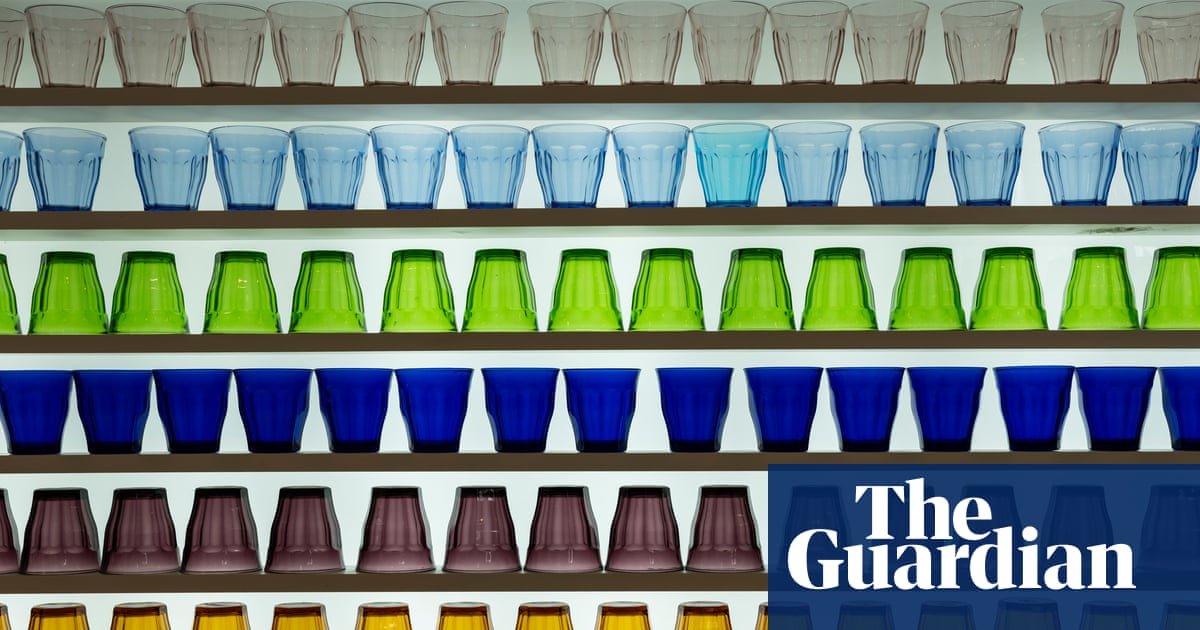
It is not known who invented the company’s trademark Picardy glass, a glass used in school canteens with a thick curved rim and half-flute shape, which first appeared in 1954. British design guru Patrick Taylor has ranked Picardy as an icon of modern design along with Levi’s jeans and Swiss Army knives. Taylor described it as: “An object whose form gives the impression that it was discovered rather than designed. It is the best beverage made by man, and its type cannot be improved upon.”
Duralex says its glass is microwave, freezer, and dishwasher-safe and won’t become cloudy or lose its color, which is what’s in it instead of glass. When they break, Duralex glasses shatter into small pieces rather than fragments, reducing the risk of injury.
Joel Cardon, 59, who has worked at the factory for 35 years, said rising gas and electricity costs are the company’s biggest and most worrying expenses.
On their screen, the liquid glass oven showed a temperature of 1,440C. It can never be allowed to cool otherwise the glass will freeze. Another screen showed that the factory was using 360 cubic meters of gas per hour. According to regulator Ofgem, the average UK home uses 97.3 cubic meters of gas per year.
Last weekend, potential investors were asked to make good on their commitments on a first-come, first-served basis. They will be issued securities that will yield 8% interest over seven years but will not give voting rights to the company. The maximum investment was set at €1,000.
Marciano said, “We want to get as many people involved as possible, but with pledges of almost €20 million, obviously some people will be disappointed.”
Since the company became an employee co-operative, turnover has increased by 22% and Marciano said he expects Duralex to break even by 2027.
The €5m raised will be used to modernize the factory and develop new products. These include a partnership with the Elysée Presidential Palace shop to sell a set of three Giugnon glasses in red, white and blue, marked RF for Republica Française.

Duralex plans to commission molds to create “pint” glasses with a measuring line for British pubs and bars and the US, both areas the company has identified as untapped markets.
Vincent Wallin, head of strategy and development, said, “It is more difficult to sell abroad because there is no nostalgia for Duralex like in France.” “Interest in the company is high and that is positive, but now we have to focus on increasing sales.”