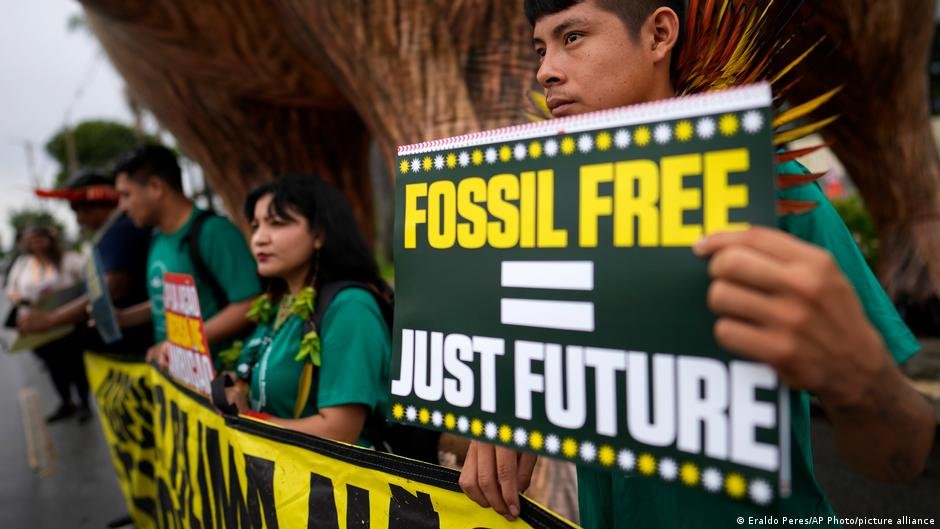
UN climate talks in Belém, Brazil are heading towards a discussion on which countries are willing to make real progress on phasing out fossil fuels.
Emissions from burning oil, coal and gas are at record levels, driving climate change that is already killing millions of people and wreaking havoc on ecosystems and economies.
Yet fossil fuels have long been a controversial topic at UN climate summits. It took 28 years for the COP’s final decision to officially recognize the need to “move away from fossil fuels”.
This year in Belém, a growing diplomatic effort led by dozens of countries aims to advance that pledge as a roadmap to accelerate the transition away from oil, gas and coal.
“We need an actionable outcome, not another roadmap,” Jasper Inventor, deputy program director at Greenpeace International, said in a statement.
Still, most oil-producing nations are opposed to the idea and with a record turnout of fossil fuel industry lobbyists present at the COP30 climate talks, the path forward is unlikely to be easy.
What are countries emphasizing?
The issue flared up even before the summit began, when Brazilian President Luiz Inacio Lula da Silva – himself under fire for approving an oil exploration project at the mouth of the Amazon – urged world leaders to work toward ending fossil-fuel dependence.
In his “Belém Call for Climate”, Lula further strengthened the message, urging the development of a timeline for the progressive phase-out of fossil fuels and greater financial aid for developing countries.
In response, countries seeking more ambitious emissions reductions have formed a coalition. France, Colombia, Germany, Kenya and others are urging that the fossil fuel roadmap be added to the official agenda and potentially reflected in the summit’s outcome.
The diplomatic effort in Belém has been supported by Brazil’s Environment Minister Marina Silva, who said she supports a roadmap “because it lays the foundation for a fair and planned transition away from polluting oil, coal and gas”.
While COP28 marked a historic call for a transition from fossil fuels, it offered few details on how to get there. It was called a “death sentence” by campaigners for countries such as the Pacific Islands, whose existence is at risk if global warming is not brought under control.
So far, about 60 countries from Europe, Africa, Latin America and small island developing states are believed to have supported the move. Supporters are aiming to reach 100.
“Our priority for the coming days is to broaden this alliance, to talk to all the countries that believe we need to move forward and accelerate this issue,” a source in the French delegation said.
Although most countries cannot commit to the roadmap with specific dates or targets, it is expected that they may be pressured to report progress towards the targets for review at future COPs.
German State Secretary for Climate Action Jochen Flaisbarth has said his country will support any decisions on the roadmap in Belém.
Colombia is reported to have drafted a declaration to phase out fossil fuels. A handful of states are believed to have signed the document, which will likely be published on Tuesday.
What obstacles might the alliance face?
The challenge will be to present a large block of support to get the roadmap on the conference agenda, said Romain Iolalen, global policy campaign manager for Oil Change International, a US-based advocacy organization.
“It’s a diplomatic puzzle that’s shaping up,” Eulalen said. Yet the phased alliance is facing stiff opposition.
Most oil-producing states, particularly Saudi Arabia, are believed to have categorically rejected the idea of the roadmap and are pushing back against diplomatic efforts in its favor.
One negotiator estimated that about 70 countries would oppose any new decisions coming from COP30 that address fossil fuels.
At COP28 in Dubai, major oil-producing countries resisted calls to phase out the transition, instead proposing the option of phasing out fossil fuel emissions using technology such as carbon capture and storage, which has not been tested on a large scale.
Record share of fossil fuel lobbyists present
The record turnout of industry lobbyists at this year’s COP is likely to add weight to their favour.
One in every 25 participants in Belém represents the fossil fuel industry, according to a report this week Kick the Big Polluters Out, a coalition of 450 organizations pushing against the influence of polluting industries in climate policy making.
An estimated 1,602 delegates from oil, coal and gas, including representatives from energy giants ExxonMobil, Shell and TotalEnergies as well as state-owned oil companies, are in Belém.
They outnumber the delegations of every country except Brazil and have two-thirds more conference passes than the 10 most climate-vulnerable countries combined.
The report highlights growing concern that those with a vested interest in maintaining dependence on fossil fuels have wielded influence at the COP summit.
“It’s common sense that you can’t solve a problem by giving power to the people who created it,” said Jacques Bonbon, a member of the Kick Big Polluters Out coalition based in the Philippines, which was recently hit by a devastating typhoon.
TotalEnergies chief executive Patrick Pouyen said he is not a lobbyist and has been invited to COP30. He also expressed skepticism about a roadmap, calling it a “European approach” and suggesting that more government regulation was not the answer.
Speaking to DW ahead of COP30, Johan Rockström, director of the Potsdam Institute for Climate Impact Research in Germany, said the COP includes “a lot of strong voices who want to avoid the elephant in the room,” which is fossil fuels.
Emissions from burning oil, coal and gas are set to reach record highs in 2025, and the world is now on track for a catastrophic 2.6 degrees Celsius (4.7 degrees Fahrenheit) temperature increase by 2100.
Rockström said progress on other key COP30 issues, such as forest protection or finance for adaptation, “can only be celebrated if we also see progress on phasing out fossil fuels.”
Edited by: Jennifer Collins