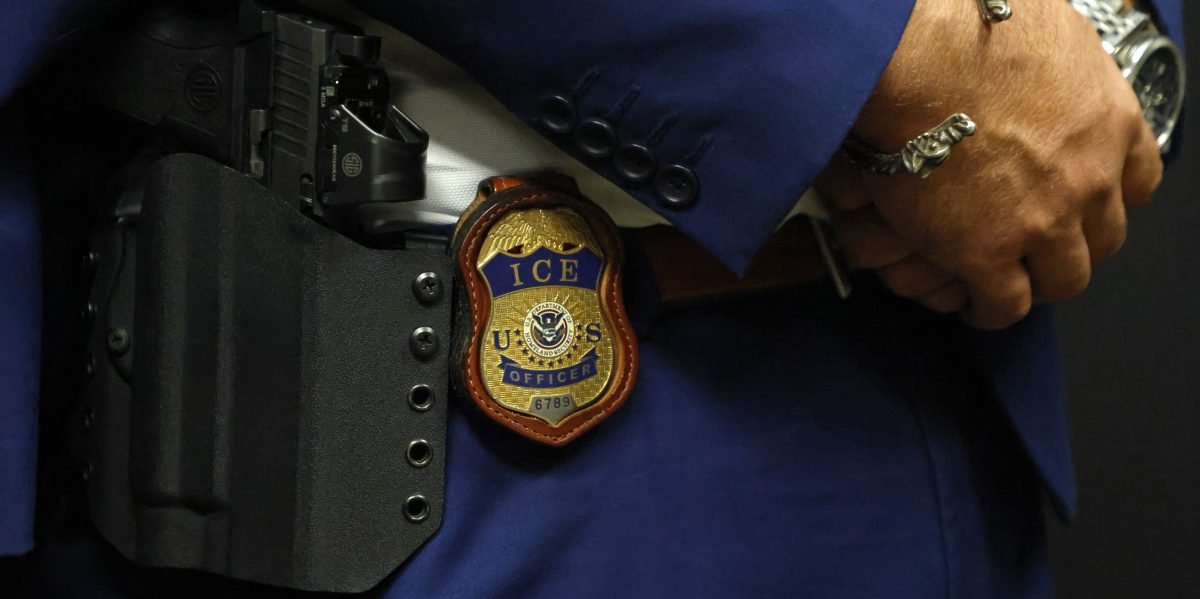

Federal prosecutors have A new indictment was filed in response to the July 4 noisy demonstration outside the Prairieland ICE detention facility in Alvarado, Texas, during which a police officer was shot.
There are many problems with the indictment, but perhaps the most serious is that it includes allegations against a Dallas artist who was not even at the protest. Daniel “Des” Sanchez is accused of carrying a box containing “Antifa material” after the incident, allegedly to conceal evidence against his wife Marisela Rueda, who was present.
But the contents of the box are not Molotov cocktails, pipe bombs or whatever else MAGA officials claim “Antifa” uses to wage their imaginary war on America. As prosecutors described in the July criminal complaint that led to the indictment, they were zines and pamphlets. Some contain controversial ideas – one was titled “Insurrectionary Anarchy” – but they are fully constitutionally protected free speech. The case reflects the administration’s intensified efforts to criminalize left-wing activists after Donald Trump announced in September that he would designate “Antifa” as a “principal terrorist organization” — a legal designation that does not exist for domestic groups — following the Charlie Kirk killing.
Sanchez was first indicted in October on a charge of “falsely concealing a document or record” as a standalone case, but the new indictment merges his charges with charges against other defendants, possibly in hopes of burying First Amendment problems with the case against him under prosecutors’ claims about the alleged shooting.
This is an extension of a familiar strategy. In 2023, Georgia prosecutors listed “zine” distribution as part of conspiracy charges against 61 Stop Cop City protesters in a massive RICO indictment, not bothering to explain how each individual defendant was involved in any actual crime. I wrote then about my concern that this was not only reckless overreach, but also a blueprint for censorship. Those fears have now been validated by Sanchez’s prosecution for merely possessing similar literature.

There have been other warnings that police and prosecutors think they’ve found a constitutional loophole – if you can’t punish for reporting it, punish for transporting it. Los Angeles journalist Maya Lau is suing the LA County Sheriff’s Department for allegedly investigating her undercover investigation for conspiracy, theft of government property, unlawful access to a computer, theft and receiving stolen property. According to his lawyers, his only crime was reporting for the Los Angeles Times on a list of representatives with a history of misconduct.
If you can’t punish for reporting it, punish for transporting it.
It is also reminiscent of the Biden administration’s case against right-wing outlet Project Veritas for possessing and transporting Ashley Biden’s diary, which the organization purchased from a Florida woman who was later convicted of stealing and selling it. The Constitution protects the right to publish material stolen by others – a right that would be meaningless if they could not publish the material in the first place.
Despite the failure of the Cop City prosecution and Lau investigation—and the dismissal of the Project Veritas case itself—the Trump administration has followed dangerous precedents by characterizing legitimate activism and ideologies as terrorist conspiracies (a strategy that Trump allies also employed during this first term) while seizing the power to prosecute pamphlet possession whenever they use the magic word “antifa.”
It’s an exciting combination for any journalist, activist or person critical of Trump. National security journalists have long grappled with the fear of prosecution under the archaic Espionage Act for merely obtaining government secrets from sources, especially after the Biden administration extracted a guilty plea from WikiLeaks founder Julian Assange. But the rest of the press – and everyone else, for that matter – understood that simply possessing written material, no matter what they said, was not a crime.
crime by literature
At what point does a literary collection or newspaper subscription become prosecution evidence under the Trump administration’s logic? Basically, whenever it’s convenient. Ambiguity is a feature, not a bug. When people do not know what political content may later be considered evidence of criminality, the safest course is to avoid engaging with controversial ideas altogether.
The slippery slope from anarchist territory to traditional journalism is not imaginary, and we are already slipping fast. Journalist Mario Guevara can tell you that from El Salvador, where he was deported in an apparent case of retaliation for livestreaming the No Kings protests. Tufts doctoral student Rumesa Ozturk may do the same, as she awaits deportation proceedings for co-authoring an opinion piece criticizing Israel’s wars, which the administration considers evidence of support for terrorism.
At least two journalists legally in the US – Yacoub Ira Vijandre and Sami Hamdi – were caught by ICE just last month. The case against Vijandre is based partly on his criticism of the overreach of the prosecution in the Holy Land Five case and his liking of social media posts quoting Quranic verses, which raises the question of how far we are from someone being convicted for carrying a news article criticizing the Quran or the war on terror.
Sanchez’s case is based on overreach by the prosecution. The National Lawyers Guild criticized prosecutors’ poor dot-connecting to justify holding 18 defendants responsible for a single gunshot wound. Some defendants were also charged with supporting terrorism due to their alleged association with “Antifa”. Anarchist zines were also cited as evidence against him.
Sanchez was charged following a finding that ICE announced on social media that he had “literally insurrectionist propaganda” that he allegedly transmitted from his home to an apartment, stating that “insurgent anarchism is considered the most serious form of domestic (non-jihadi) terrorist threat.” The tweet also said Sanchez is a green card holder granted legal status through the Deferred Action for Childhood Arrivals program.
The indictment claims Sanchez was taking those materials into hiding because they incriminated his wife. But how can possession of literature convict anyone, let alone someone who is not accused of anything but was present when someone else allegedly fired the gun? Zines are not banned; It is not illegal to be an anarchist or read about anarchism. I don’t know why Sanchez allegedly transferred the box of documents, but if it was because he (apparently correctly) feared that prosecutors would try to use them against his wife, then that’s a comment on the lawlessness of prosecutors, not Sanchez.
Violent rhetoric is subject to punishment only if it constitutes a “true threat” of imminent violence. Still, the speaker is held responsible, not someone who simply has his or her words.
Government prosecutors have not alleged that the “Antifa material” constitutes a “true threat” or any other category of speech that falls outside First Amendment protection. Nor did he allege that the materials were used to plan the alleged actions of protesters on July 4 (although he did allege that the materials were “anti-government” and “anti-Trump”).
We do not want a constitutional right to publish (or keep) only what the government likes.
Even the aforementioned “Insurgent Anarchy: Organizing for the Attack” zine, despite its hyperbolic title, reads like an idea book, not a how-to manual. It advocates tactics like rent strikes and capture, not shooting police officers. Critically, this has nothing to do with whether or not Sanchez’s wife committed the crime on July 4th.
Being guilty of possessing literature is a concept fundamentally incompatible with a free society. We don’t need a constitutional right to publish (or keep) only what the government likes, and the “anti-government” literature in Sanchez’s zine box is exactly what the First Amendment protects. With history and leaders like Vladimir Putin and Viktor Orban as guides, we also know that it is highly unlikely that Trump’s censorship crusade will stop with a few radical pamphlets.
The Framers loved zines
There is an irony in a supposedly conservative administration considering anti-government pamphlets as evidence of criminality. When the framers of the Constitution wrote the press freedom clause of the First Amendment, they had in mind a number of publications that bore more resemblance to Sanchez’s box of zines than the output of today’s mainstream news media.
Revolutionary-era America was steeped in highly ideological, politically radical literature. Thomas Paine’s “Common Sense” was designed to inspire revolution against the established government. Newspapers such as the Boston Gazette printed inflammatory articles by Samuel Adams and others, urging the colonies to prepare for war after the Coercion Acts. The Declaration of Independence itself recognized the right of the people to rise up. It was not thought that the revolution of that time would be the last.
One might call it “literal insurrectionist propaganda” – and some of it was probably transported in boxes.
The framers ensured freedom of the press, not because they envisioned today’s professionally trained journalists maintaining careful neutrality. They defended it because they already understood the need for journalists and writers who believed their government had become tyrannical to support the revolution.
Despite all their mistakes, the creators were so confident in their ideas that they were willing to test them. If government conduct did not require radical opposition, radical ideas would not have taken hold. It certainly seems that the current administration does not want to take this bet.
<a href