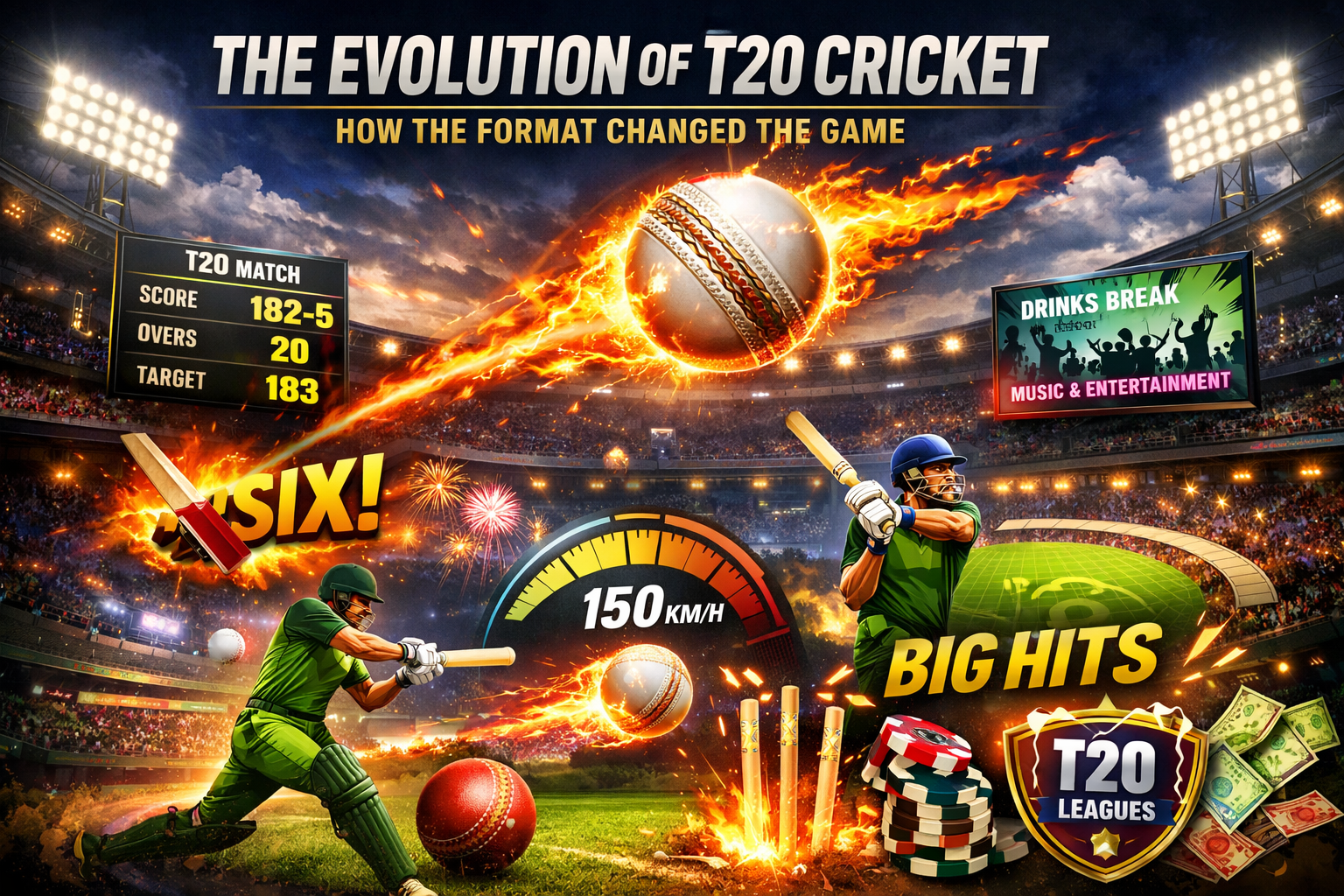
The Evolution of T20 Cricket: How the Format Changed the Game
Cricket, a sport steeped in tradition, has undergone a seismic shift over the past two decades. The introduction of Twenty20 (T20) cricket in 2003 didn’t just add a new format—it revolutionized the game, attracting new fans, reshaping strategies, and redefining what it means to be a cricketer. From the explosive batting of Chris Gayle to the death-over mastery of Jasprit Bumrah, T20 cricket has pushed boundaries, blurred roles, and turned the sport into a global spectacle.
In this deep dive, we’ll explore how T20 cricket evolved, its impact on the game, and what the future holds. Whether you’re a player, coach, or fan, understanding this transformation will give you a fresh perspective on modern cricket.
The Birth of T20 Cricket: A Revolution Begins
T20 cricket wasn’t an overnight success—it was a calculated response to declining interest in longer formats. The England and Wales Cricket Board (ECB) introduced the format in 2003 to attract younger audiences and fill stadiums. Little did they know, it would change cricket forever.
The Problem: Why Cricket Needed a Shake-Up
Before T20, cricket was dominated by Test matches (5 days) and One-Day Internationals (ODIs, 50 overs per side). While Tests were revered for their strategic depth, they struggled with:
- Declining viewership – Younger audiences found the pace too slow.
- Long match durations – Working professionals couldn’t commit to five days.
- Financial struggles – Boards needed a way to monetize the sport better.
ODIs were more accessible, but even they lasted 8-9 hours, making them less appealing in a fast-paced world. Cricket needed a shorter, more exciting alternative.
The Solution: The First-Ever T20 Match
On June 13, 2003, the first official T20 match was played between English counties—Surrey vs. Warwickshire. The rules were simple:
- 20 overs per side (instead of 50).
- Fielding restrictions to encourage big hits.
- A time limit (3 hours max) to keep the game fast-paced.
The experiment was a huge success—fans loved the high-energy, unpredictable nature of the game. Within a year, the ICC (International Cricket Council) recognized T20 as an official format, paving the way for the first T20 World Cup in 2007.
Early Skepticism & the Turning Point
Many purists dismissed T20 as “hit-and-giggle” cricket, arguing it lacked the skill of Tests. However, the 2007 T20 World Cup silenced critics:
- India’s dramatic win (defeating Pakistan in a last-ball thriller) made T20 a global phenomenon.
- MS Dhoni’s captaincy showcased how leadership in T20 required quick thinking and adaptability.
- Yuvraj Singh’s six sixes in an over (vs. England) proved T20 could produce unprecedented moments of brilliance.
By 2008, the Indian Premier League (IPL) launched, turning T20 into a billion-dollar industry and cementing its place in cricket history.
How T20 Cricket Changed Batting Strategies
T20 cricket didn’t just shorten the game—it rewrote the batting rulebook. Traditional techniques were replaced by innovation, power-hitting, and calculated risks. Let’s break down how batting evolved.
The Rise of Power-Hitting & Unorthodox Shots
In Test cricket, batsmen prioritize defense and patience. In T20, the focus shifts to maximizing runs in limited balls. This led to:
- The “360-degree” batsman – Players like AB de Villiers and Glenn Maxwell mastered reverse sweeps, scoops, and switch hits to manipulate field placements.
- The “helicopter shot” – MS Dhoni’s signature move became a weapon against spinners.
- The “ramp shot” – Jos Buttler and Eoin Morgan perfected hitting over the keeper’s head.
Actionable Tip for Batsmen:
- Practice unorthodox shots in the nets (e.g., paddle scoop, lap sweep).
- Develop a “powerplay plan”—decide whether to attack or consolidate based on match situation.
- Work on strike rotation—even in T20, dot balls can cost games.
The Importance of Strike Rate & Scoring Patterns
In T20, strike rate (runs per 100 balls) is as important as average. A batsman scoring 30 off 20 balls is often more valuable than one scoring 50 off 40 balls.
Key Scoring Trends:
| Phase | Ideal Strike Rate | Key Shots |
||||
| Powerplay (1-6) | 150+ | Big hits, aerial shots |
| Middle Overs (7-15) | 120-140 | Rotating strike, deceptive shots |
| Death Overs (16-20) | 200+ | Sixes, yorker evasion |
Example: David Warner (IPL 2023) had a strike rate of 165.5 in the powerplay, proving how aggressive starts set the tone.
Actionable Tip for Coaches:
- Analyze matchups—if a spinner bowls well in the middle overs, plan to attack them early.
- Use data—tools like CricViz or Wisden can help identify weak bowlers to target.
The Role of the “Finisher” in Modern T20s
Gone are the days when a No. 6 batsman just “played out the overs.” Today, finishers like Andre Russell, Hardik Pandya, and Kieron Pollard are game-changers.
What Makes a Great Finisher?
✅ Big-hitting ability – Must clear the ropes consistently.
✅ Nerve under pressure – Staying calm in the last 5 overs.
✅ Innovative shot selection – Using scoops, ramps, and switch hits to counter yorkers.
Example: MS Dhoni’s 2016 IPL final—chasing 192, he scored 23 off 11 in the last 2 overs, including a massive six to win the game.
Actionable Tip for Players:
- Practice death-over scenarios—bowlers will bowl yorkers and slower balls, so work on last-minute adjustments.
- Develop a “go-to shot”—like Russell’s helicopter six or Pollard’s scoop over fine leg.
Bowling in the T20 Era: Adapt or Perish
If batting evolved, bowling had to reinvent itself entirely. Traditional line-and-length bowling was no longer enough—T20 demanded variation, deception, and tactical brilliance.
The Death of the “Stock Ball”
In Tests, bowlers rely on consistency and movement. In T20, predictability is punished. Bowlers now use:
- Slower balls (knuckleball, off-cutter) – Dwayne Bravo’s variations bamboozle batsmen.
- Wide yorkers – Lasith Malinga’s toe-crushing yorkers made him a death-over legend.
- Bouncers & short balls – Jofra Archer’s pace and bounce disrupt timing.
Actionable Tip for Bowlers:
- Master 2-3 variations (e.g., slower ball, knuckleball, leg-cutter).
- Study batsmen’s weaknesses—if a player struggles against short balls, use them in key moments.
- Bowl to a plan—don’t just bowl; execute a strategy (e.g., yorkers in the 18th over).
The Rise of Mystery Spinners & Unorthodox Bowlers
T20 has given birth to bowlers who defy convention:
- Sunil Narine (carrom ball, off-spin with mystery).
- Rashid Khan (googly, leg-spin with pinpoint accuracy).
- Tabraiz Shamsi (chinaman, flipper).
Why Do They Succeed?
✔ Unpredictability – Batsmen can’t pick their variations.
✔ Economy rates – They restrict runs in the middle overs.
✔ Wicket-taking ability – Even if batsmen attack, they get out trying.
Example: Rashid Khan’s 5/3 in the 2017 IPL—his googlies and leg-breaks dismantled Gujarat Lions.
Actionable Tip for Spinners:
- Develop a “stock ball” and a “killer ball” (e.g., leg-spin + googly).
- Vary pace—don’t bowl every ball at the same speed.
- Use the crease—bowl from wide angles to create different angles.
Field Placements & Tactical Bowling
In T20, field placements are as important as the ball itself. Captains like MS Dhoni, Rohit Sharma, and Kane Williamson use aggressive fields to force mistakes.
Key Fielding Strategies:
| Bowler Type | Common Field Placements | Purpose |
||||
| Fast Bowler (Powerplay) | 2 slips, gully, fine leg | Pressure with movement |
| Off-Spinner (Middle Overs) | Short mid-wicket, deep square | Force batsmen to hit against spin |
| Death Bowler | 2 on the boundary, fine leg | Prevent boundaries, force singles |
Example: Jasprit Bumrah’s 2019 World Cup final—his wide yorkers and unconventional field placements choked England’s batting.
Actionable Tip for Captains:
- Change fields every over—keep batsmen guessing.
- Use a “sweeper” in the powerplay—prevents easy boundaries.
- Have a “plan B”—if a bowler is being attacked, switch to a part-timer.
The Impact of T20 Leagues on Global Cricket
T20 cricket didn’t just change how the game is played—it changed who plays it, where it’s played, and how much money is involved. The rise of franchise leagues (IPL, Big Bash, CPL, The Hundred) has globalized cricket like never before.
The IPL: The Billion-Dollar Game-Changer
The Indian Premier League (IPL), launched in 2008, wasn’t just a tournament—it was a cultural phenomenon. Here’s how it changed cricket:
- Financial Revolution – Players like Virat Kohli (₹17 crore/year) and MS Dhoni (₹15 crore/year) became cricket’s first superstar millionaires.
- Global Talent Pool – The IPL brought together AB de Villiers (SA), Chris Gayle (WI), and David Warner (AUS) under one roof.
- Innovation in Broadcasting – DRS, Spidercam, and player mic-ups made T20 more engaging for fans.
Example: The 2023 IPL final (CSK vs. GT) had 240 million viewers—more than the Super Bowl.
Actionable Insight for Players:
- Leverage leagues for exposure—perform in the IPL, BBL, or CPL to get noticed.
- Learn from legends—playing alongside Dhoni or Kohli can improve your game.
- Understand the business—endorsements, social media, and branding matter.
The Rise of Associate Nations & T20 Specialists
Before T20, Ireland, Netherlands, and Afghanistan were considered “minnows.” Now, they’re competitive forces:
- Netherlands’ 2022 T20 World Cup win over England – Proved Associate nations can challenge the best.
- Afghanistan’s spin trio (Rashid, Nabi, Mujeeb) – Became IPL superstars.
- Namibia’s rise – Qualified for T20 World Cups and produced stars like David Wiese.
Why Are They Succeeding?
✅ T20 is skill-based, not experience-based – A young player with power-hitting ability can outperform a Test veteran.
✅ Leagues provide exposure – Players from Associate nations get IPL, CPL, and BBL contracts.
✅ ICC’s push for global cricket – More T20 World Cup spots mean more opportunities.
Actionable Tip for Young Cricketers:
- Focus on T20 skills—if you’re from a smaller nation, power-hitting and variations can get you noticed.
- Play in multiple leagues—experience in IPL, CPL, and BBL makes you a complete T20 player.
- Use social media—players like Suryakumar Yadav built their brand through highlight reels.
The Commercialization of Cricket: Sponsors, Broadcasting & Fan Engagement
T20 cricket turned cricket into a global entertainment product. Here’s how:
- Sponsorships & Branding – Teams like Mumbai Indians (Reliance) and Chennai Super Kings (India Cements) are billion-dollar franchises.
- Broadcasting Innovations – Hotstar (Disney+), Sky Sports, and Willow TV made cricket accessible worldwide.
- Fan Engagement – Fantasy leagues (Dream11), in-stadium experiences, and social media keep fans hooked.
Example: The 2023 IPL auction saw Sam Curran sold for ₹18.5 crore—more than Virat Kohli’s base price.
Actionable Insight for Cricket Boards:
- Invest in digital engagement—YouTube highlights, TikTok clips, and interactive polls attract younger fans.
- Expand T20 leagues—The Hundred (England), SA20 (South Africa), and ILT20 (UAE) are growing markets.
- Monetize women’s cricket—the Women’s IPL (WPL) is already a huge success.
The Future of T20 Cricket: What’s Next?
T20 cricket is still evolving. From new formats to AI-driven strategies, the next decade will bring even more disruption. Here’s what to expect.
The Rise of “The Hundred” & Shorter Formats
The ECB’s “The Hundred” (100-ball format) was met with mixed reactions, but it proved one thing—cricket is willing to experiment.
Why Shorter Formats Could Work:
✔ Even faster-paced – Matches finish in 2.5 hours (vs. 3 for T20).
✔ More accessible – Easier for casual fans to watch.
✔ New strategies – Bowlers get 5-ball sets, batsmen have fewer balls to score.
Will T20 Be Replaced?
- No—T20 is too entrenched in global cricket.
- But—shorter formats could coexist (like T10 leagues).
Actionable Insight for Players & Coaches:
- Adapt to new rules—if The Hundred grows, practice 5-ball bowling spells.
- Stay flexible—cricket is constantly evolving; don’t get stuck in old methods.
Technology & AI in T20 Cricket
From Hawk-Eye to AI-powered analytics, technology is changing how teams prepare.
How AI is Used in T20:
- Predictive analytics – Teams use CricViz to predict batsmen’s shot success rates.
- Bowling machines with AI – Merlyn (used by England) simulates real-match scenarios.
- Fan engagement – AI chatbots provide live stats and predictions.
Example: Mumbai Indians use AI to analyze opposition weaknesses before matches.
Actionable Tip for Teams:
- Invest in data analytics—tools like Wisden Edge can give competitive advantages.
- Use VR training—players can practice against virtual bowlers.
- Leverage social media AI—automated highlight reels can boost fan engagement.
The Globalization of T20: New Leagues & Markets
Cricket is no longer just India, Australia, and England’s game. New leagues are expanding the sport:
- SA20 (South Africa) – Backed by IPL franchises, attracting global stars.
- ILT20 (UAE) – A hub for T20 cricket, with big-money contracts.
- MLC (USA) – Major League Cricket aims to grow cricket in America.
Why This Matters:
✅ More opportunities for players – Even Associate nation cricketers can earn six-figure salaries.
✅ New fanbases – Cricket is growing in USA, Middle East, and Europe.
✅ More competition – Leagues will push players to improve.
Actionable Insight for Aspiring Cricketers:
- Target emerging leagues—SA20, ILT20, and MLC are easier to break into than the IPL.
- Learn multiple skills—all-rounders and power-hitters are in high demand.
- Build a personal brand—YouTube, Instagram, and TikTok can open doors.