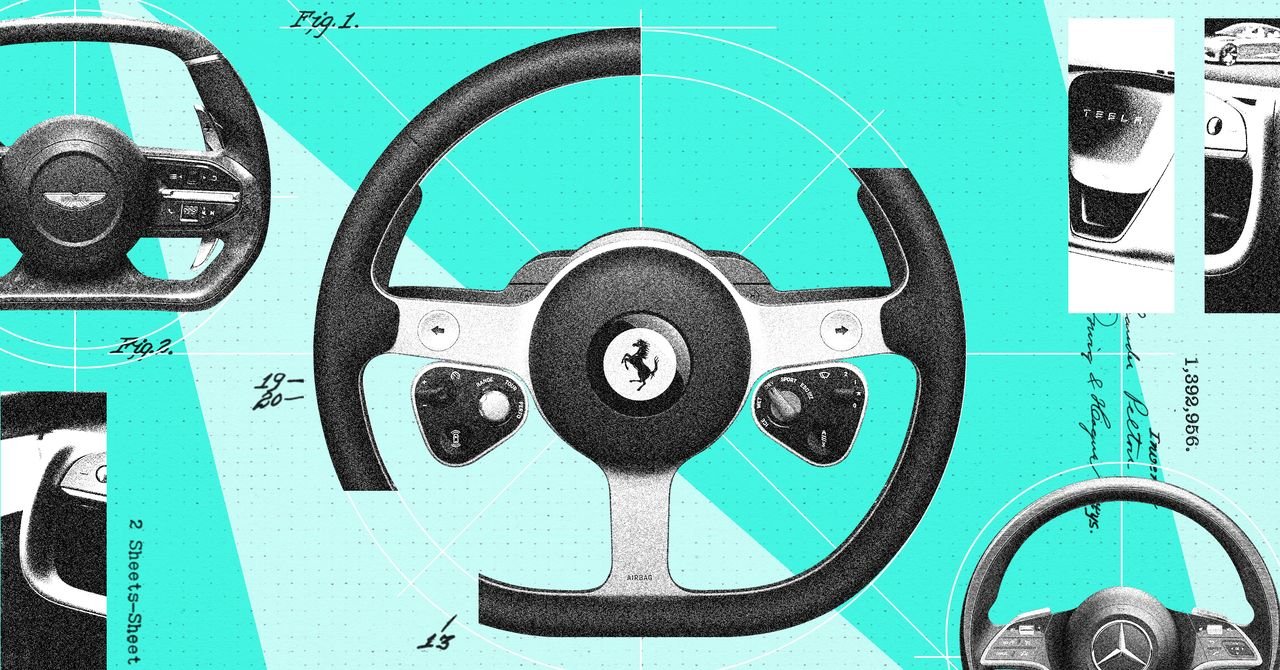
Cars did not always have steering wheels. The very first car – the 1885 Benz Patent-Motorwagen, invented by Karl Benz – used a tiller system: a horizontal bar with a handle mounted on a vertical bar. The lever-like handle was in many ways similar to the rudder of a boat. Amazingly, it would be nine years later when French engineer Alfred Vacheron wised up and fitted the first known steering wheel to his 4-horsepower Panhard for the Paris-Rouen race. Just four years later, in 1898, Panhard made the highly preferred and safe steering wheel standard for all of its cars. And we’ve been using them ever since.
Hans-Peter Wunderlich is the creative director of interior design at Mercedes. He has been designing steering wheels for 35 years. “I started my first one in 1991,” he told me. “A steering wheel is really the most challenging and difficult element to sculpt, to design, to develop in a car.” It is so difficult that Wunderlich has used the wheel as a test on potential recruits.
“When we hire a designer, after looking at a good portfolio, I task them with creating a steering wheel,” he says. “The steering wheel, for me, is the proof. Should I hire them or not? If a designer is able to create a perfect steering wheel, even as a scribble, then they will be a good designer for the entire interior of the car.”

It was this challenge that partly attracted Ive and his team. “Our starting point was to try to understand the essential nature of the problem to be solved, and that usually meant rejecting received wisdom,” Ive told me. “A car is an aggregation of many products, and, in many ways, we’re designing furniture. We’re designing complex and sophisticated input methods. One of the challenges was to try to create cohesion. You don’t get something to be unified by one set of rules. It was a wonderful new challenge, and one to grapple with for many years.”
For both Ive and Wunderlich, the science comes with the art of design. They talk about the intricacies of ergonomics, the logic of switches, the “exploding element in the center” (airbag), which is becoming more and more complex, says Wunderlich. “Even the rim is an ergonomic science in itself,” he says, adding that his team works closely with Mercedes’ in-house ergonomics department on these steps. “It’s about 50-50. We get requirements data from engineering and ergonomics.”
hanging out
Check your steering wheel rim carefully; In cross-section, it will not be round. Cut it into sections, and each will likely have a different profile, aimed at optimizing grip wherever your hands grip the wheel. Even the padding should be perfect. “It shouldn’t be boney but also not too thick. You need a good balance,” says Wunderlich. “[It must say] This car is solid, it’s quality, it’s strong, it’s powerful, but it’s not crude.”
“If you hold the wheel at the three and nine o’clock positions, you can carve with your fingers on the back of the rim—so you have the hump, the scallop, of the rim,” Wunderlich says. “And then we create a valley where your fingers can rest. That means your hands can be closed. You feel like you’re holding a car. It’s very challenging, because in that area you have such a technical structure to maintain – complex electronics and heating elements. We torture engineers to keep that area so small so we can sculpt it.”
I have tortured Raffaele De Simone, Ferrari’s chief engineer and lead development driver. De Simone is sometimes described as “Customer No. 1” at the company because, apparently, no Ferrari road car leaves the factory until he is satisfied with its performance.
<a href