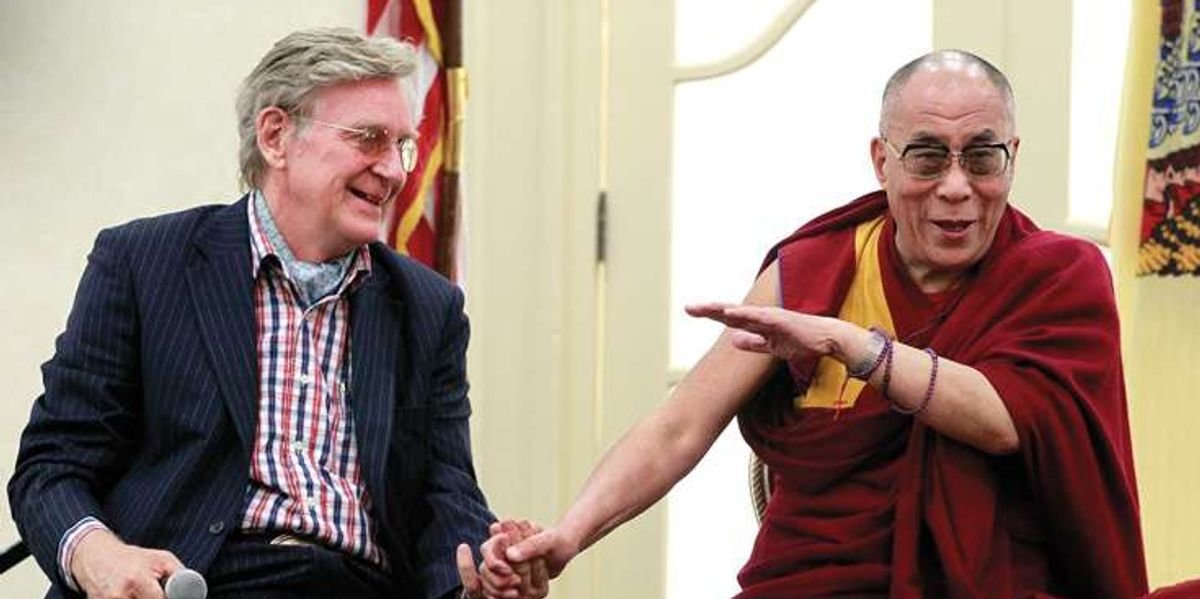
“They had to flee in 1959 because they had guns on Norbulingka and were going to destroy it,” Bob told me. He fled to India with about eighty thousand followers. “When he left, and they found out, they decimated the Tibetan mob. They were using him as bait to lure the last batch of guerrillas to Lhasa to rescue him, then they were going to capture them.”
What was his first impression of the young Dalai Lama? “He was a young boy like me, and he seemed a little stressed, lonely and a little sad, although basically energetic and happy.”
Dalai Lama is now 90 years old. In the intervening decades, he became a global spiritual statesman, an apostle of peace and nonviolence, who was awarded the Nobel Peace Prize in 1989.
Bob Robert Thurman, professor at Columbia University, founder of Tibet House US, became a prolific writer and broadcaster and was awarded the Padma Shri by the Government of India for his services to Buddhism.
On 3 November, I helped to arrange an event at the British Parliament to celebrate His Holiness’s 90th birthday as Global Ambassador UK of the International Buddhist Confederation and invited Professor Thurman to give a public talk with me. It was hosted by the Rt Hon Chris Law, MP and the All-Party Parliamentary Group for Tibet, and the Tibet Office, and was very well attended.
“In 1964, I had a good education but was still looking for reality. Being an omniscient teenager, I felt I should be able to understand the world. I really liked the fact that the entire Buddha movement is based on exploring the nature of life.” Buddha himself was a scientist of sorts who discovered the nature of reality. Sitting and observing yourself is not religion. It is a skill to manage your own psychology.
What changes has he seen in the Dalai Lama? “By the time he was in his 30s he was not so stressed and his aura was so big. Kissinger blocked his travels during the 1970s, so he had time for meditation and retreats. He became Adi Guru. But the best thing about His Holiness is that he is not a stuck-up personality. He can be Adi Guru and brilliant, then when he meets you in town he can tickle you and Can laugh. He treats people equally. He is very proud as a President, he says ‘All of you brothers and sisters are one big human family.’ Tibetan culture is based on a sense of belonging among the people.
My first meeting with His Holiness the Dalai Lama was in Delhi about 30 years ago. Then in 2011, I was a speaker at the first Global Buddhist Conference in Delhi. Later, when the International Buddhist Confederation (IBC) was formed, I was appointed Global Ambassador for the UK. I was asked to host a lunch for him in London in 2015 when he came here for his 80th birthday visit. The simplest and most profound lesson I have learned from him is how to practice spirituality in daily life, here and now, in the stressful world we live in. Be joyful and able to laugh despite terrible tragedies; How to be kind even to your mortal enemies; How to remain human despite the great glory given by the world. And interdependence. We are social creatures and our sense of well-being comes from each other, so to harm another is to harm ourselves.
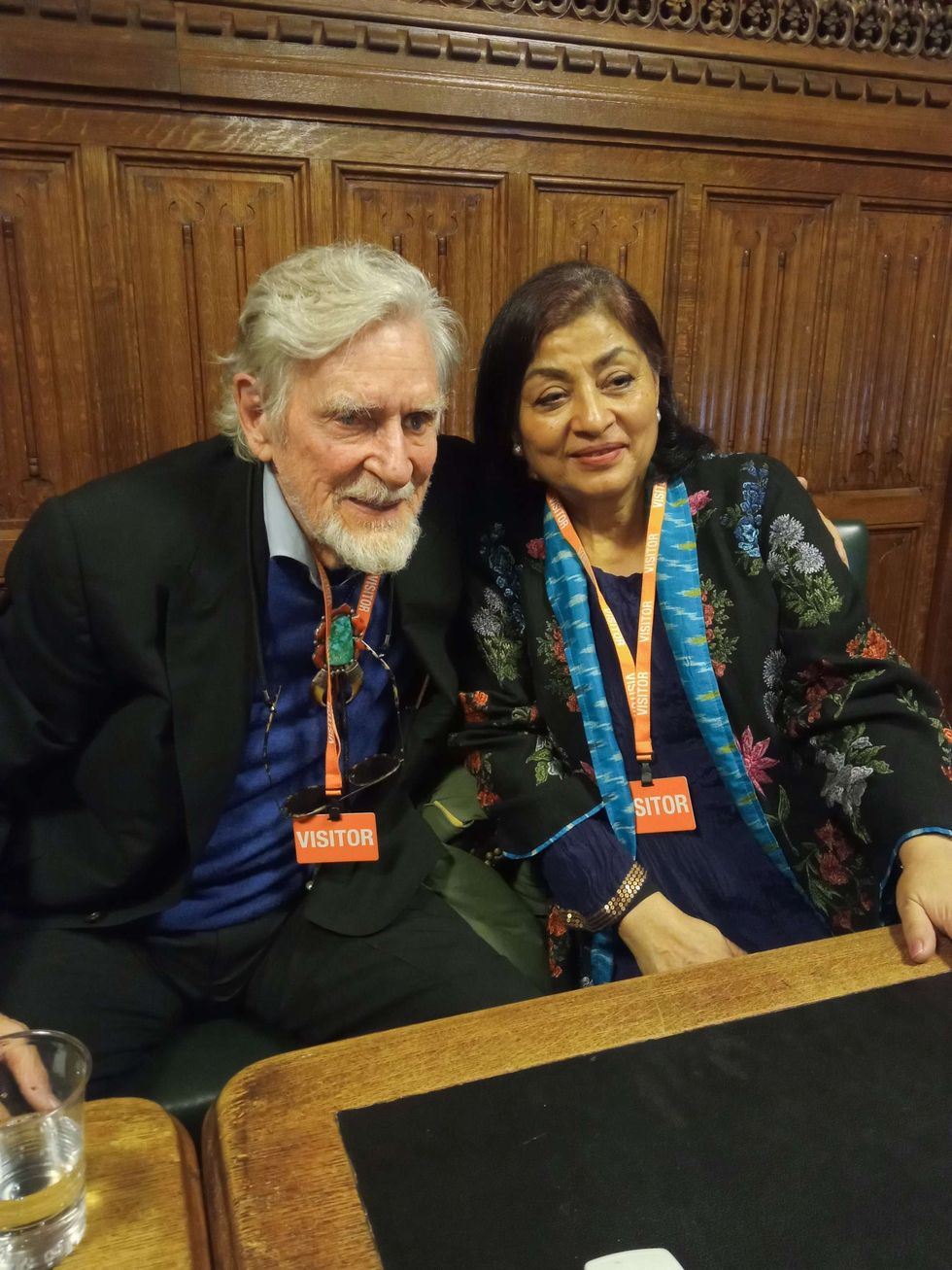 Robert Thurman and Lady Mohini Kent Noon
The Dalai Lama said, happiness is the answer to all ills. Her laughter enters the room even before that. When we hosted lunch for him in London in 2015, he recounted how, as a boy, he had tried bunking class. His teachers were confused: how to discipline the Dalai Lama, even though he was only a seven-year-old boy? “They made a whip out of yellow silk. It was a holy whip, but I felt holy pain!” His Holiness roared with laughter.
The Dalai Lama is the embodiment of Avalokiteshvara, the Bodhisattva of Compassion: “If you want to be happy, be kind. If you want to make others happy, be kind.” I used to travel from London to Delhi every March to attend his 3-day sermons until they stopped just before the pandemic. I will never forget an incident that he narrated in one of those sermons. One of his followers managed to reach him in Dharamshala after years of imprisonment and torture in a Chinese prison. “Were you scared?” His Holiness asked him. “Yes.” The answer came. “I was afraid I would be hated by the Chinese.” Such a level of commitment to nonviolence is, even in thought, unimaginable. The Dalai Lama emphasizes that no matter how much suffering others cause us, we should not add to it by tormenting ourselves out of anger and vindictiveness, which will destroy our health and well-being.
Amitabh Mathur was in-charge of Tibetan affairs appointed by the Government of India. His first meeting with the Dalai Lama was in Paris in 1989 when he was on his way to receive the Nobel Peace Prize. “The Dalai Lama has worldwide moral stature beyond national boundaries. After 60 years in exile his followers have only grown, the community has not disintegrated. His followers inside Tibet have also increased and about 200 Tibetans have committed self-immolation demanding the return of the Dalai Lama. Thinking about after 14th The World of the Dalai Lama While the next Dalai Lama will inherit devotion and loyalty, it will be difficult to match the stature of the great fourteenth.
The biggest tribute to him is China’s acknowledgment that controlling the institution of the Dalai Lama is necessary for peace in Tibet. That means whatever effort he made in the last 60 years was unsuccessful. It is an admission of failure that they have no legitimacy in Tibet unless they have their own Dalai Lama. Chinese attempts to take over the institution of the Dalai Lama will not succeed because of the moral stature of this 14th Dalai Lama. This is his strength. This power is much greater than the power of armies.”
<a href=