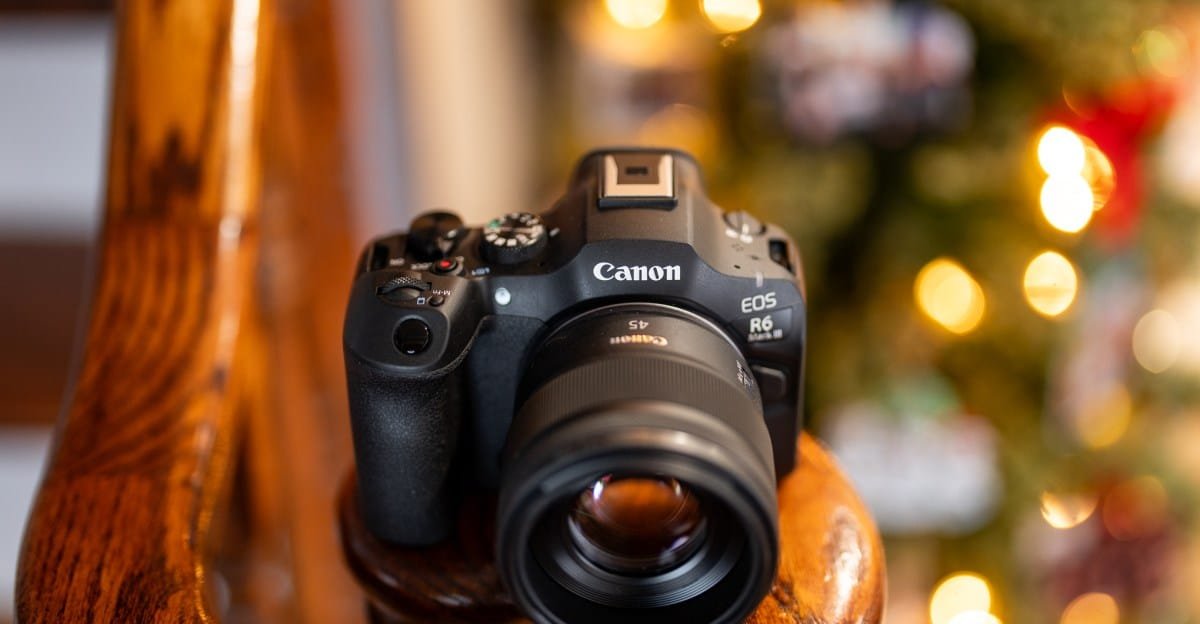
Canon’s new EOS R6 Mark III is a great camera. It’s not a groundbreaking upgrade to the 3-year-old R6 Mark II, but it takes the same body with great ergonomics and adds more resolution, video that now goes up to 7K with open-gate filming, and improved autofocus performance. If you need an extremely good all-around camera for anything from wildlife photography to weddings and videography, you can’t go wrong. This is an easy recommendation, especially if you already shoot Canon and are about to upgrade. (But if the high price of $2,799.99 is too steep, a used R6 Mark II is also very attractive.)
But the lens that Canon has launched with this camera? This is something special. As a lover of fast-aperture glass, I’m completely obsessed with it. And it’s everything I want to see more of in the world of lenses.
The RF 45mm f/1.2 STM lens is a rare breed. It costs $469.99 – an unheard of price in the photo/video world for an f/1.2 maximum aperture. This kind of price for such a fast lens is usually reserved for manual focus lenses from lesser-known third parties like Rokinon or Miike. Canon is notorious for not allowing third-party manufacturers to make lenses for its full-frame RF mount, so it has created some artificial scarcity of its own that makes its new 45mm all the more unique. Canon’s own RF 50mm f/1.2 L USM lens costs an eye-watering $2,600. And even a cheap Sigma 50mm f/1.2 DG DN lens for other Sony and L-mount systems costs over $1,500. Pricing under $500 makes fast-aperture lenses like Canon’s 45mm accessible to more than just professionals and enthusiasts with deep pockets.
But the 45mm f/1.2 isn’t just cheap, it’s a great lens. It’s very compact for a full-frame glass with such a wide aperture, making it a perfect everyday combo with an R6 or smaller R8 body. This is not a “Pro” lens like Canon’s L models, so it lacks weather sealing. And a lens hood for added protection and flare prevention costs an extra $59. But I would never expect weather resistance on a full-frame lens at this price, and I personally wouldn’t bother with a hood – keeping this package as compact and grab-and-go as possible. As someone who often resorts to the larger and heavier Sony FE 50mm f/1.2 GM lens (weighing 778 grams / 1.72 pounds) even at occasional family events and social gatherings, I’m absolutely envious of this little Canon. It weighs almost a full pound less than my lens, and is much less bulky.
1,29
Is the 45mm f/1.2 optically equivalent to the world’s larger, pro-focused f/1.2 lenses? No, not at all. But its “good enough” level of image quality and the looks it can capture are so enjoyable that I don’t want to care about its technical shortcomings. The RF 45mm is all about its wide aperture look, with extremely shallow depth of field and lots of background blur (often referred to by the Japanese term “bokeh”) behind close subjects. It’s quite sharp at its wide-open f/1.2 in the center of the frame. It does get a little grainy in the corners of the frame, but it’s worth it for the price. And you’re likely to place your subjects (for example, close-up portraits of people) near the lens’ sweet spot in the center anyway, so most of the focus will be on the sharpest part of the frame.
This is not a “dreamy” lens, or full of “character” – which are photo nerd code words for soft lenses. I’ve kept the aperture set at f/1.2 almost all the time I’ve been using the 45mm and have rarely been disappointed by its rendering. If I had a Canon system, this lens would be my default choice for everyday life scenes. Hey, if Canon made this lens into a compact camera like the Fujifilm (Bring back the canonette, coward!)
Comparison photos with Sony FE 50mm f/1.2 GM:
1,14
Of course the RF 45mm is not without its flaws. Its biggest drawback is creating artifacts in high-contrast areas, where you see purple or green casts in front and behind the focus point. This is a common problem in lower priced lenses with larger apertures, called longitudinal chromatic aberration (often called “LoCa”). And you can get a lot of it in 45mm, especially if you like shooting holiday string lights this time of year. It’s distracting and extremely annoying, especially when pixel-peeping, but for an f/1.2 of this size and price I can handle it.
I will admit that I am kind of fond of this lens. I like fast primes and good values. While it’s amazing how good most lenses from Canon, Sony, Nikon, Fujifilm, etc. are these days, their prices keep rising as they reach new levels of image quality and autofocus performance. We need more lenses like the RF 45mm f/1.2: very fast, affordable Primes that are compact enough to take almost anywhere. It compromises on image quality, but they are perfect for a look and experience that you can’t get anywhere else at this price.
Photography Antonio G. By Di Benedetto/The Verge
<a href