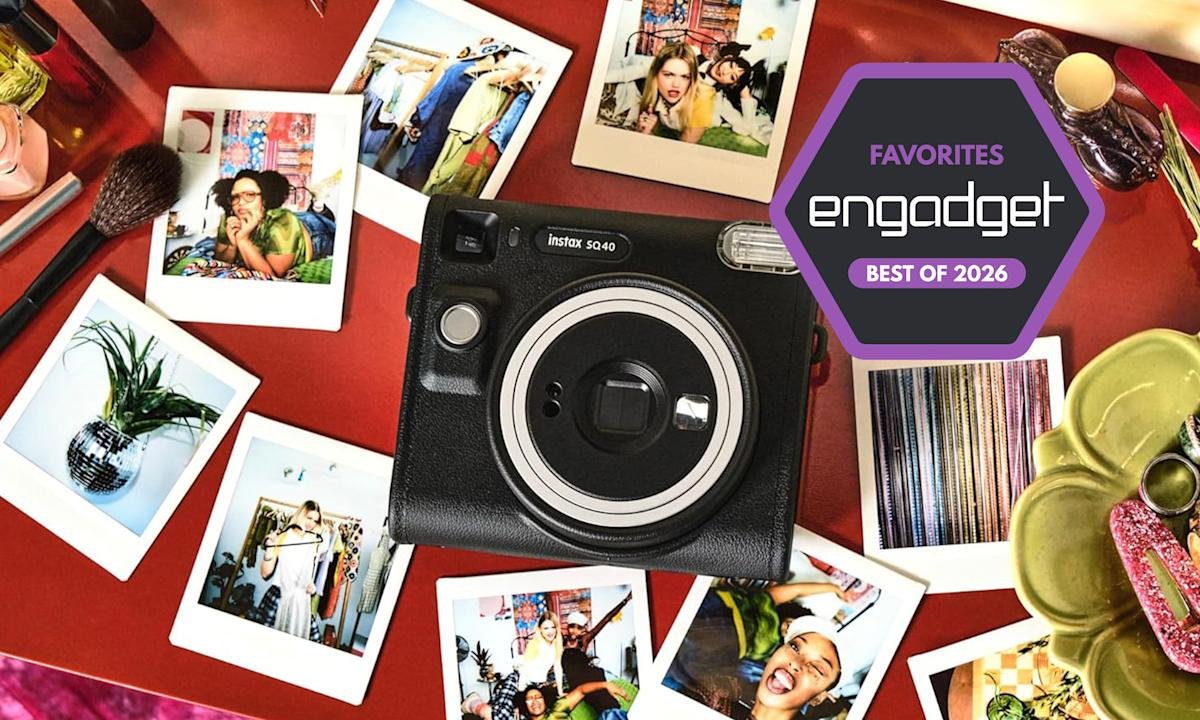
Instant cameras have become a popular category for a simple reason: They’re fun. You can go to a party or event and take a photo, then after a few minutes you’ll have a real, physical, instant photo that everyone can touch, feel, and enjoy instead of staring at a screen. It’s much nicer than a smartphone shot because of the retro, nostalgic vibes of analog photography.
Given the large number of camera brands on the market, it can be difficult to choose one. That’s why we’ve put together this buying guide that will help you choose the best instant camera for you based on price, instant film size, photo quality, and other factors.
Best instant cameras for 2026
Fujifilm
wireless connectivity: bluetooth | Camera Weight: 436 grams (without battery, strap and film)
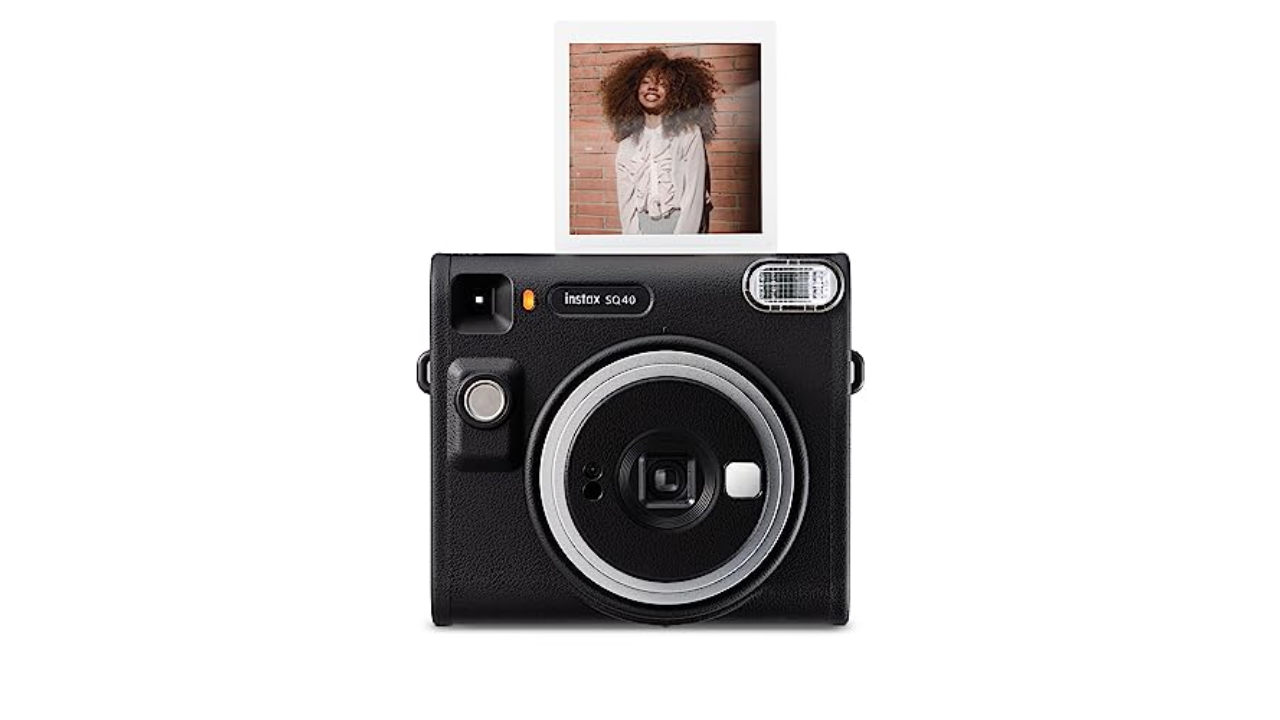
The best instant camera is the Fujifilm Instax Square SQ40. It looks great thanks to the leather details and retro design, while offering minimal controls for ease of use. It features a 3.39 x 2.83-inch Instax Square print that totally gives off retro vibes. You also get a flash, selfie mirror, front shutter release and hand strap, plus it’s relatively lightweight and easy to carry. The camera alone costs $150, but you’ll need to budget for film as well.
$206 on Amazon
Fujifilm
wireless connectivity: bluetooth | Camera Weight: 306 grams (without battery, strap and film)
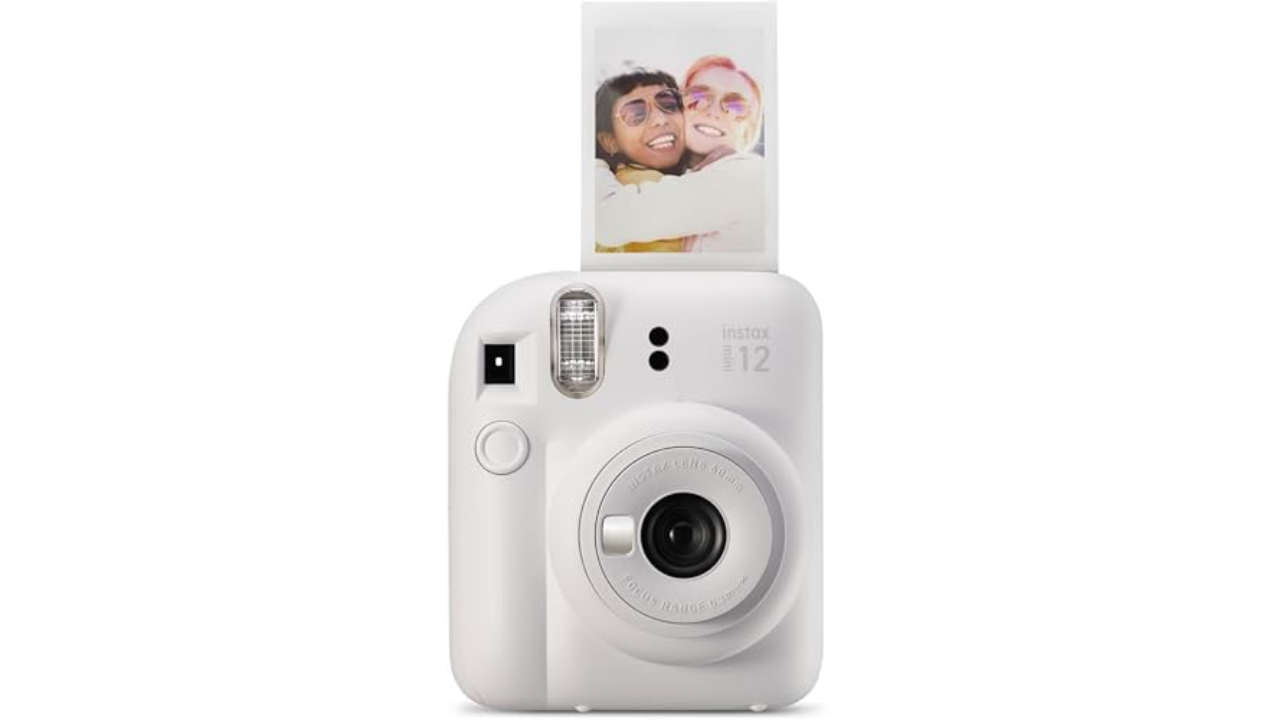
If you want to spend less on both camera and film, take a look at Fujifilm’s Instax Mini 12. It’s an ideal instant camera for beginners that lets you start shooting in just minutes. The controls couldn’t be simpler, as you just need to twist the lens to the “on” or “off” position. It’s also small and slim, so it can be carried in a pocket and fits well in the small hands of budding young photographers.
$93 on Amazon

Fujifilm
wireless connectivity: bluetooth | Camera Weight: 12 ounces (without battery, strap and film)
While the Instax Mini 12 is cheap and attractive, the Instax Mini 99 offers far more controls and features. The best feature is the four colored LEDs inside the camera that can be enabled to produce “looks” such as “fade green” and “light leak” in the camera, which creates a glow simulating a broken camera. Plus, unlike other models, you can turn the flash off completely for a more natural look. Other good features are the rear display and sports mode, the one downside of which is the lack of selfie mirror.
$208 on Amazon

Polaroid
wireless connectivity: bluetooth | Camera Weight: 240g (without battery and film)
The Polaroid Go may be basic and relatively cheap, but it offers a lot. You get a self-timer and double-exposure mode, as well as Polaroid’s Square Go format film that brings back memories. It is also quite small and lightweight, making it an easy option to carry with you on any occasion. The main drawback is the autofocus, which produces blurry results unless you’re far away from the subject.
$106 on Amazon
Polaroid
wireless connectivity: bluetooth | Camera Weight: 451.5g (without film)
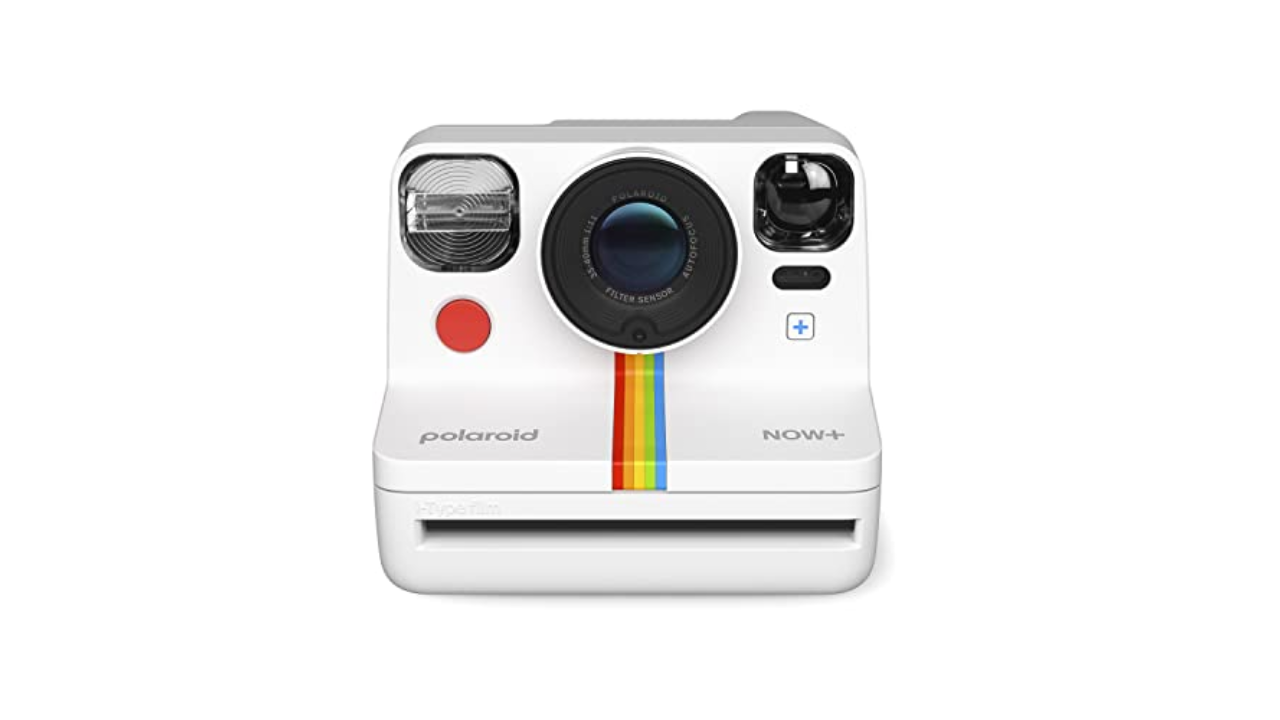
Polaroid is a name that’s synonymous with instant cameras, and its Now+ model is the best choice for big film. Although the prints are a bit smaller than those produced by Fujifilm’s Instax Wide 400, I prefer the square format that evokes old-school Polaroid photos. It also offers a number of features like an updated app with creative shooting modes that include manual mode, a self-timer, double exposure, light painting, and an aperture priority option for depth of field.
Although the second generation model occasionally had exposure issues, the new model has largely rectified this and added a tripod mount to the boot along with some new colors. The main downside is the relatively high price of Polaroid’s i-Type film.
$83 on Amazon
Fujifilm
wireless connectivity: bluetooth | Camera Weight: 616 grams (without battery, strap, film cartridge and close-up lens)
For the largest print possible (as long as you don’t mind the rectangular format), Fujifilm’s new Instax Wide 400 is your best option. It offers simple operation with one-button, fully automatic shooting, along with a new close focus option to add tight shots to your repertoire. The main downside is the lack of hybrid options, but the fact that it’s relatively basic helps keep the price low. The film is also much cheaper than Polaroid’s I-Type.
$150 at B&H Photo

Polaroid
wireless connectivity: bluetooth | Camera Weight: 30.4 ounces (without battery and film)
In 2025, Polaroid introduced the Flip, its most advanced modern instant camera to date. Despite being expensive compared to other models, it has some serious photography features. They include a sonar autofocus and a hyperfocal four-lens system that improves sharpness, as well as a large powerful flash that can vary the brightness to nail exposure. It has a (very) colorful, retro compact design that closes for storage and to protect the lens. It uses Kodak’s larger (but more expensive) I-Type film, so it produces beautiful, shareable prints.
$200 on Amazon
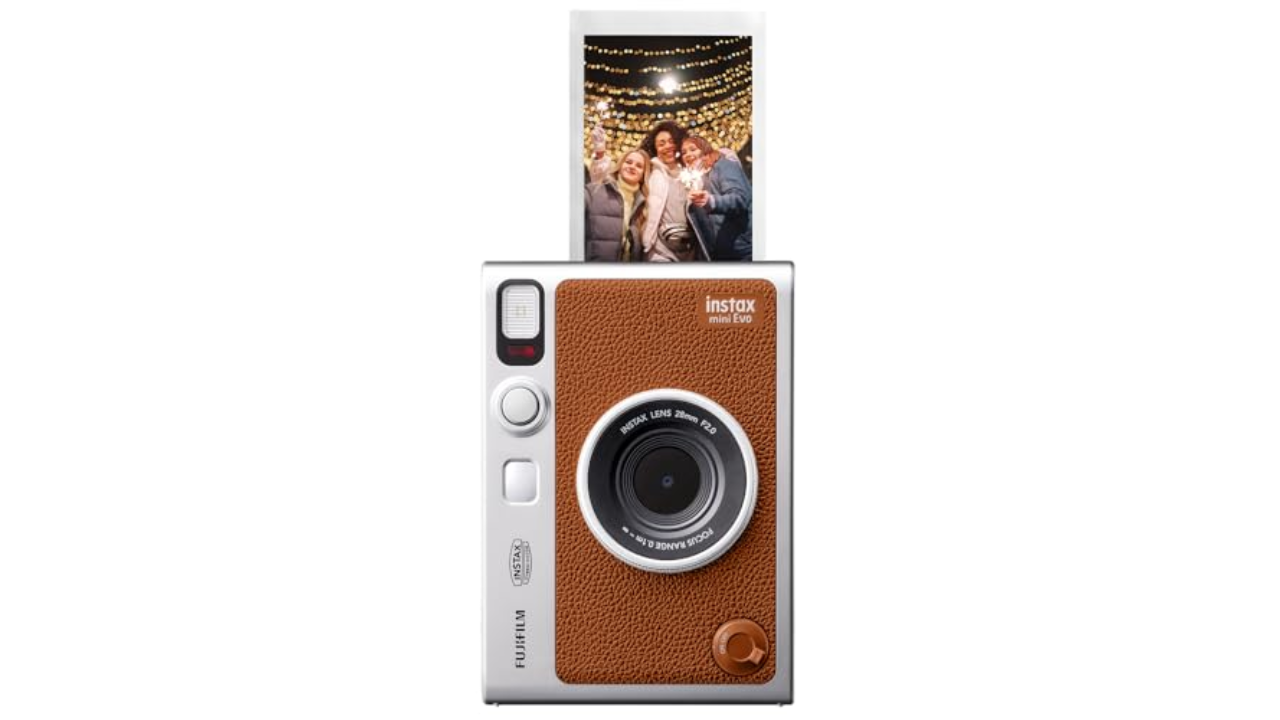
Fujifilm
wireless connectivity: bluetooth | Camera Weight: 285 grams
For the next most full-featured instant camera, look no further than Fujifilm’s Instax Mini Evo. It matches the age-old fascination of instant photography with digital shooting, giving you the ability to preview shots on the three-inch rear display and print only the ones you want. Another cool trick is that it can act as a printer for your smartphone photos.
Design-wise, it matches the aesthetics of sleek digital cameras like Fujifilm’s X100 VI, and is significantly more compact than other Instax models. And like the X-series cameras, you have the ability to apply multiple simulations and effects to prints. The downside is that it is more complicated to operate than other instant cameras, but its versatility will appeal to many buyers.
$234 on Amazon
lomography
wireless connectivity: Nobody Camera Weight: 725.7 grams
If you’re very particular about your instant photography, Lomography’s Lomo’Instant Wide Glass is the perfect model for you. It has perhaps the best lens of any instant camera with a 90mm multi-coated glass model that produces very sharp photos. It comes with a number of advanced features, including exposure compensation controls, a built-in flash, multiple exposure capability, a manual focus lens, a sync socket for an external flash, a selfie mirror, and the ability to add optional wide-angle and macro conversion lenses. The main disadvantages are its large size and relatively high price.
$169 at Lomography
leica
wireless connectivity: bluetooth | Camera Weight: 320g (without battery and film)
If the canapé table at your typical gathering consists of caviar blinis and quail egg tartines, your instant camera of choice may be the Sofort 2 from Leica. It is a point-and-shoot model with a 28mm equivalent f/2.0 lens that shoots mini-sized Sofort film (or Fuji’s Instax film). Although the features aren’t very impressive for a $400 instant camera, Leica has improved the social aspect with the ability to capture digital images to a microSD card, view them on a three-inch LCD display, and then share them with friends using Leica’s Photo app. It doesn’t take the best photos of any instant camera, though it offers great battery life and good portability. However, the main reason to get this model is the Leica brand and the red dot. This lets others know that you may be taking light-hearted photos, but you definitely know what you’re doing.
$399 at B&H Photo
Fujifilm
If you have an instant camera that can save images to a memory card, an instant printer lets you share favorite photos with friends and family. The best of them is Fujifilm’s Instax Link Wide printer. It’s portable and prints instantly with true colors, plus photos last forever. It is also very economical.
$182 on Amazon
Canon
Canon has a fun photo printer experience with the Ivy 2 printer. It uses special photo paper (that’s a sticker, too!) so it never requires ink and allows you to print photos with graphics and funky borders. Also, it is easy to install, reliable, very portable and economical.
$110 on Amazon
What to consider before purchasing an instant camera?
The main factor for most people is the size of the film. When most people think of retro instant cameras, they think of the square image shape. This is why Instagram, which used to have a Polaroid-like app icon, only supported square images for years. If that’s what you’re after, Fuji’s Square or Polaroid formats are best.
However, if you want the largest image possible, Fujifilm’s Instax Wide is the way to go. For those who prefer a smaller size to pin on their fridge or slip into an envelope (or inexpensive film), Fujifilm’s Instax Mini or Polaroid’s Go format are best.
With that in mind, here are the options. Fujifilm’s Instax alone offers three formats: Mini, Square, and Wide, with film sizes of 3.4 x 2.1 inches, 3.4 x 2.8 inches, and 3.4 x 4.3 inches. The corresponding image sizes are 2.44 x 1.81 inches, 2.44 x 2.44 inches, and 2.44 x 3.9 inches.
Leica’s Sofort 2 and Lomography models also use Fujifilm’s Mini format, while Polaroid’s smaller Go format is 2.64 x 2.13 inches (1.81 x 1.83-inch image) and has an i-Type size of 3.46 x 4.21 inches, with a square image size of 3.11 x 3.11 inches.
As far as prices go, Fujifilm’s Instax films typically range from $1 – $1.20 per shot for square or wide color film and $.60 – $.75 for mini color film. Prices go up slightly if you choose custom models with colorful or patterned borders, and go down if you buy in bulk. Polaroid’s I-Type film costs a little more, about $2.00 per shot, or $1.00 – $1.35 per shot for Go Color film.
Image quality is not really important in the case of instant cameras, as they will always be blurry compared to digital photos. However, some models (notably the Fujifilm and Polaroid models) are a little better than others.
And in terms of price of cameras, models with larger film are generally more expensive. This increases even more if you add hybrid features like USB-C connectivity, smartphone sharing, the ability to print photos, and more, along with niceties like a selfie mirror. The best, most feature-packed cameras can cost more than $200, and basic versions can cost less than $100.
<a href