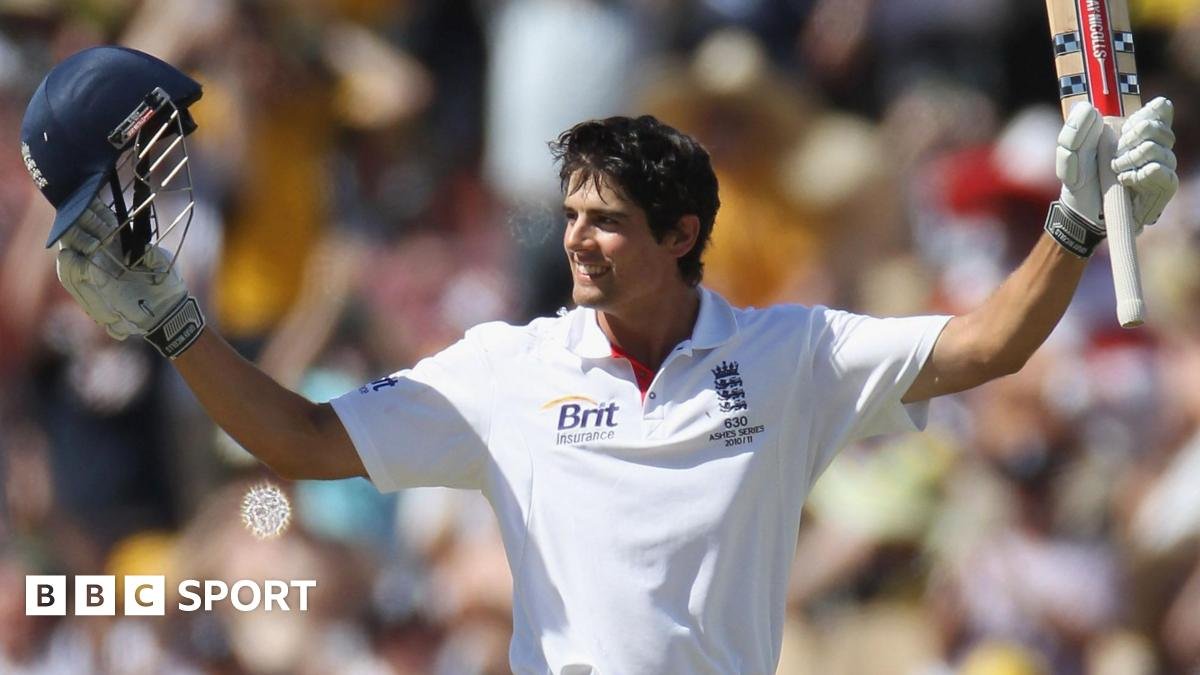
What happened next was perhaps England’s greatest day of Ashes cricket in Australia.
At the Melbourne Cricket Ground, the 100,000-seat cathedral of Australian sport, and on Boxing Day, the highlight of the calendar in this country, the home team was bowled out for 98. England – Cook and Strauss – were 157–0 at the end.
Cook says, “If Carlsberg did Boxing Days, this was it. There was disbelief at the end of the day.” “Me and Strauss cleaned up the MCG with our batting – when we were batting together most people wanted to go home.
“The Australians are very proud of how many people they can get to the MCG on Boxing Day. By the end there were only 20,000 English people watching me and Strauss grinding around Melbourne.
“If I could go back in my career and play again one day, it would be perfect because of what we did as a group.”
Trott scored 168 and England won by an innings and 157 runs. They celebrated retaining the Ashes with a sprinkler dance on the MCG outfield.
“I felt a little uncomfortable doing it, because we didn’t go there to retain the Ashes – we went there to win it,” says Cook.
“I enjoyed the dressing room in Melbourne and some of the boys went out and enjoyed a night with the Barmy Army, but we weren’t finished yet.
“A 2-2 result would have felt a bit unfair. No matter how good Melbourne was, we still had Sydney.”
Focusing on winning the Vase, Cook was at it again at the Sydney Cricket Ground. His 189 took England to 644, their highest score in a Test in Australia.
The question was not whether England would win the match and the Ashes, but when.
“On the fourth evening, Chris Tremlett dismissed Brad Haddin and brought Mitchell Johnson to the wicket,” says Cook.
“The song the Barmy Army sang, I never heard anything like it. I spoke to the Tremors and they said, ‘I’ll bowl it as fast as I can.’ He bowled a perfect jaffa to Johnson and he bowled him out. I never heard a noise like that.”
England took half an hour of extra time on that fourth evening, but could not achieve the target.
There was a victory procession on the fifth morning. The Barmy Army and the rest of the traveling supporters were joined at the SCG by every ex-pat and backpacker in Sydney for the English Ashes party.
“The atmosphere was incredible,” says Cook. “It felt like an age had passed, I was desperate to take the last wicket.
“When Tremlett got Michael Beer out to win the match, it was a moment of immense joy, absolutely unbelievable.
“It was so early in the day, we had plenty of time to soak it up. I don’t know when we came off the field, but we stayed in the outfield and the changing rooms for quite a while. It was very, very special.”
Cook was the player of the series. The remaining seven years of his Test career were highlighted by other milestones: stellar performances in the 2012 series win in India, winning the Ashes as captain in 2015 and breaking England’s records for most Test runs and centuries.
There were also disappointing moments, most notably the embarrassing 5–0 defeat in Australia in 2013–14 when he was captain.
Following his international retirement in 2018, Cook was knighted for services to cricket. That service was best provided on the 2010–11 tour of Australia.
“I couldn’t have played better,” he says. “I was very fortunate to be part of a team that achieved something rare for England in Australia.
“When you win a game of cricket, it’s incredibly special. It was hard work, but the international game is hard work.”
“It was a cool team to be a part of. Flowers and Strauss were tough, and that regime was very controlling, but we had the best time of our lives there.”
<a href