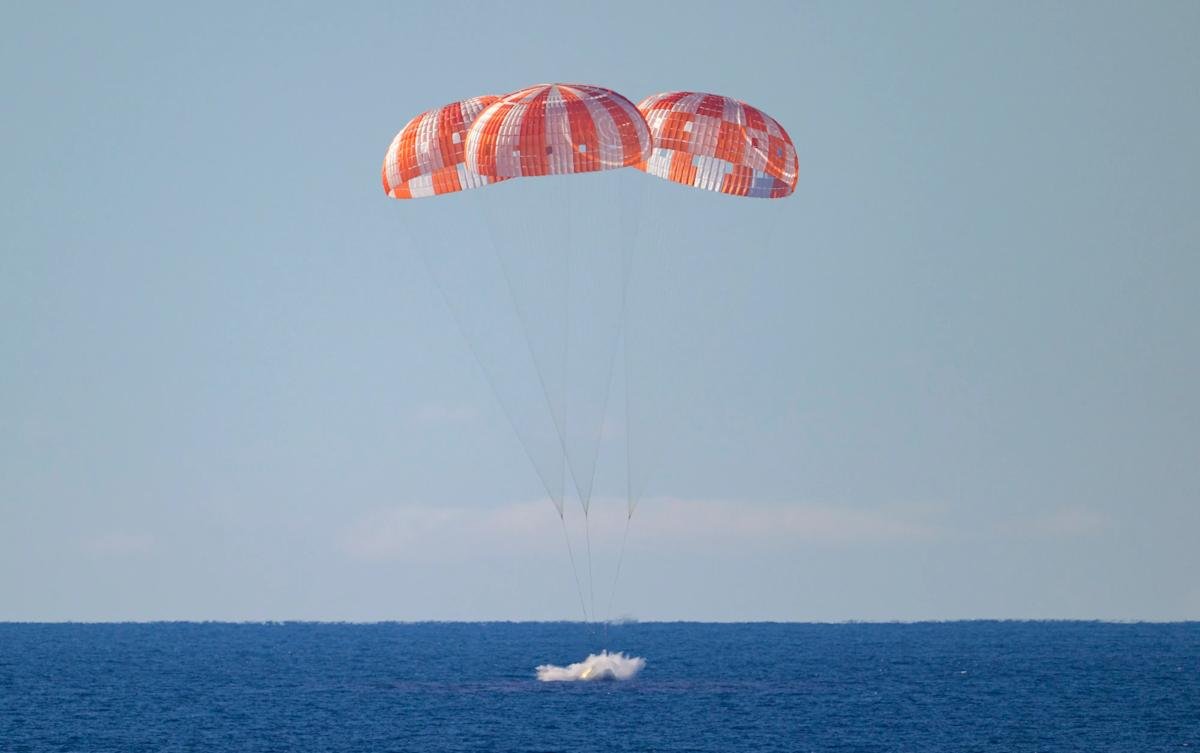
The Orion capsule carrying Artemis II astronauts has successfully landed off the coast of San Diego on April 10 at 8:07 pm Eastern Time. This marks the conclusion of Artemis II’s 10-day journey around the Moon, meant to be a test flight for a future mission that will return humanity to the lunar surface. The Orion crew module, carrying the mission’s astronauts, separated from the service module at 7:33 p.m. While the service module was designed to burn up in Earth’s atmosphere, the crew capsule was built to return astronauts home safely.
By 7:53 p.m., Orion reached our planet’s upper atmosphere, where overheating caused a six-minute communications blackout as the capsule began its guided descent. The capsule has 11 parachutes, with its drogue parachute deployed at 23,400 feet to stabilize and decelerate. When Orion reached 5,400 feet above the ground, the drogue parachutes were disconnected so that the three main parachutes could be deployed. This reduced the capsule’s velocity to 200 feet per second, allowing safe splashdown.
While the capsule was in the water, NASA engineers conducted a series of tests before recovery teams headed to the capsule on inflatable boats to extract the crew from Orion. By 9:34 pm all four crew members were out of the capsule. They were then loaded into helicopters and flown to the USS John P. Murtha dock ship, where doctors would assess their health.
Artemis II launched on April 1 with four astronauts: NASA’s Reed Wiseman, Victor Glover and Christina Koch, as well as the Canadian Space Agency’s Jeremy Hansen. They traveled around the Moon for about 10 days, a distance that no other crewed mission had reached before. Astronauts took photos of the far side of the Moon, the side we don’t see from our planet, including amazing close-ups of the lunar surface, using their smartphones. This makes him the first human to see the far side of the Moon directly and in person.
During NASA’s post-splashdown news conference, the agency said it would soon announce the Artemis III crew. Artemis III will rendezvous in low Earth orbit with one or both of the commercial landers being developed by SpaceX and Blue Origin, which will carry humans to the lunar surface. It will test the lander’s ability to rendezvous with Orion before NASA can land humans on the Moon again.
<a href