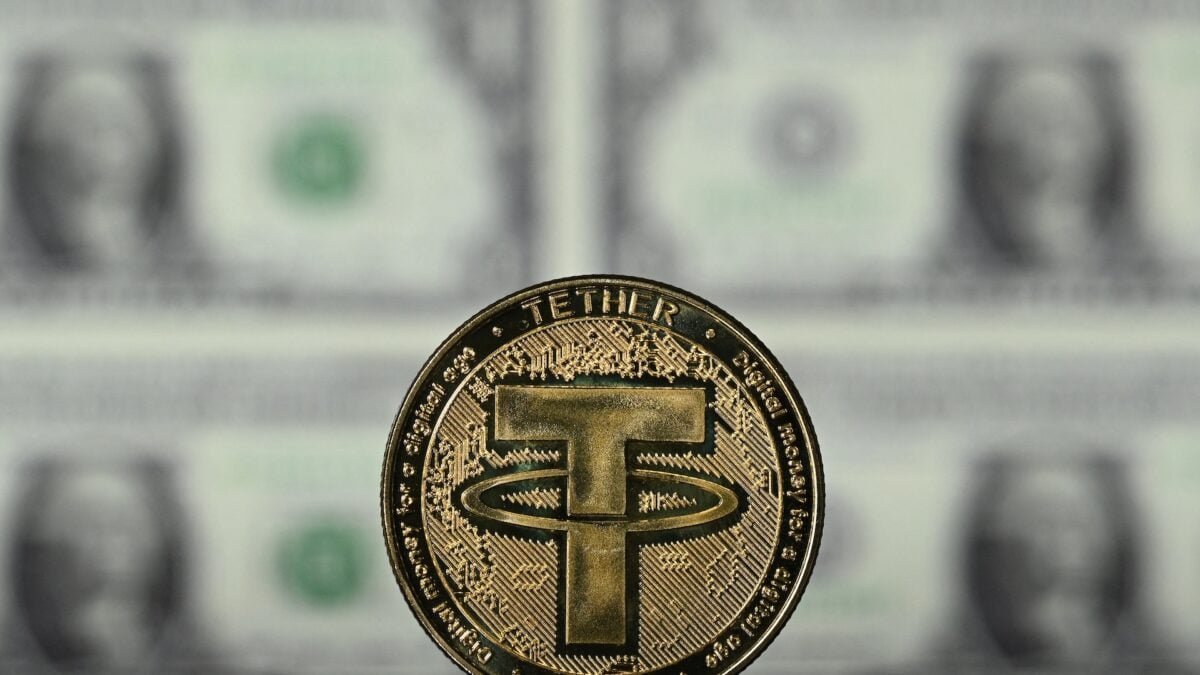

In a company blog post, Tether called the upcoming review the largest inaugural financial audit in the history of the financial markets. The effort covers the company’s mix of digital assets, traditional holdings, and tokenized liabilities on a scale comparable to major sovereign institutions. Tether positioned the audit as one element of a broader effort to secure trust in USDT through stronger transparency measures, compliance programs, and law enforcement partnerships.
Notably, a report from blockchain analytics company Chainalysis found that 2025 was the biggest year on record for illicit activity in crypto at an estimated $154 billion. Stablecoins have become a big part of these activities, with their respective share of the total pie estimated at 84%. Nation-states such as Iran and Venezuela are said to have used USDT in particular to avoid sanctions; However, Tether is also using its ability to blacklist and freeze tokens to put a stop to these types of transfers.
Paolo Ardoino, CEO of Tether, said, “For the millions of people and businesses that rely on USD₮ every day, this audit is not just a compliance exercise; it is about accountability, resiliency, and trust in the infrastructure they depend on.”
Tether currently relies on quarterly verifications from accounting firm BDO. These provide snapshots confirming reserve support at specified dates but do not constitute a full financial statement audit. Circle follows the same verification model for its USDC stablecoin through monthly reports, often handled by firms like Grant Thornton or Deloitte.
As previously written by Protos, Tether has fielded audit plans several times over the years, including one failed attempt in 2017 after retaining Friedman LLP and another that ended with no such report after Tether’s then-general counsel Stuart Hoegner claimed it was “months away, not years.”
Stablecoin issuers have pointed to the hesitancy of major accounting firms over reputational risk and the heavy regulatory spotlight on crypto as the main obstacles to earlier audits.
Redemption of USDT tokens has been available to users throughout this time. However, in 2018, Tether made a loan to sister exchange Bitfinex to cover approximately $850 million in frozen funds, which the exchange can no longer access through third-party processors. This move made Tether technically bankrupt for some time. The New York Attorney General’s Office investigated, resulting in a 2021 settlement that required an $18.5 million fine, the halting of New York operations and ongoing quarterly transparency filings. The Commodity Futures Trading Commission also imposed a $41 million fine that year because Tether had overstated the extent of its US dollar backing.
Cantor Fitzgerald head Howard Lutnick later confirmed that his company holds US Treasuries for Tether and that the reserves remain intact. Lutnick faced criticism for these business relationships while serving in the Trump administration, which supported the GENIUS Act. The 2025 law set federal requirements for stablecoins to maintain one-to-one backing with Treasuries and deploy custodians like Cantor to manage those holdings. A recent Bloomberg report also revealed that to comply with federal ethics rules, Lutnick transferred his billion-dollar ownership stake in Cantor Fitzgerald last October to trusts benefiting his four children, one of which borrowed an undisclosed amount from Tether.
Tether originally held its reserves only in cash and short-term dollar equivalents. It later expanded into gold and Bitcoin positions and now counts among the largest global holders of physical gold, with approximately 148 tonnes worth approximately $23 billion. Last year, S&P Global cited the company’s growing reliance on Bitcoin holdings as a key reason for giving USDT a “weak” rating. S&P’s rating model may not be suitable for building a company at the top of a new global monetary system like Bitcoin, he said.
The relatively limited transparency over Tether’s operations has impacted the broader crypto market for years, as market observers have argued that any major failure at the company could lead to a black swan collapse of the entire industry. Expectations of such trouble were especially high during the deleveraging wave of 2022 and the FTX bankruptcy, yet USDT maintained its peg and market position. Whatever the accuracy of earlier warnings, the arrival of the Big Four audit is meant to reinforce confidence in the asset that is second only to Bitcoin in overall importance to crypto. Of course, if all of Tether’s claims prove to be true.
<a href