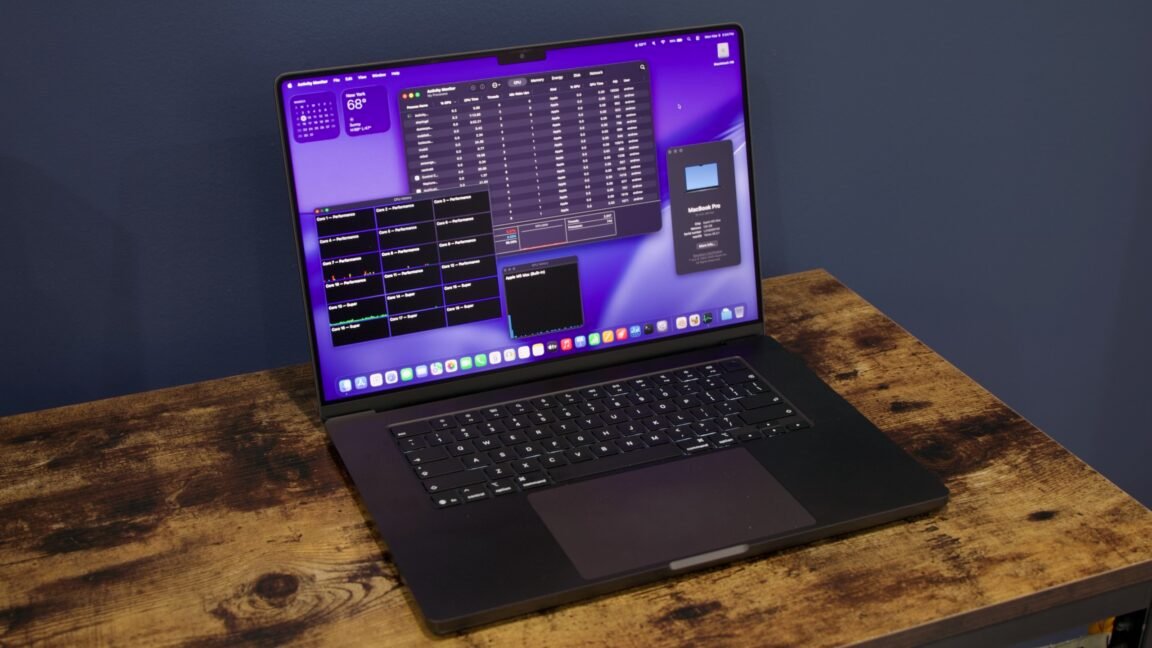
If you’re interested in a slightly more comprehensive review of the new MacBook Pro, I’d point you toward a review of the M1, M3, and M4 generation models, as well as a review of the lower-end 14-inch MacBook Pro with the standard M5 (now $100 more expensive than before, but with 1TB of base storage instead of 512GB).
Apple is using the same external design for these laptops that it’s been using since 2021 — it’s getting pretty dated, and we still mostly like it, especially compared to the Intel-era MacBook Pro. There’s not much else to say about the design that hasn’t already been said.
M5 Max benchmark
In our testing, the single-core performance of the fully capable M5 Max is about 10 percent higher than the fully capable version of the M4 Max in last year’s 16-inch MacBook Pro. Multi-core performance improvements are more variable (Cinebench R23, which shows a 30 percent improvement, appears to be an outlier), but most tests show even modest 10 or 12 percent improvements.
The improvement in graphics performance is slightly stronger, ranging between 20 to 35 percent depending on testing. Apple suggests you may see greater increases in GPU compute workloads that can take advantage of the neural accelerators Apple built into each M5-family GPU core.
The jump from the M4 Max to the M5 Max is not as large, expressed as a percentage, as it has been for the past few generations; Both the M3 Max and M4 Max were huge leaps forward from before. But assuming you’re upgrading from an M1 or M2-based Pro, you’ll still be making a big jump. Based on these results, fears that Apple’s best-performing CPU cores (in the M4 Max) will drop from 12 to six are also overstated.
Compared to the original M5 in the 14-inch MacBook Pro, the M5 Max’s single-core performance is nearly identical, which is in line with how Apple typically works — moving up to higher-end chips gets you better multi-core and graphics performance, but Apple doesn’t bump up the clock speeds on individual cores the way Intel or AMD do with their higher-end processors.
<a href