Drones in Ukraine and the war with Iran have made the Earth’s surface a contested place. The US has discovered that 1) air superiority and missile defense systems (thad, Patriot Batteries designed to counter tens or hundreds of aircraft and missiles are inadequate against asymmetric attacks from thousands of drones. and that 2) undefined high value fixed Civilian infrastructure – oil tankers, data centers, desalination plants, oil refineries, energy nodes, factories, etc. – are all at risk.
When the target is no longer just military assets Anything Valuable on the surface, the long-term math is no longer in the defender’s favor. To solve this problem, the US is spending $10 billion on low-cost counter-UAS systems – detection systems, cheap missiles, kamikaze drones, microwave and laser weapons.
But what we are not spending $10 billion on is learning how to cheaply and quickly keep our high-value, difficult-to-replace, and time-critical assets (materiel, fuel delivery, command and control continuity nodes, spares), etc. out of harm’s way – sheltered, underground (or in space).
Lessons learned from Gaza reinforce that underground systems can also protect forces and enable maneuver. The lesson from Ukraine is that survival during persistent drone observation/attack requires using underground facilities to provide overhead cover (while masking RF, infrared and other signatures). And lessons from Iran’s attacks on infrastructure Gulf Cooperation Council country is that Anything There is going to be a target on the surface.
We need to rethink the nature of force protection as well as the protection of military and civilian infrastructure.
For decades the US has built air defense systems designed to shoot down aircraft and missiles.navy’s aegis destroyer To provide protection for carrier strike groups using surface-to-air missiles against hostile aircraft and missiles. of army Patriot Anti-aircraft batteries provide area defense against aircraft and missiles. Missile Defense Agency (MDA) provides missile defense from North Korea for Guam and is leading the development of limited missile defense MDA for the U.S. golden domeA missile defense system to protect the entire United States from ballistic, cruise, and hypersonic missiles from China and Russia. All these systems were designed to shoot down equally expensive aircraft and missiles using expensive missiles. None of these systems were designed to shoot down hundreds/thousands of extremely low-cost drones.
After destroying Iraqi aircraft shelters with 2,000-pound bombs in the Gulf War, the US Air Force convinced itself that building aircraft and maintenance shelters was not worth the investment. Instead, his plan – Agile Combat Employment (ACE) Program – In wartime small teams had to be dispersed in remote difficult locations (with minimal air defense systems). Dispersion with air superiority would be an alternative to building rigid shelters. oops. It did not rely on low-cost drones finding those scattered planes. (Who would have thought that Ukraine’s operation spider web Using 117 drones smuggled in shipping containers – which attacked and destroyed Russian bombers – would have been a warning.)
The cost of not having hardened air shelters became apparent during the 2026 Iran war when Iran destroyed an AWACS aircraft and KC-135 tankers sitting in the open. Meanwhile, China, Iran and North Korea have invested extensively in hardened shelters and underground facilities.
protect ground forces
The problem of protecting soldiers with foxholes from artillery is hundreds of years old. In World War I, trenches added foxholes to the system. The bunkers were hardened against direct attack. Each step was a response to increased lethality from above. Today, drones are the new guns; A persistent, cheap and accurate overhead threat but with the ability to maneuver laterally, penetrate and rotate into open spaces. And massive drone attacks put every high-value military at risk And Civilian targets on the surface are at risk. Like building more rugged shelters for soldiers Army Modular Protection System Overhead Cover Shelter is the first step to FPV kamikaze drone defense, but drones can get inside buildings through any sufficiently sized opening.
drone security
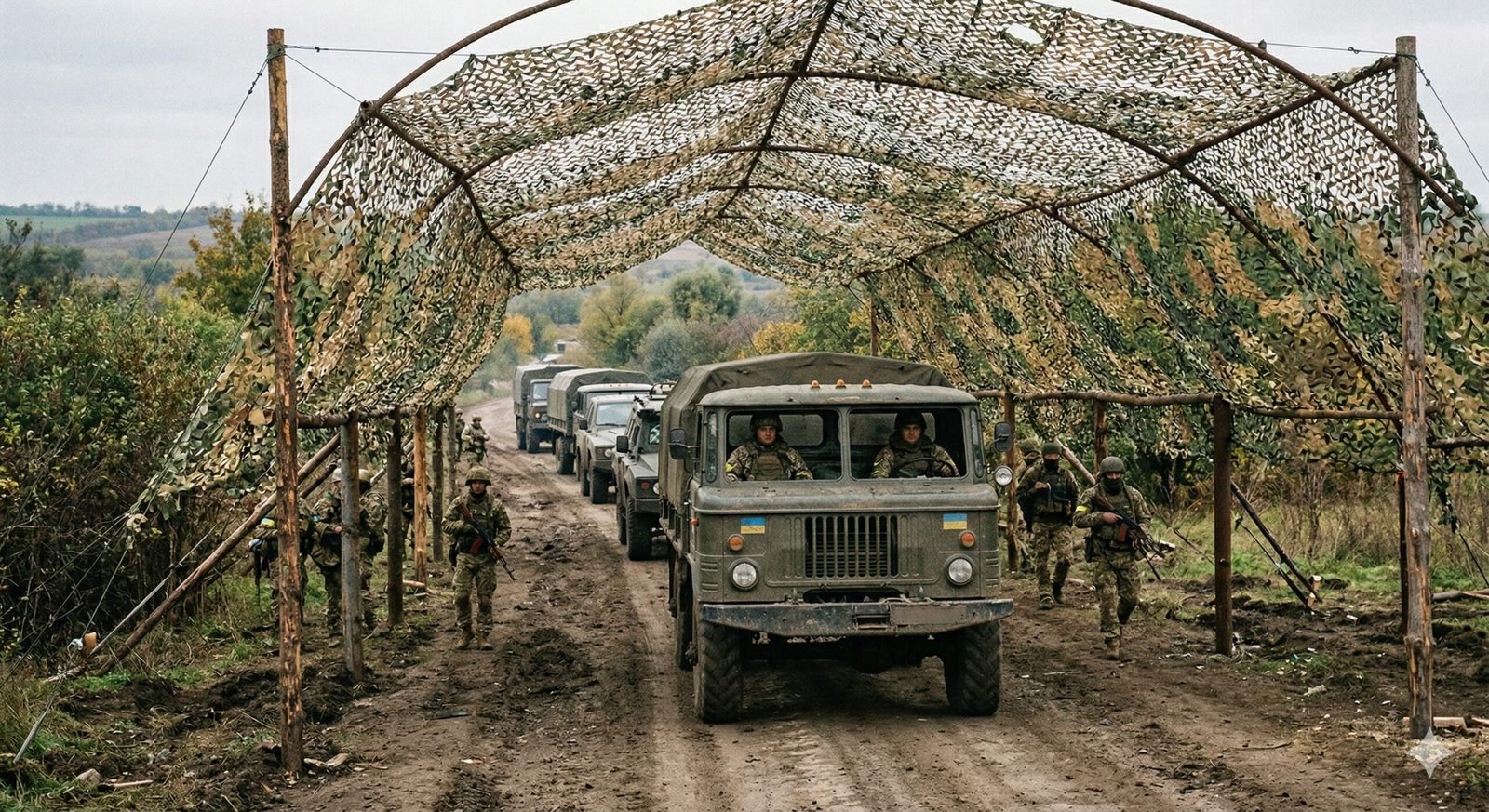
Ukraine has installed ~500 miles of anti-drone net tunnels, with a goal of 2,500 miles by the end of 2026. These are metal poles and fishing nets strung across roads but they represent the same trend: the surface is a killing zone, so cover it. Russia has also done the same.

The logical response is to go underground (or into space) but the technology to do this quickly, cheaply, and at scale is really new. The distinction in current thinking is between “laying down traps” (cheap, fast, limited) and “building Cold War concrete bunkers” (expensive, slow, permanent). The middle layer is missing – increasingly rugged shallow tunnels Which provide physical overhead cover for movement corridors, equipment parking and personnel protection.
What tunnels solve that traps and shelters cannot
A net blocks the propeller of the FPV drone. A shelter stops shrapnel. But a tunnel 15-30 feet down is invisible to ISR, immune to most top-attack weapons, cannot be entered by drones through a door or window, and is survivable by anything less than a bunker-buster. Gaza proved that despite total air superiority and ground control, Israel has destroyed only 40 percent of Gaza’s tunnels after two and a half years of war.
This is the benefit of an asymmetric defender that the US military should think about for its own use, not just to deter a threat.
The change that has been made to make this possible is that we will not need boring tunnels, but instead modular, pre-fabricated tunnel segments that can be installed by cut-and-cover methods at expeditionary bases. Or autonomous boring machines sized for military logistics (smaller versions of Boring Company TBMs) corridors rather than highway traffic.

The problem is lack of urgency and imagination
The problem is real, the incumbents (Army Corps of Engineers) are slow, and the existing commercial tunneling industry is not thinking of military applications anytime soon.
The theoretical difference is between “digging a hole with a strong tool” (individual soldier, hour) or deploying something Army Modular Protection System Overhead Cover Shelter or “Construction of a Cold War-ready aircraft shelter” (major construction project, year, billion). There is no theory for increasingly boring rigid underground movement corridors, dispersed equipment shelters, or protected command post positions using modern tunnel technology.
Army doctrine considers excavation as work done with organically engineered equipment – backhoes, bulldozers, soldiers with shovels – to create individual fighting positions and cut-and-cover bunkers. Air Force doctrine barely addresses physical toughness, having spent 30 years assuming that air superiority would be its substitute.
No one in the theoretical community is asking: What if the military could cut and cover 100-meter precast tunnel sections a day or if we could dig a 12-foot-diameter tunnel 30 feet underground at a rate of hundreds of meters per week and use it as a protected logistics corridor, command post, or aircraft emplacement?
Summary
Allies on both sides of the ocean and on our borders have lulled America into a false sense of security. After all, the United States has not fought a foreign power on American soil since 1812.
Security and survivability is no longer a problem for any one service, nor is it a problem of single solutions or incremental solutions. Something fundamentally disruptive has changed the nature of asymmetric warfare and there is no going back. While we are actively pursuing immediate solutions (Golden Dome, JTAF-401, etc.), we need to rethink the nature of force protection, and the security of military and civilian infrastructure. Security and survivability solutions are not as lucrative as buying aircraft or weapons systems, but they can be the key to winning the war.
America needs a coherent security and survivability strategy across the DoW and all sectors of our economy. This conversation should not only be about how we do it, but also about how we organize To do this, how do we Budget and Pay for It and how do we rapid deployment it.
lessons learned
- There is no coherent security and survivability strategy that addresses drones across the DoW and the country as a whole
- For troops near the front, tunnels can reduce visual, thermal, and RF signatures while providing piecemeal protection with a network of small, hidden, overhead-covered positions, short connectors, buried command posts, protected aid stations, and modified vehicle skins.
- We need to underground those assets that cannot be replaced quickly
- Command posts, com nodes, ammunition, fuel delivery points, repair facilities, major power systems, maintenance spares, and high-value aircraft or drones.
- Think protected taxiways, blast walls, covered trenches, buried cabling, alternate exits, redundant portals and rapid runway repairs. Sortie generation under attack depends not on a single bunker, but on the entire system.
- We need to work with commercial companies to strengthen/defend their sites
- Provide proactive protection and promotion for underground critical facilities
- Army and Air Force need to rethink their doctrines and techniques for security and survivability
- Army Technical Publication (ATP) 3-37.34 – In survival operations digging is done with soldiers with backhoes, bulldozers, shovels, to create individual fighting positions and cut-and-cover bunkers. Update it.
- The Air Force needs to do the same with AFDP 3-10, AFDP 3-0.1 (force protection and AFTTP 3-32.34v3AFH 10-222, Volume 14 and UFC 3-340-02
- We need to think holistically, not piecemeal, about force and infrastructure security
- Part of the requirement and budget for any weapon system must now include protection and survivability.
- Protection and survivability must be deployed along with weapon systems
- We need a whole of nation approach to the security and survivability of both forces and critical infrastructure
Filed under: National Security, Technological Innovation and Modern Warfare |
<a href