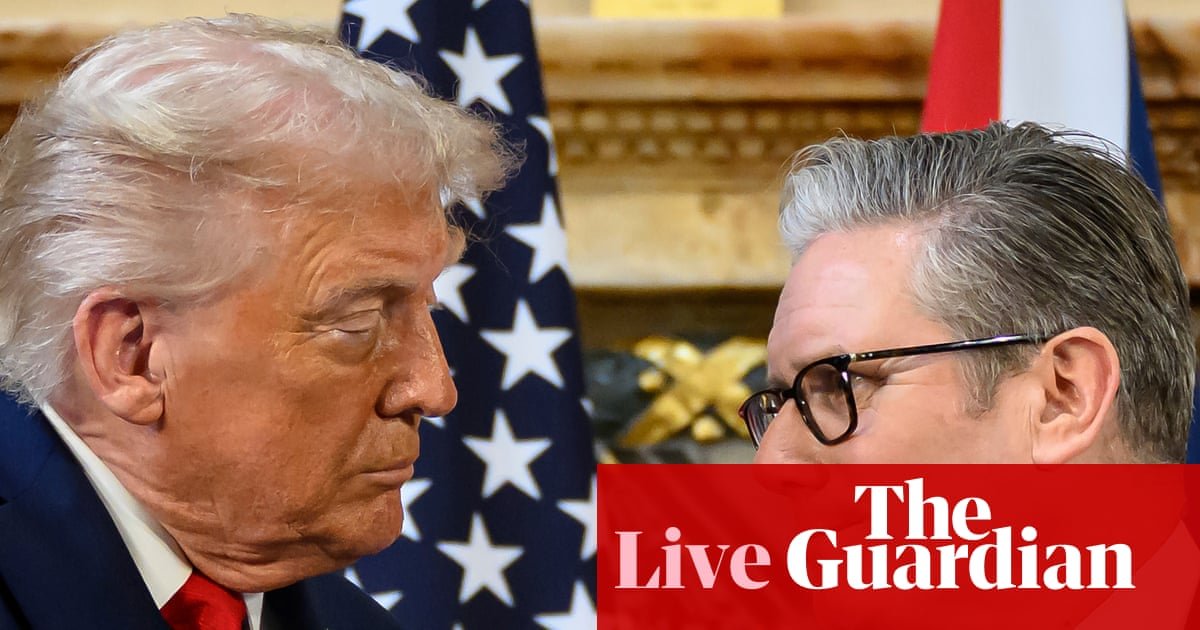
Starmer set to face first PMQs since US attack on Iran
Keir Starmer will face a Commons grilling over his decisions on the Middle East war after Donald Trump launched a personal attack against him over the refusal to allow initial US strikes on Iran from British bases.
In his latest broadside against the prime minister, the US president said on Tuesday he was “not happy with the UK” over the extent of its support and that “this is not Winston Churchill that we’re dealing with”.
Starmer had later on Sunday agreed to allow America to use British military bases, but only for “defensive” strikes on Iranian missile sites to protect countries being targeted by Tehran.
He is yet to respond personally to the president’s latest rebuke but will face MPs for Prime Minister’s Questions in about an hour’s time, when the conflict is likely to dominate the agenda.
Downing Street has insisted the US remains a “staunch” ally despite the remarks from Trump, who criticised the prime minister in interviews with the Telegraph and Sun newspapers.
PMQs is coming up in just under an hour’s time and I will be bringing you all the news lines that emerge. Stay tuned.

Richard Adams
The government has announced details of its review of antisemitism in England’s schools and colleges, with the Department for Education naming its former permanent secretary David Bell to lead the independent inquiry.
Bell, a former Ofsted chief inspector and currently vice-chancellor of the University of Sunderland, is to look at how schools and colleges “identify, respond to and prevent antisemitism,” and issue a report in autumn.
Bell said:
I will come at this review with an open and independent mind. I will review both policy and practice to ensure that everyone can learn free from prejudice and hate. I am also keen to know more about those institutions who are tacking antisemitism effectively so that lessons can be shared widely across the education system.
Bridget Phillipson, the education secretary for England, first announced the review in January after reports that a school in Bristol postponed a visit by a local MP, Dan Eggan, who is vice-chair of Labour Friends of Israel, following opposition from some members of staff and a pro-Palestine group.
A snap Ofsted inspection of the school, Bristol Brunel academy, found “no evidence of partisan political views” and said that the school’s curriculum and teaching were politically impartial.
The DfE said the review followed evidence that school-related antisemitic incidents have doubled since 2023. More than a fifth of British Jewish parents say their children have experienced antisemitism in or around their school.
The review will look at how schools and colleges handle incidents of antisemitism, as well as what they are doing to prevent antisemitism and the influence of external factors such as protests and international events.
The DfE said the review “will not look to blame, or place undue burdens on schools and colleges, but rather to identify areas for improvement in the prevention, identification and response to incidents of antisemitism.”

Lisa O’Carroll
Keir Starmer’s efforts to reset the UK’s relationship with the EU are lacking in “direction, definition and drive”, parliament’s foreign affairs committee has said.
A report based on months of expert witness testimony found the summit between the UK and the EU at Lancaster House last May had “substantially improved the overall political relationship” after years of Brussels-bashing by the Conservatives.
But it concluded the UK “lacks clear strategic priorities”, which in turn results in “the appearance that the EU has achieved more concrete progress towards their most pressing demands than the UK”.
Emily Thornberry, Labour MP and chair of the committee, said: “Sadly, we found that despite progress in some areas, the government’s reset is languishing, suffering from a lack of direction, definition and drive. It feels as though we are on a journey with no clear destination.
“In many areas, the government has failed to provide timelines, milestones or priorities, and it does not appear to have an ambitious, strategic vision for the UK’s new relationship with the EU.”
The report said that unless the government provides a structure and clear vision with goals, it will repeat “these mistakes” when it enters the second set of negotiations after a second bilateral summit due to be held in early July.
Starmer set to face first PMQs since US attack on Iran
Keir Starmer will face a Commons grilling over his decisions on the Middle East war after Donald Trump launched a personal attack against him over the refusal to allow initial US strikes on Iran from British bases.
In his latest broadside against the prime minister, the US president said on Tuesday he was “not happy with the UK” over the extent of its support and that “this is not Winston Churchill that we’re dealing with”.
Starmer had later on Sunday agreed to allow America to use British military bases, but only for “defensive” strikes on Iranian missile sites to protect countries being targeted by Tehran.
He is yet to respond personally to the president’s latest rebuke but will face MPs for Prime Minister’s Questions in about an hour’s time, when the conflict is likely to dominate the agenda.
Downing Street has insisted the US remains a “staunch” ally despite the remarks from Trump, who criticised the prime minister in interviews with the Telegraph and Sun newspapers.
PMQs is coming up in just under an hour’s time and I will be bringing you all the news lines that emerge. Stay tuned.
Meanwhile, Reform UK leader Nigel Farage has this morning been making the case for dragging Britain into another Middle Eastern conflict.
He suggested that Britain joining the US in its war on Iran was a different situation to the Iraq war.
Farage, who has criticised the UK joining the Iraq war alongside the US, told a central London press conference:
There are times to say no to the Americans, absolutely. We should have said no a couple of times in the last 25 years. Of course, because Saddam Hussein didn’t pose any direct threat to this country, they had to invent a threat.
I would argue in the case of Iran, since 7 October this country has fundamentally changed as a result of terrorism funded by Iran. Frankly, if this operation stops Iran getting a nuclear weapon, it would have been worth it. I believe that very, very strongly.
I’m really incredibly nervous about intervening in foreign wars, I believe it’s the right one.
Ex-Nato commander defends Starmer after Trump’s ‘no Winston Churchill’ jibe

Ben Quinn
Britain cannot become embroiled in a war “without a clear end point”, a former senior Nato commander has said, as he defended Keir Starmer after Donald Trump’s jibes that he was “not Winston Churchill”.
Trump was “another American president who had launched a war of choice,” said Gen Sir Richard Shirreff, as a minister insisted that the UK prime minister had acted “with a cool head” by not allowing British bases to be used for initial strikes.
The US president launched a deeply personal attack on Starmer over his refusal to let Washington launch initial strikes on Iran from British bases, telling reporters on Tuesday in the White House: “This is not Winston Churchill that we’re dealing with.”
Trump also said he was not happy with the UK even though Starmer eventually agreed the US could use the Diego Garcia military base in the Chagos Islands for strikes on Iranian missile facilities.
Shirreff, who was Nato’s deputy supreme allied commander Europe, was among those who supported Downing Street’s approach, saying: “Britain has to do what is right for Britain.
“There is absolutely a case for getting involved but it should not get involved in any shape or form with an operation where the end stage has not been made clear, there is not a clear strategy and yet again where we have an American president who has launched a war of choice with no clear understanding of how this thing is going to end,” he told BBC Radio 4’s Today programme.
“We have been here before with Iraq in 2004 and we don’t want to be going back again into a situation like that.”
A bit more now from chief secretary of the Treasury James Murray’s media round from this morning.
Speaking to Sky News, he said it was “early days” in terms of what is happening in the Middle East and that the government is “monitoring very closely” as he faced questions about the effect on oil and gas prices.
Asked whether he was worried, Murray said:
I can understand because people have been concerned about the cost of living for a long time, so when people see what they do on the news, they will wonder ‘what does this mean for us?’
He added:
What I would say to people is that it’s early days in terms of what’s happening in the Middle East.
We’re all very concerned about what’s happening and, as a government, we’re monitoring very closely, but it is early days, and in terms of how people will experience their energy bills in the immediate future, they will see that reduction come through via the price cap on 1 April.
UK puts emergency brake on study visas for four countries’ nationals

Nadeem Badshah
The government has imposed an emergency brake on visas for the first time on nationals from four countries, as Shabana Mahmood accused them of exploiting Britain’s generosity to claim asylum.
Study visas for nationals from Afghanistan, Cameroon, Myanmar and Sudan have been halted, in addition to work visas for Afghans.
The home secretary claimed a growing number of people from these countries were using legal migration routes as a back door to claim asylum in the UK.
Mahmood said on Tuesday: “Britain will always provide refuge to people fleeing war and persecution, but our visa system must not be abused.
“That is why I am taking the unprecedented decision to refuse visas for those nationals seeking to exploit our generosity. I will restore order and control to our borders.”
According to Home Office figures, 39% of the 100,000 people who claimed asylum in 2025 did so after arriving in the UK through a legal migration route such as a study visa.
Minister dismisses Trump’s claim that Keir Starmer is ‘no Churchill’
Hello and welcome to the UK politics live blog.
A government minister has dismissed Donald Trump’s claim that Keir Starmer is no “Winston Churchill”, arguing that the prime minister had approached the Middle East situation with a “cool head, a real clarity of purpose” and “a determination to do the right thing for the British people”.
In his latest extraordinary salvo, the US president said he was not happy with the UK even though the prime minister eventually agreed the US could use Diego Garcia for strikes on Iranian missile facilities.
It was the third time in 24 hours that Trump had criticised Starmer for the UK’s refusal to aid the initial strikes, underlining his frustration at western allies for not unequivocally backing the action.
Asked whether the US president was right, chief secretary to the Treasury, James Murray told Times Radio:
No, look, president Trump has expressed his disagreement with the decision that we took about joining those initial strikes on Iran over the weekend.
But I think what’s really important when we think about that decision is to recognise that the prime minister took the decision he did in the national interest, you know, and he’s approached this with a cool head, with a real clarity of purpose, with a real focus and a determination to do the right thing for the British people.
That’s why we took the decision we did not to join those offensive actions, the initial strikes, a few days ago, but then when it came to a defensive action in order to protect British citizens, we stepped up and made sure that we are doing what we need to do to keep British people safe.
Trump told the Sun on Monday that the “relationship is obviously not what it was” as a result of the decision, and in an interview with the Telegraph he said Starmer had taken far too long to allow the US to use UK bases.
Starmer has previously been praised for his ability to maintain a relationship with the volatile US president, but on Monday in the Commons, he expressed doubt about the US action in Tehran and its legality.
Asked whether he did not think Trump’s remarks were important, Murray said:
Well, I think, you know, the president has expressed himself using his words, but what’s important for me is that the prime minister is taking the right decisions for the UK, and, of course, that the special relationship between the US and the UK continues. You know, we work together with the US, day in, day out.
In other developments:
-
A Royal Navy destroyer is expected in Cyprus next week after Keir Starmer announced it would be sent to defend the country and British bases there after hostile drones targeted RAF Akrotiri on Monday.
-
The UK government will charter a flight from Oman in the coming days, prioritising vulnerable British nationals in the region amid continued strikes by Iran, the foreign secretary has said. Yvette Cooper said the closure of the airspace and the threat of strikes from Iran, retaliating for US-Israeli attacks, meant the situation was “fast-moving”.
-
The chancellor, Rachel Reeves, insisted Labour had “the right economic plan” for a world that had become “yet more uncertain” as she delivered a spring forecast that downgraded growth for this year. The UK faces weaker economic growth and higher unemployment than previously expected.
-
A new YouGov poll showed a surge in support for the Green party, which climbed to second place (behind Reform) as Labour slumped to its lowest figure to date.
<a href