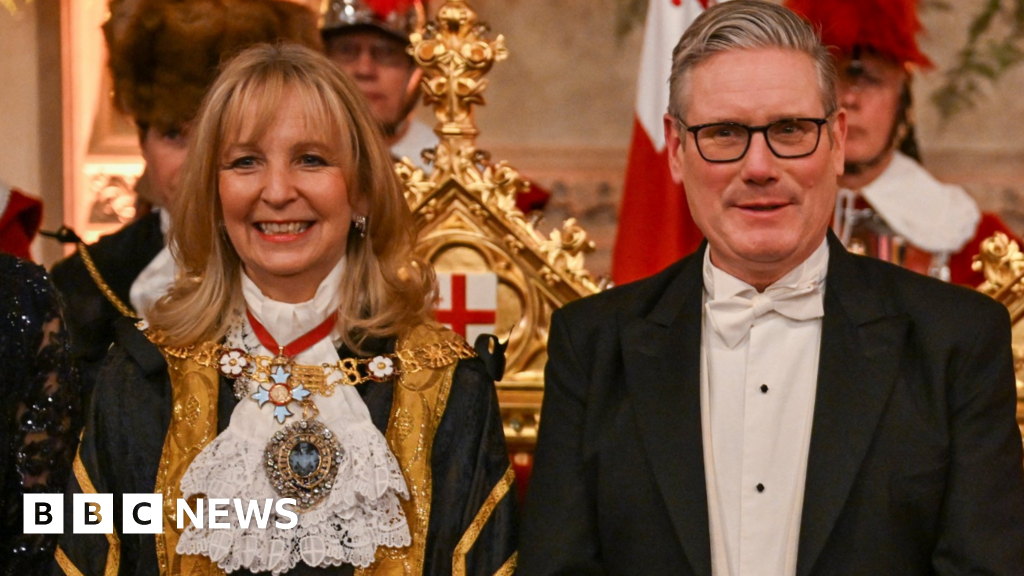
Prime Minister Sir Keir Starmer says the UK government’s policy towards China cannot continue to be “hot and cold”.
Speaking at the annual Lady Mayor’s Banquet, which is traditionally used to set foreign policy for the coming year, Sir Keir told guests his government would focus on relations with China.
The speech follows an MI5 alert about Chinese spies targeting MPs and parliamentary staff, and comes less than a fortnight before a decision on whether China gets the green light to set up an embassy in the capital despite security concerns.
The Prime Minister insisted that toughening on national security would enable Britain to pursue economic opportunities with the world’s second-largest economy.
Sir Keir’s speech in the City of London rejected the “isolationism” line put forward by opponents of the Chinese government, particularly former Conservative leader Iain Duncan Smith, who says the state should be treated as an enemy.
However, failing to advance the relationship with China would be a “dereliction of duty”, the prime minister said, when China is “a decisive power in technology, trade and global governance”.
Building a careful relationship will strengthen Britain’s place as a leader on the international stage and help safeguard Britain’s national interests, he said, while still recognizing the “reality” that China “poses a national security threat”.
“Instead, for years we have endured heat and cold,” he said. “We had a golden age, which then turned into an ice age. We reject that binary option.
“So our response will neither be motivated by fear, nor softened by confusion. It will be based on strength, clarity and sober realism.”
Those security threats were clearly underlined earlier this month, when security services took the unusual step of issuing an alert that specifically identified two LinkedIn profiles set up with the names Amanda Qiu and Shirley Shen.
The alert reported that the profiles were being used on behalf of the Chinese Ministry of State Security (MSS), acting as a “civilian recruitment headhunter” to target individuals working “at large” in British politics, including economists and think tank staff as well as people in Parliament.
A Chinese embassy spokesman denied the spying allegations and said they were “pure fabrications” that were “undermining China-UK relations”.
Espionage fears have also been raised around a huge new Chinese embassy, which will be the largest in Europe, located on a site at the Royal Mint Court, close to the City of London and with fiber optic cables carrying huge amounts of highly sensitive data.
Housing Secretary Steve Reid has the final say and is expected to give the plans the green light after consultation with MI5 and MI6 in a decision opposed by the Conservatives and Liberal Democrats.
In a speech at London’s Guildhall, Sir Keir insisted there would be no “trade-off” between security and economic access with China, ruling out trade on defence, AI or critical national infrastructure sectors.
“Protecting our security is not negotiable – our first duty,” he said.
“But by taking strict measures to keep us safe, we enable ourselves to cooperate in other areas.”
These sectors will include financial and professional services, creative industries, pharmaceuticals and luxury goods, he said, adding: “Great British success stories – the export opportunities are huge and we will support you to seize them.”
<a href