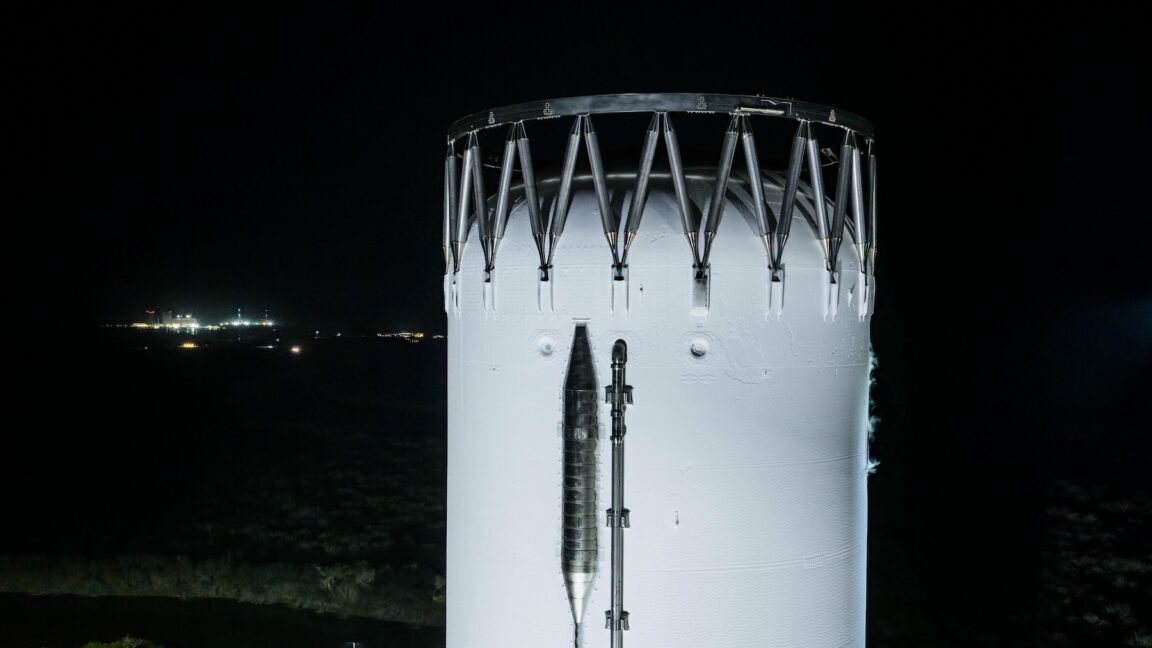
The advanced Super Heavy booster that will launch SpaceX’s next Starship flight has completed cryogenic proof testing, clearing a hurdle that resulted in the destruction of the company’s previous booster.
SpaceX announced the milestone in a social media post on Tuesday: “The first-ever cryoproof operation completed with the Super Heavy V3 booster. This multi-day campaign tested the booster’s redesigned propellant system and its structural strength.”
Ground teams at Starbase, Texas, lifted the 237-foot-tall (72.3 m) stainless-steel booster out of its factory and delivered it to the Massey Test Site a few miles away last week. The test team first conducted pressure tests on the rocket at ambient temperatures, then loaded super-cooled liquid nitrogen into the rocket four times over six days, putting the booster through repeated thermal and pressurization cycles. The nitrogen is a stand-in for the cryogenic methane and liquid oxygen that will fill the booster’s propellant tanks on launch day.
The proof test is notable because it moves engineers closer to launching the first test flight of an upgraded version of SpaceX’s mega-rocket, called Starship V3 or Block 3. SpaceX launched a previous version, Starship V2, five times last year, but the first three test flights failed. The previous two flights met SpaceX’s goals and the company moved forward on V3.
better results this time
The Super Heavy booster originally assigned for the first Starship V3 test flight failed during a pressure test in November. The rocket’s liquid oxygen tank ruptured under pressure, and SpaceX removed the booster and moved on to the next line.—Booster 19. The Super Heavy vehicle appears to have passed stress testing, and SpaceX returned the booster to the factory early Monday. There, technicians will mount 33 Raptor engines on the bottom of the rocket and install the booster’s grid wings.
These components are replaced from Starship V2. According to SpaceX, the Raptor engines starting on Starship V3 produce more thrust and include changes to improve reliability. The Raptor 3S is lightweight due to plumbing and sensors integrated into the engine’s main structure, eliminating the need for self-contained heat shields between the engines at the base of the rocket.
<a href