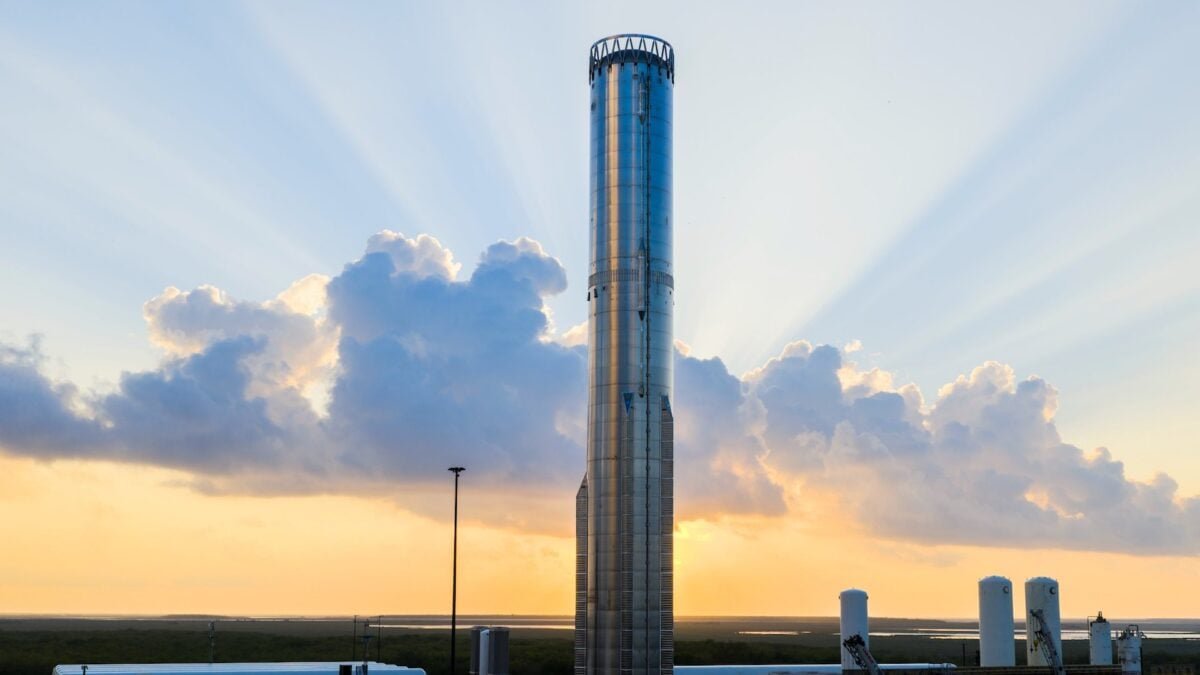

SpaceX launched an upgraded version of its megarocket for pre-launch testing, but images of the next-generation booster show signs of damage ahead of Starship’s first orbital flight early next year.
On Thursday, SpaceX began the initial round of pre-launch testing of Booster 18, the first Super Heavy for Version 3 of Starship that is scheduled to launch in 2026. Footage from the company’s Massey test site in Texas showed the booster exploding on its pedestal, and an image later posted on Twitter also revealed severe damage to the lower half of the rocket where the liquid oxygen propellant is stored.
It appears that Booster 18 exploded during testing at Massey Base. pic.twitter.com/fmVdYPmWvA
– Labpadder Space (@labpadder) 21 November 2025
“The first operation will test the booster’s redesigned propellant system and its structural strength,” SpaceX wrote on X. The company, however, did not comment on the damage caused to the rocket during the test.
Bigger is better?
Last month, Starship version 2 was launched for the last time, ending the two-year run on a high note with a successful test flight. The second iteration of the rocket launched on a suborbital trajectory, but SpaceX is now turning its attention to a third, larger version of Starship in preparation for the first orbital flight.
The next generation Starship has a larger vehicle capable of carrying more propellant. The rocket will also use third-generation Raptor engines, a more powerful and efficient version of its engines. Although Starship’s previous two test flights were a huge success, they followed a series of failed launches earlier this year that affected the rocket’s operating path. So, a lot is riding on the success of the latest starship prototype. The new version of the rocket includes several upgrades and design improvements to avoid the explosive streak of version 2.
Earlier in September, SpaceX founder and CEO Elon Musk acknowledged that because “a lot changes on the rocket with Version 3,” there will be a learning curve with the new prototype. “The Advanced Starship may have some teething problems because it is a very new design,” he said during an interview.
It is unclear whether the apparent explosion of Booster 18 was an accident or intentional, as SpaceX may have been pushing the rocket to the breaking point – an intentional failure – to see how it performed under extreme conditions. Either way, SpaceX is on a tight deadline to deliver a Starship that can land astronauts on the Moon in 2027 as part of NASA’s Artemis 3 mission. Due to development delays, NASA’s acting chief Sean Duffy recently revealed that the agency may reopen the Artemis 3 contract to SpaceX’s competitors.
Musk has also said he would like to send an unmanned Starship to Mars during an upcoming launch window next year. It all depends on the next-generation Starship’s ability to reach orbit by next year and the company’s success in learning how to fly a larger rocket on a new trajectory.