
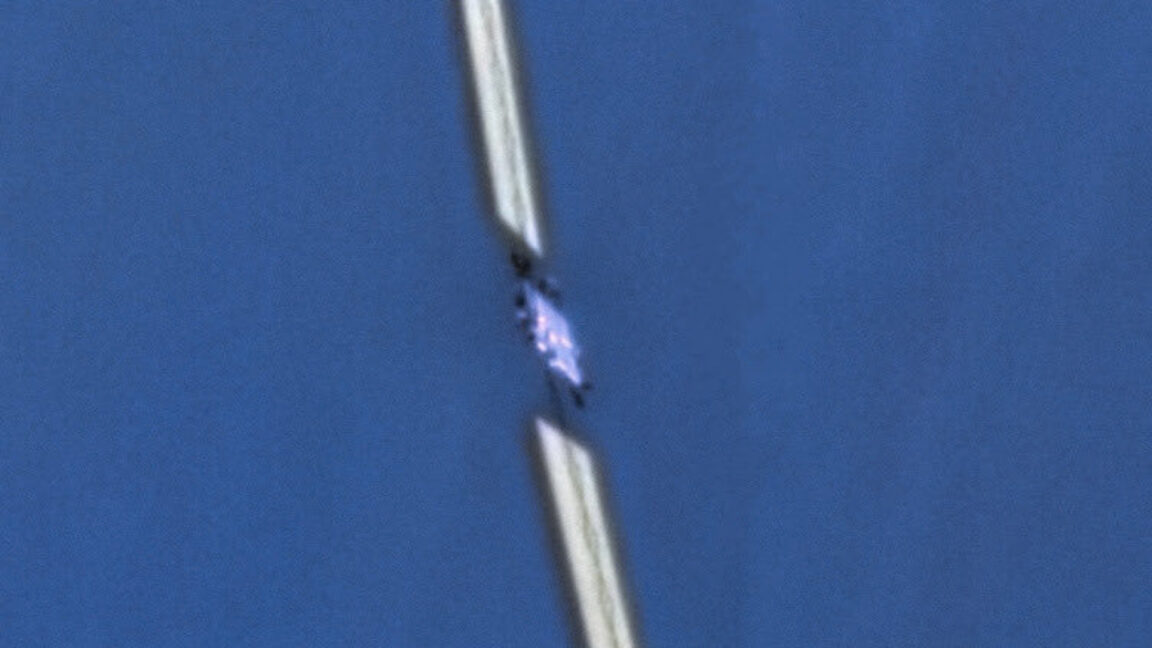
The year 2025 ends with more than 14,000 active satellites from all countries orbiting the Earth. A third of them will soon move to lower altitudes.
This maneuver will be performed by SpaceX, owner of the largest satellite fleet in orbit. According to Michael Nichols, SpaceX’s vice president of Starlink engineering, the company’s approximately 4,400 Starlink internet satellites will go from an altitude of 341 miles (550 kilometers) to 298 miles (480 kilometers) during 2026.
“Starlink is launching a significant restructuring of its satellite constellation focused on enhancing space security,” Nichols wrote in a post on X on Thursday.
The maneuvers performed with the plasma engines of Starlink satellites will be gradual, but they will eventually bring together a large portion of the orbital traffic. The effect, perhaps adversely, would be to reduce the risk of collisions between satellites orbiting in near-Earth space at speeds of about 5 miles per second. Nichols said the decision “will enhance space security in many ways.”
why now?
There are fewer debris objects at lower altitudes, and although Starlink satellites will be more tightly packed, they follow choreographed paths distributed across dozens of orbital lanes. “The number of debris objects and planned satellite constellations below 500 km is quite small, making the overall probability of a collision low,” Nichols wrote.
The 4,400 satellites flying close to Earth make up about half of SpaceX’s Starlink fleet. At the end of 2025, SpaceX had approximately 9,400 operational satellites in orbit, with more than 8,000 Starlinks in operational service and hundreds more undergoing testing and activation.
There is another natural reason to reconfigure the Starlink constellation. The Sun is beginning to cool down after the 11-year solar cycle reached its peak in 2024. The decline in solar activity has the effect of reducing air density in the upper layers of the Earth’s atmosphere, which is a meaningful factor in planning satellite operations in low-Earth orbit.
As solar minimum approaches, the Starlink satellites will face less aerodynamic drag at their current altitude. In the rare event of spacecraft failure, SpaceX relies on atmospheric resistance to pull Starlink satellites out of orbit, causing catastrophic destruction upon re-entry. Taking down the Starlink satellites would cause them to naturally re-enter the atmosphere and burn up within a few months. According to Nichols, at solar minimum, it could take more than four years to pull the satellites out of their current 550-kilometer orbit. At lower altitudes, this will take just a few months.
<a href