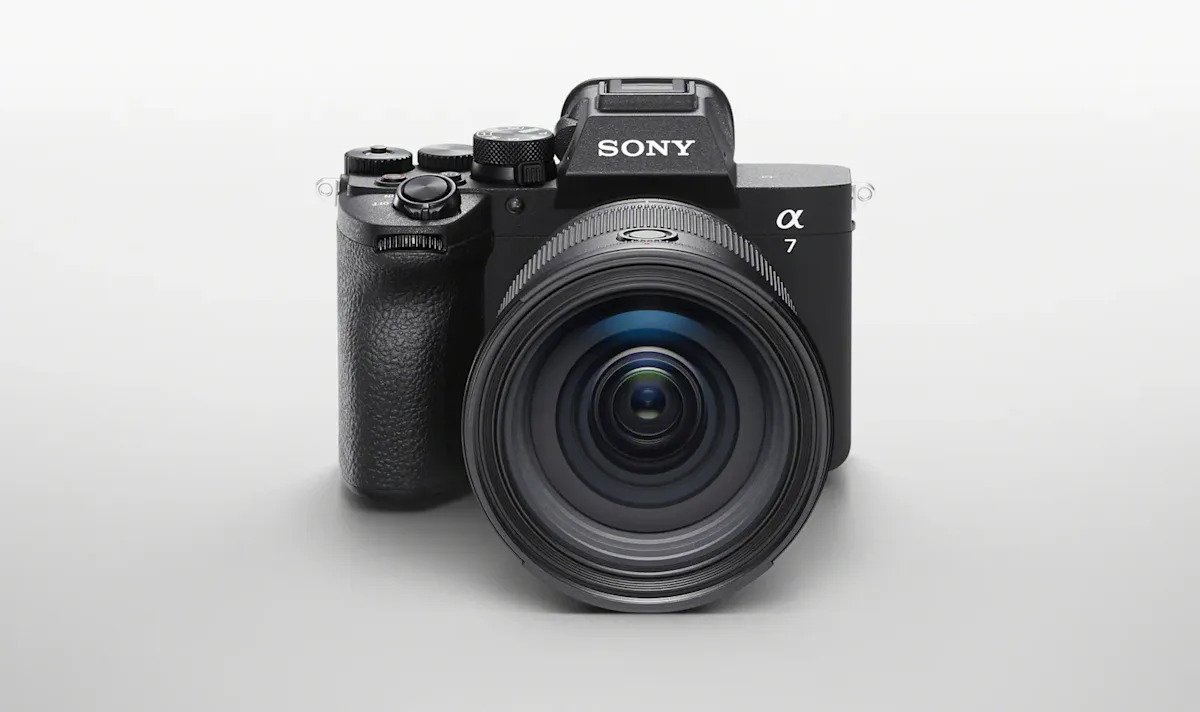
Sony has launched its mid-range flagship mirrorless camera, the A7 V, with an emphasis on speed but a bit less than expected on video. The new model features a 33MP partially stacked full-frame Exmor RS sensor and an all-new Bionz XR2 processor with built-in AI for what the company says is the fastest, most accurate subject-detect autofocus ever. Plus, it can shoot 14-bit photos at up to 30 fps with 16 stops of dynamic range, which is the most we’ve ever seen on a Sony (or almost any other) camera.
On the video side, the A7 V now supports 4K 10-bit S-Log3 video at 60 fps using the full sensor width with supersampling from 7K. Note that to get full-width video in 4K 60 fps mode, you have to turn on a feature called Angle of View Priority which according to Sony turns off noise reduction in the camera but does not affect the quality. 4K at 120 fps with APS-C crop is also possible. The graphite heatsink dissipates heat well, so you can record 90 minutes continuously at 4K 60 fps.
However, the A7 V doesn’t offer any resolution beyond that, unlike its primary rivals in this price range: the Canon R6 III (7K at 60 fps), the Nikon Z6 III (6K at 60 fps) and the Panasonic S1 II (6K at 60 fps). Also surprisingly, unlike all three rival cameras, there’s no internal or external RAW capture, with recording limited to Sony’s XAVC (H.265 and H.264) formats.
Sony told Engadget that instead of RAW or 7K, it preferred to focus on features it says manufacturers really want, namely sharp, high-quality 4K at 60 fps that won’t fill up your hard drive (with fast and accurate autofocus, of course). It also prioritized motion with a partially stacked shutter to reduce rolling shutter for full-frame video.
The company believes that RAW video offers additional quality, can take up gigabytes of space a minute and requires a powerful PC for processing. That said, I’d personally like to have the 6K or 7K capture option if I need to reframe a shot or output high-resolution vertical video. However, the A7 V can do this with its Auto Framing mode that places a human in the scene and automatically crops in on them like a robotic cameraperson.
With all the extra speed, the A7 V can shoot 30 fps blackout-free RAW bursts with Precise AF and auto exposure in electronic shutter mode (with 14-bit RAW quality instead of 12-bit as before), or 10 fps with the mechanical shutter. There isn’t a full uncompressed RAW option, but it does support lossless compressed RAW and a new lightweight RAW format. It also supports extended RAW processing on PC with 12 creative look presets with custom parameters, as well as high-resolution output.
Along with the new sensor and image processor, Sony is promising precision AF up to EV-4.0 in low-light conditions, with 759 phase-detection points that cover about 94 percent of the image area. It also supports pre-capture and speed boost so that you don’t miss important moments in wildlife or sports photography. In terms of AI detection, it now supports auto detection of targets as well as detection of human, animal, bird, insect, car/train, and airplane.
Sony
The A7 V’s five-axis in-body stabilization provides up to 7.5 stops of shake reduction, compared to 8.5 for Canon and Panasonic’s latest models. It offers both Active and Dynamic Active modes, depending on how vigorously you’re handling the camera, with the latter offering some cropping.
The 2.1 million-dot rear display flips up for vloggers as before, but also tilts up and down for easy hip-level photography. The OLED electronic viewfinder has the same 3.69 million dot resolution as the A7 IV. Sony’s NP-FZ100 battery extends battery life to 750 shots (CIPA), the best of any camera in this class. Instead of the dual-dual card slot configuration of the A1 II, the A7 V offers hybrid CFexpress Type A (which only Sony uses) and SD UHS II slots, along with a single SD UHS II slot. Other features include a 3.5mm mic and headphone port, a full-sized HDMI port, Wi-Fi 6, and two USB-C ports.
With the added speed, higher resolution than rivals, and gains in picture quality, Sony’s A7V should appeal to hybrid shooters who focus on photography and some video. It’s on pre-order now starting at $2,899 ($3,099 with kit lens) or $3,699/$3,899 CAD. It is scheduled to begin shipping on December 18, 2025, but only in limited numbers initially.
<a href