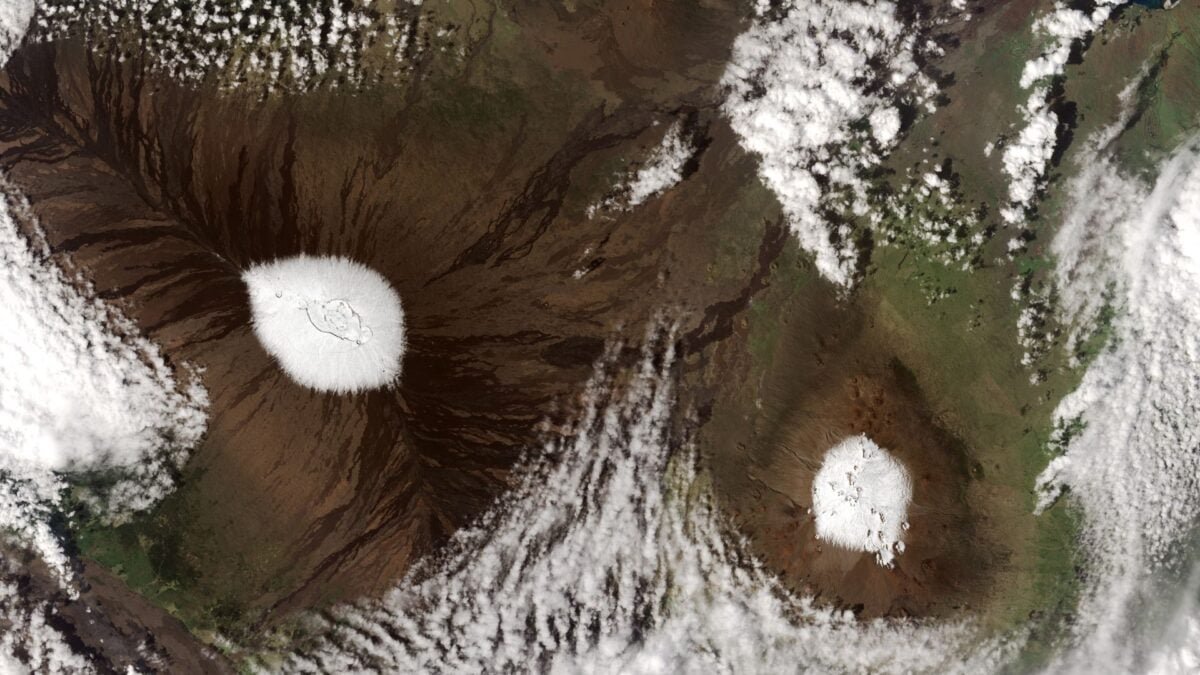

While residents of snow-prone Denver and Boston wait for the first layer of snow to fall, Hawaii’s highest peak is already covered in white.
On Tuesday, the Maunakea Visitor Information Station (VIS) shared photos and webcam footage of snow accumulated above the volcano’s summit. According to the National Weather Service (NWS), all Big Island summits are currently under a winter weather advisory that will remain in effect until 5 p.m. ET Thursday.
“CMS [Center for Maunakea Stewardship] Rangers reported snow and ice on the summit this morning,” VIS said in a Facebook post Tuesday morning. “The access road above the Visitor Information Station is currently closed. “Winter weather is forecast with very limited visual conditions over the next few days.”
Well, it officially snows in Hawaii before Denver this year. What a time to be alive! #cows pic.twitter.com/Pdoy07r97t
– BoulderCast Weather 🏔️⛈️ (@BoulderCast) 18 November 2025
seriously? Snow in Hawaii?
Despite its tropical climate, Hawaii’s largest volcanoes – Maunakea and Maunaloa – receive snowfall every year. Maunakea is approximately 14,000 feet (4,300 m) above sea level, which is within the altitude range of below zero temperatures.
Light snow accumulation on Hawaii’s highest peaks in mid to late November is not as unusual as you might think. What’s unusual, however, is that Boston and Denver have yet to see the Flakes flying this season. In fact, it’s the first time in Denver’s recorded history that not a trace of snow has fallen until the second half of November, local news station KDVR reports.
According to the NWS, Denver typically sees the first measurable snowfall around October 18. With no snow on the ground as of Thursday, the 2025 season currently marks the third-latest first snowfall in Denver’s recorded history. If there is no snowfall by December 10, it will threaten the latest first snowfall record.
According to The Weather Channel, the first snowfall in Boston occurs around November 29, so winter weather is coming to a close but is technically still on track. But both Boston and Denver’s snowy seasons are changing later due to climate change — a phenomenon that is reshaping winter across North America
Changing weather and snowfall
As the Earth’s average temperature is rising, winter is arriving later in the year in the Northern Hemisphere. The total length of the season has also decreased, falling from 76 to 73 days between 1952 and 2011, according to a study published in 2021.
These changes are already having a significant impact on snowfall in the northern states. A recent analysis by The Washington Post’s weather team found that the Northeast’s snowfall has fallen to levels 40% below average over the past five winters. NOAA also reported significant declines in snowfall across the West.
In a warming world, seasonal anomalies like delayed first snowfall will only become more common in Denver, Boston, and other parts of North America. As the contrast between Hawaii’s early snowfall and the mainland’s missing chunks shows, winter is not as predictable as it used to be.