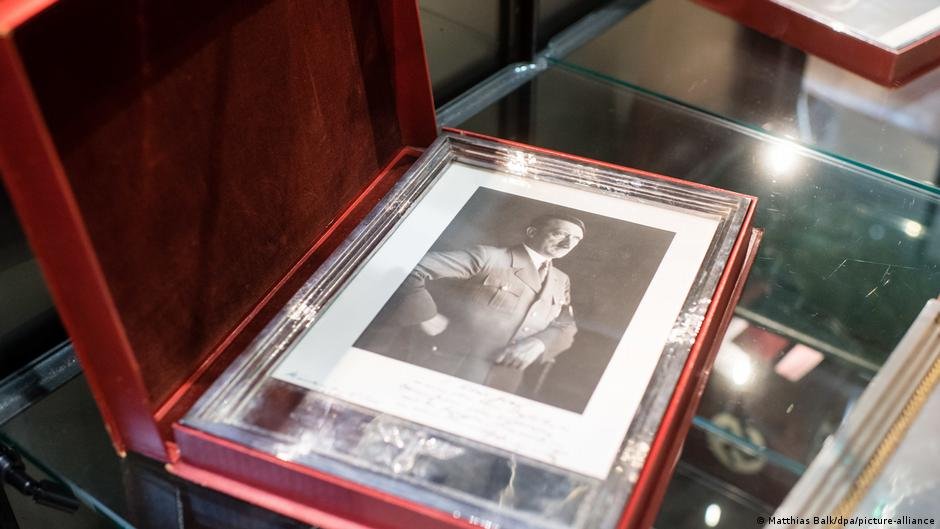
These are some of the items that were supposed to be sold this week at the Felzmann auction house in the western German city of Neuss, but it was canceled due to public outcry. Many of the items from 1933 to 1945, put up for sale under the title “System of Terror Volume II”, included the names and personal information of those persecuted.
“For the victims of Nazi persecution and the survivors of the Holocaust, this auction is a reprehensible and shameless undertaking that leaves them angry and speechless,” Christoph Huebner, executive-vice-president of the International Auschwitz Committee, said in a statement. “They should be displayed in museums or memorial exhibitions and not transformed into mere objects.”
German Foreign Minister Johann Waddefull said, “Something like this is absolutely not appropriate, and it must be clear that we have a moral obligation to the victims to prevent such things.” He also called for a complete ban on the commercial sale of such items in Germany.
Complete ban on sale of Nazi artefacts ‘impractical’
Third Reich artefacts have been auctioned off before in Germany and it is easy to find dealers online. According to Leipzig-based lawyer Peter Gischke, this is because a complete ban would be legally impractical.
“It is intolerable, but even contemplating such a despicable act is not a criminal offense. No criminal law in the world can stop it,” Gischke told DW. “When our Foreign Minister says for obvious reasons that all this should be banned, that is all well and good, but what do you really want to ban? Do you want to ban every paper written between 1933 and 1945?”
According to Section 86 of the German Criminal Code (StGB), it is prohibited in Germany to distribute, trade or make publicly available on data storage devices promotional materials from unsympathetic organizations – including books. The law applies to propaganda material, such as the swastika and the SS Totenkopf (skull) insignia, issued by any banned organization, whether from the left or the right of the political spectrum, with some exemptions for use as artworks or in educational contexts.
It specifically prohibits the distribution and display of propaganda materials that aim to further work toward the objectives of the National Socialist regime, particularly flags, badges, parts of uniforms, slogans and forms of greeting such as Sieg Heil or the “Hitler Salute”. Items decorated with Nazi symbols may be sold but in the case of online sales the symbols themselves must be taped or pixelated.
“Distribution – and distribution is a broad term – also includes hanging a Nazi flag in my living room and inviting 20 people over for a cozy evening, because then I’m distributing a Nazi symbol, which is actually banned in Germany,” Gischke explained.
Although keeping a copy of Hitler’s “Mein Kampf” on your bookshelf is not a criminal offense, printing multiple copies and selling them at the local flea market certainly is. Such cases can be reported to the police and documented by any member of the public.
For sale: Hitler’s wristwatch and Harry Truman’s letters
Similar laws on the sale of Nazi souvenirs exist in Austria, France and Hungary. But in the US and elsewhere, it is largely a free market. It’s hard to know how big the market is, but demand is growing, at least according to Bill Panagopoulos, owner of Alexander Historical Auctions in Maryland.
While major auction houses such as Sotheby’s and Christie’s refuse to handle such artefacts, Panagopoulos’ auction house made headlines in 2022 over the sale of a gold wristwatch believed to have belonged to Adolf Hitler and a dress worn by Hitler’s wife Eva Braun. Despite the anger of Jewish leaders On behalf of the European Jewish Federation, which described the auction as “disgusting”, the watch sold for $1.1 million.
Panagopoulos acknowledges that he has “faced a lot of criticism” for his work over the years, but he refutes “the common accusation that people are profiting from genocide.”
He believes that the auction in Neuss should have gone ahead to prevent the artefacts from disappearing completely.
“Not selling them on a public platform, I consider it a crime in itself because it makes those materials unavailable to families, scholars and institutions,” he told DW. “I wouldn’t want to make a profit on it but I wouldn’t like to see it sold under the table, you know, or thrown in the trash.”
Panagopoulos’ father comes from the village of Kalavrita in Greece, where Nazi soldiers massacred hundreds of men and boys over the age of 14. The women and children were captured and confined to a local school, which was later set on fire, but they managed to escape. He said he had a framed document bearing the rare signatures of Carl von Le Suire, the Nazi general who ordered the massacre, and Wilhelm Speidel, the Nazi military commander of Axis-occupied Greece at the time. For Panagopoulos, it is “a reminder of crimes committed in the past.”
He claimed that most of the objects of historical importance were sold to Jewish buyers. When asked if he saw any connection between rising right-wing extremism and the apparently growing market for Third Reich artifacts, he said that neo-Nazis are “too stupid and too poor to buy this kind of stuff and they don’t want it.” The stereotypical billionaire buyer with deep appeal is also a myth, he said.
Panagopoulos sells everything of interest to collectors, including slavery artifacts such as shackles and bills of sale, as well as Confederate swords and flags from the American Civil War. The most popular items relate to the First and Second World Wars, the Vietnam War, and to a lesser extent the Korean War. The real high-value lots are what he calls “content material”, which are objects of major historical significance.
He said, “You can buy a letter from (former US President) Harry Truman that says, ‘Thank you for the smoked fish,’ which is very boring and it will sell for $120. Several years ago I sold a letter from Harry Truman explaining why he decided to drop the bomb on Hiroshima and I sold it for $20,000.”
Researchers explore eBay, flea markets
Fritz Backhaus, historian and director of collections at the German Historical Museum (DHM) in Berlin, understands well the outrage over the sale of Third Reich artifacts. In his opinion, these things belong in public institutions where they can be researched, preserved and presented in their proper context.
“It’s a really important discussion that has now started about what ethical, legal and educational questions are associated with the trade in objects from the Nazi period, especially objects belonging to victims or that reflect their fate,” Backhaus told DW. “The question is always the background and provenance of the object being offered. Were they obtained unjustly, is there any information about how the person donating the piece came to own the object?”
Backhaus said most of the Third Reich artifacts in the DHM have been donated by members of the public. When the Third Reich collapsed, German society was flooded with Nazi propaganda and in the immediate post-war period, much of it was either destroyed or hidden. But Backhaus said that since the 1970s, 80s and 90s, more and more things keep emerging as perspectives on how best to deal with Germany’s dark past change.
Museum researchers like to keep an eye on auction catalogs and upcoming sales in order to purchase items of particular historical relevance for their collections. He added, “However, it is difficult for us to keep track because there is such a huge marketplace of material on offer, for example on eBay and flea markets.”
Discussing the market for these types of items, Backhaus said, “In right-wing extremist circles there is a fascination with evil and, for some, even a certain admiration for National Socialism.”
He also mentioned a large purchase by the DHM from the son of Wolfgang Haney, a man whose Jewish mother had survived the Holocaust in hiding and who made it his mission to buy as much anti-Third Reich propaganda as possible to donate to research institutions.
‘I’m less excited when someone finds Hitler’s toothbrush’
Thomas Weber is a professor of history at the University of Aberdeen in Scotland and author of “Becoming Hitler: The Making of a Nazi.” He said that although he would like it more if people would do ethical things and donate to public institutions, he was not convinced that imposing a complete ban “would yield the results we are all hoping for.”
“The unintended consequence of the ban is not that suddenly that kind of market will disappear completely (…) You run the risk that this content will actually disappear forever in the wrong channels,” he told DW.
Motivations vary from person to person, Weber said. For some people it is a hobby in the same way that people collect stamps and Aston Martins. It has the thrill of the hunt, which Weber compared to Indiana Jones searching for the Holy Grail.
“I also get very excited when I find new documents, as I sometimes do, in private hands, but I’m less excited when someone finds Hitler’s toothbrush or Goring’s lederhosen or all the news last week about Hitler’s DNA, this kind of obsession about micropenis and so on, it’s something I find really disturbing,” he said.
The largest collection of Nazi memorabilia in the world is said to be amassed by British millionaire Kevin Wheatcroft. His personal collection includes Panzers and the door to Hitler’s prison cell in Landsberg, where he wrote parts of “Mein Kampf.”, Wheatcroft also claims to have slept in the bed of the Nazi dictator.
Edited by: Sarah Hoffman
<a href