As a child, Mikel López García was fascinated by the conch shell kept in the bathroom, which his father’s family played to warn their fellow villagers in the southern Spanish region of Almeria about rising rivers and flood waters.
The hours he spent achieving that “particularly powerful sound” bore fruit last year when the archaeologist, musicologist and professional trumpet player pressed his lips to blow eight conch-trumpets. He says their tones could provide insight into the lives of people living in north-east Spain 6,000 years ago.
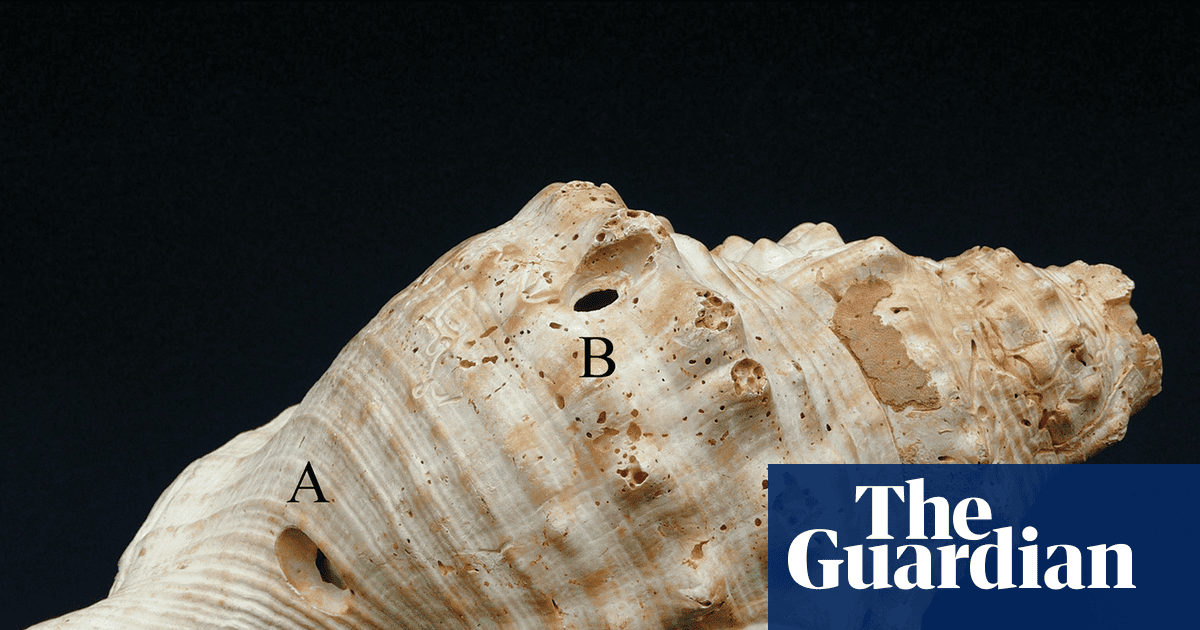
The University of Barcelona researcher argues in an article co-written with his colleague Margarita Diaz-Andreu that 12 large shell trumpets found in Neolithic settlements and quarries in Catalonia – and dated to between the late fifth millennium BC and the early fourth millennium BC – would have been used as long-distance communication devices and rudimentary musical instruments.
The fact that the shells appear to have been collected later Charonia lamps The sea snails inside them were dead, suggesting they were collected for non-culinary purposes, as was the removal of the pointed ends of the shells, suggesting they were used as trumpets.
To test their theories, the pair obtained permission to conduct acoustic experiments on eight shell trumpets that are sufficiently intact to produce sound. In November 2024, López García extracted a “really powerful, steady tone” from the shells.
He says, “It’s quite amazing that you get that very recognizable tone from a simple instrument that is a very slightly modified animal body.” “I think the closest instrument today in terms of tone is the French horn.”
But he and Díaz-Andreu, a research professor at the Catalan Institution for Research and Advanced Studies, who is also based at the University of Barcelona, wanted to go beyond single notes and determine the shell’s full musical potential.
“We wanted to see if there was room for improvisation or exploration of sonic resources in any of the pieces we played,” says López García. “So we recorded small improvisations as we played on these instruments. We realized that by doing different things, we could also shape the tone and notes of the conch’s sound.”
By putting his hand into the holes of the shells, he found that he could alter and lower their pitch, while blowing with the T-sound or R-sound also changed the timbre.
“These are basically some of the first devices – or pieces of sound technology – that we know of in the whole of human history,” he says. “They work by the vibration of your lips and the way you produce sound with them is similar to modern brass instruments, such as trumpets and trombones; shells are their most ancient ancestors.”
In their article published in the journal Antiquity, he and Diaz-Andreu said that shell trumpets would have been used “as a communication tool, either between the different communities living in the area, or between these settlements and the individuals working in the surrounding agricultural landscape”. They suggest that the shells may also have been used by workers in various galleries of the variesite mines where six shells were found.
“We know that it is one of the oldest and longest-surviving sound-producing technologies known to humans – at least on the continent of Europe,” says López García. “The oldest conch trumpet with practically identical characteristics to the one found in Catalonia was found in the Marsolas Cave in the south of France, which is an Upper Palaeolithic cave, and is dated to about 18,000 BC. So you have almost identical instruments being used from 18,000 years ago until the middle of the last century, when my family was using their conch shells in Almería.”
Like the Marsolas conch – which lay forgotten in museum collections for more than 80 years before it was discovered that it had been modified for use as a wind instrument by its prehistoric owners – the “expressive qualities of the Catalan shells also hint at wider musical applications”.
As López García says: “Although these instruments have had a very utilitarian function in ethnomusicological terms, they are also instruments with sufficient melodic capacity to provide an expressive musical function. We think it is plausible that beyond their utilitarian and practical use, these instruments can also be used for expressive discourses; they can meet the minimum requirements for musical development and the development of expression.”
The trumpeter, who plays everything from brass band music and Dixieland jazz to salsa, funk and Catalan folk music, says the ancient shells have inspired him to consider how and why humans first came to play instruments.
“The whole debate about to what extent music is a utilitarian affair and to what extent it is an aesthetic, expressive, emotional and very personal affair has always fascinated me,” he says.
“These conch trumpets have made me think about what the origins of humans’ musical expression were. Was it a question of necessity and survival, as some studies about the evolution of music have argued? Or was it a question of other types of needs that are also important to humans – less human material needs to express themselves, form bonds, and show their love and emotions within groups?”
<a href