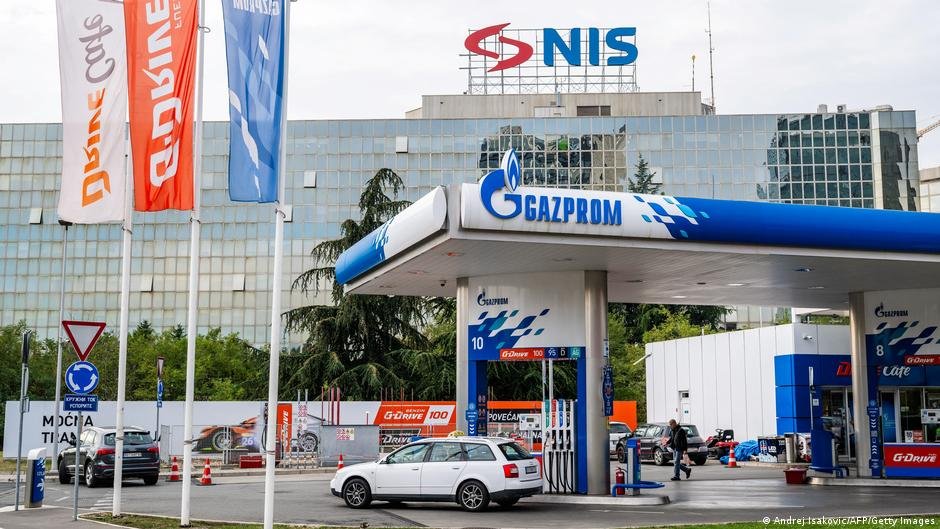
Russian state-owned oil company Gazprom Neft owns a 45% stake, and another Russian firm, Intelligence, owns an 11.3% stake in NIS, putting it within reach of US sanctions aimed at preventing Russia from using energy revenues to finance its war in Ukraine.
These restrictions have been postponed at least eight times since January but finally came into effect on October 9.
Their impact was immediately felt: according to Serbian officials, the US measures disrupted the flow of crude through the JANAF pipeline, leaving Serbia’s refineries with only enough supply to process through the end of November.
Impact on Serbia’s energy security and financial stability
NIS occupies a strategically important position in the energy system of Serbia. It operates a refinery in Serbia and supplies four-fifths of the country’s gasoline and diesel, as well as almost all aviation and heavy fuel.
Energy expert Milos Zdravkovic warned that closing the refinery would have devastating consequences for the economy.
“NIS employs about 14,000 people. They (NIS) contribute about €2 billion ($2.3 billion) to Serbia’s budget (state treasury) in 2023 and €2.08 billion in 2024. It is important for our GDP and budget, and we cannot do without it,” Zdravkovic told DW.
But there is even more at stake: the NIS is subject to secondary sanctions, meaning any company or bank doing business with it could also be affected.
National Bank of Serbia (NBS) Governor Jorgovanka Tabakovic has confirmed that NBS has received a warning that it could fall under secondary sanctions if it works with an entity already under measures.
“I hope those sanctions will not be imposed because that would mean a halt to all payments,” Tabakovic said.
What solutions are being explored?
The only way out of the crisis is a permanent change of ownership, in other words the exit of Russian shareholders from NIS.
Serbia is now trying to find a solution.
Energy Minister Dubravka Jedovic Handanovic has said that Gazprom Neft has agreed to sell its stake in NIS.
He stressed that the name of the third-party buyer is not being disclosed at this time as negotiations are ongoing.
Will the state buy Gazprom Neft’s stake?
Serbian President Aleksandar Vucic has said that if the deal with this third party fails, the state will buy the stake.
“If we don’t have another solution, no matter what the cost, we will find the money. We will negotiate with the Europeans and everyone else,” Vucic said.
Economic journalist Radojka Nikolić estimates that such purchases would likely cost Serbia between €1.5 billion and €2 billion.
If funding is diverted from the state budget, the country may delay other projects, such as the Expo 2027 project, or the construction of the national stadium. Alternatively, it could take additional loans or draw from budget reserves.
“This would be a very bad sign, because the foreign exchange reserves are there to guarantee the state’s ongoing liquidity,” Nikolic told DW. “It’s quite risky. It sends a very bad message. Reserves are not a guarantee as such. They can be used for something else.”
geopolitical dilemma
Because Serbia is energy-dependent on the East and economically dependent on the West, the government’s decision on NIS gives rise to a series of interconnected dilemmas that Serbia can no longer avoid.
“We are between a rock and a hard place. On the one hand, US sanctions are preventing refinery operations. On the other, we are dependent on Russian gas. This is an even bigger problem because Serbia consumes 2.8–3 billion cubic meters (98.8–105.9 billion cubic feet) of gas annually, of which 1.73–1.75 billion goes to industry. Gas cannot be bought at newsstands, so, whenever you Can get what we want,” explained energy expert Milos Zdravkovic.
The government in Belgrade is trying to calm the situation on both fronts.
President Vucic has publicly boasted of “warm” relations and efforts to appease the West.
Recently, Serbia also accommodated the interests of US President Donald Trump’s family by passing a law that will speed up the process of obtaining permits to convert the former army headquarters into a luxury complex. This project is related to Trump’s son-in-law Jared Kushner.
At the same time, Belgrade is trying to avoid angering Moscow by adopting a cautious stance towards NIS and ensuring continuity of gas supplies.
difficult balancing act
Analysts warn that such a strategy is becoming increasingly difficult to defend.
Any delays or unclear messages could directly impact financial aid decisions, investments, and relations with partners who have become more wary of Belgrade’s “multifaceted diplomacy”.
“Politically, it is more important to separate from Russia, at least in terms of energy,” Radomir Diklic, president of the European Movement in Serbia, told DW. “It will be painful, but we’ve already been living in a precarious situation for years, so hopefully we’ll be OK after this.”
However, Diklik fears that the government may be acting in its own interests rather than the country’s.
Radojka Nikolić believes that despite short-term measures to prevent the immediate crisis, the long-term solution would be for the US to enter Serbia’s energy sector.
“I believe that whatever transaction happens now – there has been some discussion of billion funds – it can only be a temporary, short-term solution. The long-term solution will certainly be the entry of US capital into the entire energy sector of Serbia. (…) Now, the question is what the implementation will look like,” Nikolic said.
Diplomatic skill and willingness to compromise on all sides will define not only Serbia’s international position, but also its internal stability in the coming months.
“Serbian policy has been guided by the ‘what will be, will be’ principle,” says Zdravkovic. He warned, “There will be oil. It’s just a question of price. The pumps will run, we will import – like Bosnia and Herzegovina imports, like Croatia imports. It will affect the standard of living. And as far as gas is concerned, if the supply stops, it will be really difficult. You can’t compensate for it.”
As energy dependence and geopolitical pressures tighten their grip, Serbia’s failure to act decisively could leave its future at the mercy of others.
Edited by: Angiel Flanagan
<a href