26/11/2025
13837 Scene
48 like it
The unprecedented Copernicus Sentinel-1 mission saw the arrival into orbit of its newest satellite in early November: Sentinel-1D was launched on November 4 on an Ariane 6 launcher from Europe’s spaceport in French Guiana.
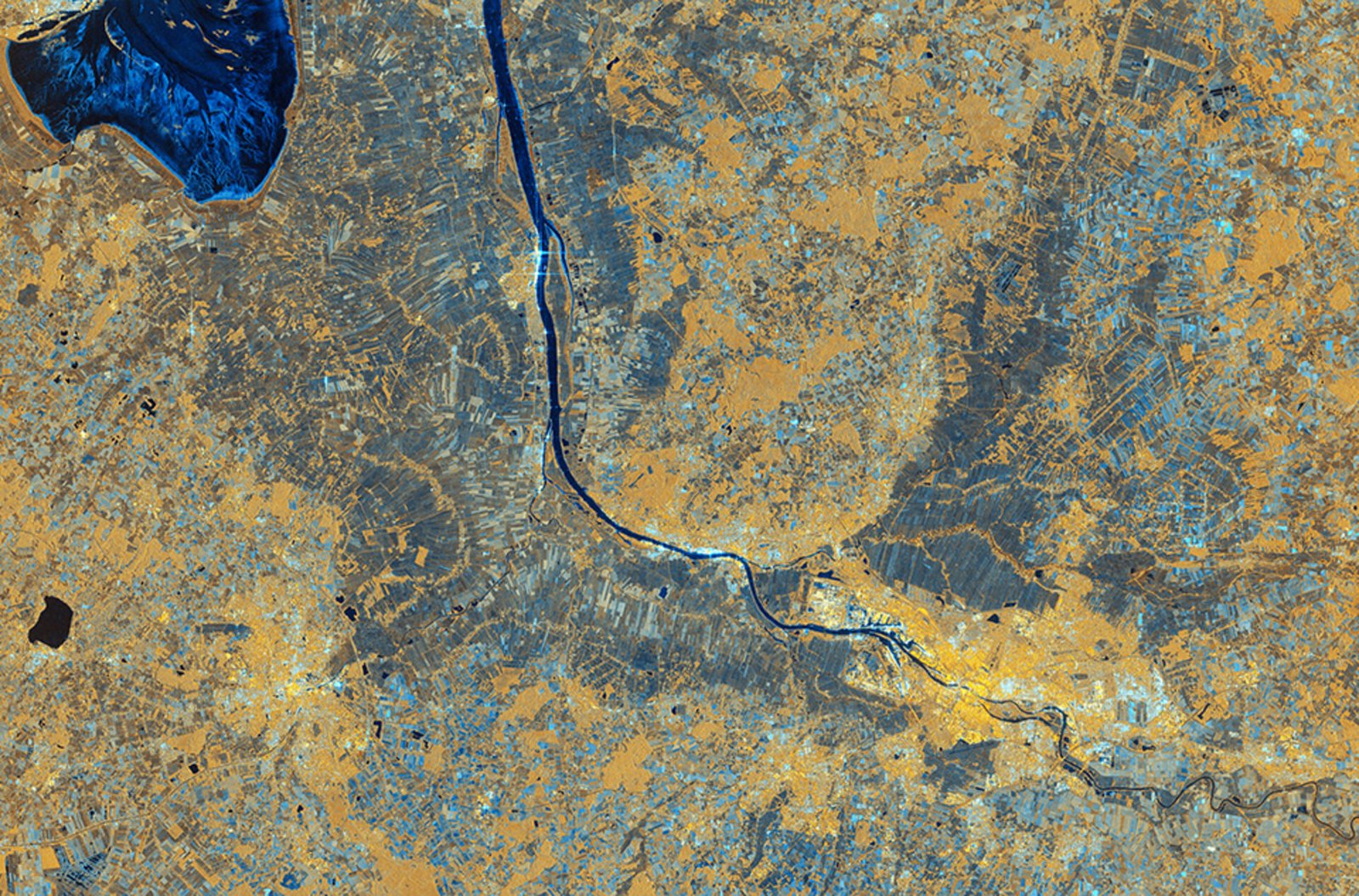
Once in orbit, the satellite and its instruments – it consists of a 12-metre-long synthetic aperture radar (SAR) instrument – were turned on, ready to capture images as it passed over Antarctica and South America two days after launch. On the night of 6 November (European time), the first photographs were taken over the Antarctic Peninsula, Tierra del Fuego and Thwaites Glacier. About six hours later, on the morning of November 7, Sentinel-1D also took images of Bremen in Germany. The data were then transmitted or ‘downlinked’ from the satellite to a ground station in Matera (Italy), which is part of the Copernicus ground segment. All of this was done within 50 hours of launch, which is likely to be the shortest time from launch to data delivery for a radar-based Earth observation satellite.
Elbe River Delta by Sentinel-1D
According to ESA’s Sentinel-1 mission manager Nuno Miranda, the images are of unprecedented data quality for a ‘first light’ acquisition. They are similar to images recently taken by Sentinel-1C, which, according to Nuno, is very promising for the commissioning phase. He said, “These images have been downlinked and processed within an exceptionally short time frame. Some of us remember that when Sentinel-1B was launched, it returned its first radar images within two hours of activation. Sentinel-1D achieved this in an even faster time, which we believe to be a new record for space radar. This remarkable performance reflects the dedication and extraordinary preparation of all the teams involved.”
Radar instruments can image the Earth’s surface through clouds and precipitation, regardless of sunlight, making them particularly suitable for monitoring polar regions. The Sentinel-1C and -1D satellites also carry an Automatic Identification System (AIS) instrument – improving the mission’s ability to detect ships and marine pollution. As the satellite passed over Antarctica, the Sentinel-1D AIS was also activated and the presence of ships in these extreme areas was captured.
First photos show fragility of glaciers
Antarctic Peninsula by Sentinel-1D
Antarctic Peninsula (Above) is part of the larger peninsula of Western Antarctica, which extends for 1300 km. It is an ice sheet resting on a chain of rocky islands and its tip is just 1000 km from the southern tip of South America. The Antarctic Peninsula ice sheet is one of the smallest ice sheets in Antarctica, but is perhaps the most sensitive to climate change because its glaciers are small and in a rapidly warming region. Observable changes such as the collapse of ice sheets, thinning and rapid retreat of glaciers are all key indicators of climate change in the region.
This image is in black and white, showing the contrast between the sea and the snowy landscape of the peninsula.
Tierra del Fuego by Sentinel-1D
tierra del fuego (Above) is an archipelago off the southern tip of the South American continent. It covers the territory of both Argentina in the east and Chile in the west and is separated from the mainland by the Strait of Magellan. The southernmost point of Tierra del Fuego is Cape Horn.
The bright contrasting colors in this image are created using several types of radar waves, with known polarizations. In this image the ocean and snowy peaks are shown in blue, while the land appears yellow.
Thwaites and Pine Island Glaciers by Sentinel-1D
Thwaites Glacierand the nearby Pine Island Glacier (above), located west of the Antarctic Peninsula. Both are sensitive to climate change. Thwaites is one of Antarctica’s most unstable glaciers and is at risk of rapid retreat. The details shown in this Sentinel-1D image remind us of the fragility of glaciers in the Antarctic. And since 2025 is the United Nations’ International Year of Glacier Conservation, it’s worth looking at this image taken on November 6, 2025.
This image also uses multiple radar polarizations to capture enhanced data on the landscape. In this image, sea ice in the water appears purple or violet, while the glacier appears white.
The publication of these images also comes after the 30th meeting of the Conference of Parties, or COP30, where the consequences of climate change and necessary mitigation actions were discussed. The World Meteorological Organization’s position on climate update for COP30 says that from October 2023 to September 2024 glaciers are set to lose the largest amount of ice since records dating back to the 1950s. This is equivalent to 1.2 mm of global average sea-level rise, the report said. The report also notes that, on 24 February 2025, Antarctic sea ice extent reached its third-lowest extent since satellite records began in 1978, with a peak in 2023.
Simonetta Cheli, Director of ESA’s Earth Observation Programmes, said: “This is a huge achievement and I am very pleased to see these results from Sentinel-1D. It really puts the data obtained from our innovative missions in the spotlight – this is the data we rely on as a society as we continue to discuss and take action on climate change, and is also the data we need in applications to understand and study our planet.
“The Sentinel-1 team has done amazing work and I want to thank everyone within ESA, along with our colleagues in the space industry and European institutions, for delivering such a high-quality job. It is an honor to deliver this mission for the Copernicus Earth Observation Programme, and we thank the Commission for their support and cooperation. We also look forward to developing future Sentinel missions to further enhance the capability and capacity of Copernicus for Europe.”
Bremen by Sentinel-1D
Ramon Torres, ESA’s Sentinel-1 Project Manager, expressed the pride of the entire team, “The unveiling of the first images from Sentinel-1D is an incredibly emotional milestone for all of us. The feeling of awe and satisfaction goes beyond the thrill of liftoff, as seeing those breathtaking images from the SAR instrument brings our hard work to life. They are not just photographs – they are proof of our vision becoming reality, underscoring how cutting-edge this mission truly is.” The fact that these amazing photos also confirm the satellite’s health and flawless operation fills us with relief and joy and achieving all this in a surprisingly short time – only two days after launch – makes this moment even more unforgettable for our team.
Copernicus Sentinel-1D Launch Highlights
<a href