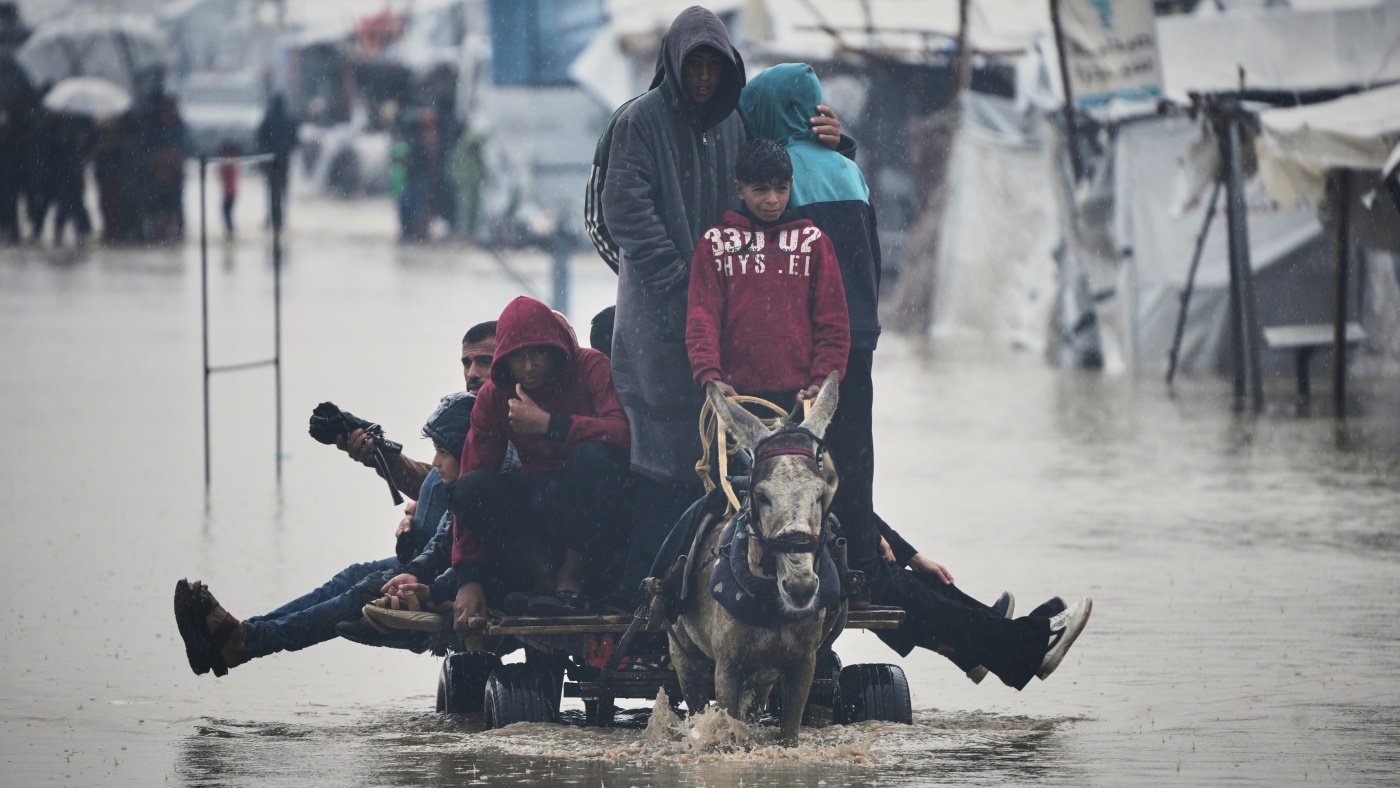

Palestinians cross a flooded road after heavy rains in Khan Yunis, southern Gaza Strip, on December 11.
Abdel Karim Hana/AP
hide caption
toggle caption
Abdel Karim Hana/AP
TEL AVIV, Israel – Efforts to recover the body of the last Israeli hostage in Gaza have been hampered by heavy rain and bad weather in the enclave, according to an Israeli official, who spoke to NPR on condition of anonymity because he was not authorized to speak to the media.
“Search operations and continued raids have been coordinated, but are currently being delayed due to weather conditions in the northern Gaza Strip,” the official said.
The official told NPR that search efforts “are expected to resume as soon as ground conditions become favorable.”
The start of the second phase of a US-brokered ceasefire agreement has been put on hold until the last bodies are transferred by Hamas to Israeli authorities.
The second phase will include the surrender of arms by Hamas and the withdrawal of Israeli forces from Gaza.
The body of Ran Gwili, who was killed while trying to help people escape from the Nova music festival, is the last Israeli hostage held by Hamas. Gwili was 24 years old and a member of an elite police unit.
The Hostages and Missing Families Forum, which has advocated for the return of hostages since the beginning of the war, told NPR that “there is no search operation currently underway,” because weather conditions do not permit it.
The Israeli military did not confirm the delay in efforts to search for Gwili’s body, but called on Hamas to “fulfill its part of the agreement”.
Hazem Qassem, a Hamas spokesman in Gaza, told NPR that search efforts were “very complicated.”
Both sides have blamed each other for violating the terms of the first phase of the ceasefire.
Israel has continued attacks on Gaza since a ceasefire agreement was signed in October, killing more than 380 Palestinians, according to local health officials.
Earlier this month, Israeli forces killed a top Hamas leader who was seen as the second-in-command in the group’s military wing. Hamas has called it a violation of the ceasefire.
Heavy rains have already left thousands of tents used as shelter by displaced Palestinians submerged in water.
UNRWA, the United Nations agency responsible for Palestinian refugees, appealed to the Israeli military to allow more aid into Gaza.
“People are freezing to death in the Gaza Strip due to the heavy rain and cold caused by Storm Byron,” UNRWA Commissioner-General Philippe Lazzarini posted on Twitter.
Lazzarini said that the ruins of buildings submerged in water are collapsing.
Gaza civil defense spokesman Mahmoud Bassal said dozens of Palestinians were killed when buildings collapsed.
“These buildings are a huge nightmare in Gaza and put thousands of lives at risk,” Bassal told NPR.
Itay Stern contributed to this report from Tel Aviv. Abu Bakr Bashir contributed from the United Kingdom. Ahmed Abuhamda contributed from Cairo.
<a href