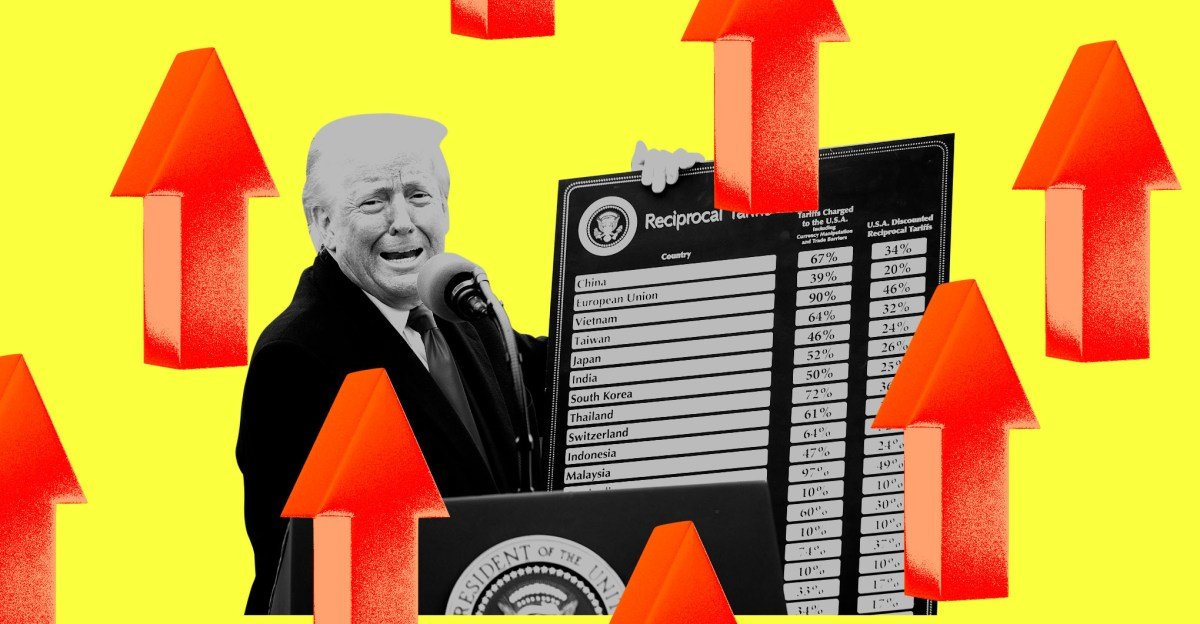
The US Supreme Court struck down some of Donald Trump’s tariffs on foreign imports that have become a hallmark of the chaos of the second Trump administration.
The court’s decision specifically relates to duties imposed using a law called the International Emergency Economic Powers Act (IEEPA), which no other president has done — a 1977 law initially created to limit the president’s ability to declare a national emergency when the threat came from outside the US. The legality of using IEEPA to tariff imports has been in question since the taxes were announced last year; The IEEPA was used to justify massive tariffs on Canada, Mexico, and China, as well as so-called “reciprocating” tariffs imposed on goods coming into the US from almost every other country on Earth. IEEPA was also implemented to eliminate de minimis exemptions, which allowed packages under a certain value to enter the US duty-free.
Other tariffs imposed outside IEEPA – such as those on steel and aluminum and other industry-specific taxes – will not receive relief from Friday’s Supreme Court decision. Additionally, the Trump administration is exploring other ways to impose tariffs: At a press conference on Friday, Trump lashed out against Supreme Court justices while praising dissenting Justice Brett Kavanaugh, and he vowed to impose additional tariffs in the future and open investigations into unfair trade practices.
“The bottom line is that the industry should expect a continued high tariff environment for the foreseeable future.”
It’s still unclear what this will mean for importers, small businesses and consumers who have paid billions in taxes as a result of Trump’s tariffs — the ruling does not directly spell out how refunds will work, if at all. In his dissent, Kavanaugh said that the U.S. Treasury could be required to refund importers who paid tariffs under IEEPA, and that the process for returning the money could be “messy.” the new York Times Refund requests are reported to total $120 billion, although consumers, who are often the parties ultimately paying for the tariffs, are unlikely to get that money back. Monica Gorman, managing director of Crowell Global Advisors, who worked on manufacturing under Joe Biden, told The Verge The issue will now go to the Court of International Trade and could take several months to resolve, an email said.
Gorman said, “The President has announced Section 122 tariffs to take effect almost immediately at a rate of 10 percent. Although the 122 statute is limited to 150 days without a subsequent act of Congress, this will allow the Administration time to take additional tariff actions under Section 301 and other tariff statutes.” “The bottom line is that the industry should expect a continued high tariff environment for the foreseeable future.”
The National Retail Federation said the decision “provides much-needed certainty for American businesses and manufacturers,” and called for “a seamless process to refund the tariffs to American importers.”
Small businesses were some of the first and most vocal opponents of Trump’s tariffs, and U.S.-based companies dependent on components and parts from abroad had already sounded the alarm. We Pay the Tariffs, a coalition of hundreds of small businesses, released a statement celebrating the decision, but warned that “a legal victory is meaningless without real relief for the businesses who pay these tariffs.
“The Administration’s only responsible course of action now is to establish a fast, efficient, and automated refund process that returns tariff money to paying businesses. Small businesses cannot wait months or years because of bureaucratic delays, nor can they risk costly litigation to get back money that was illegally collected from them in the first place. These businesses want their money back now.”
From the beginning, Trump used tariffs as a weapon to extract obedience from foreign governments and large corporations, meaning the taxes were largely disincentives and subject to change at any time, especially if one party took over the administration. The rapidly changing nature of tariffs meant that businesses and consumers were reacting in real time. Now, we are in a new era of uncertainty, but with different questions – something consumers and businesses will want to once again stock up on for an unclear future.
Sure, the SCOTUS decision is a blow to Trump’s agenda, but businesses and consumers are still living the trade nightmare created by the president: The Port of Los Angeles told CNN it is expecting an influx of cargo ships as U.S. importers rush to bring inventory into the country. Economist and policy advisor Katherine Anne Edwards told The Verge An email said that even after the decision, uncertainty remains.
“Taking control of tariffs [Trump’s] Hands are clearly good for the economy,” he said. “That doesn’t mean this decision won’t hurt, but he was using the American consumer as leverage.”
As economists warn, the American consumer is likely to foot the bill — for future tariffs imposed by Trump, for refunds, and for a new normal of higher prices that companies have no reason to back out of.
“I think the political blowback could be incredible, given that companies are willing to see refunds, but consumers are not,” Edwards said. He said approval rates and attitudes toward businesses have reached historic lows.
“Many people will see this as a payment to companies at their expense.”
<a href