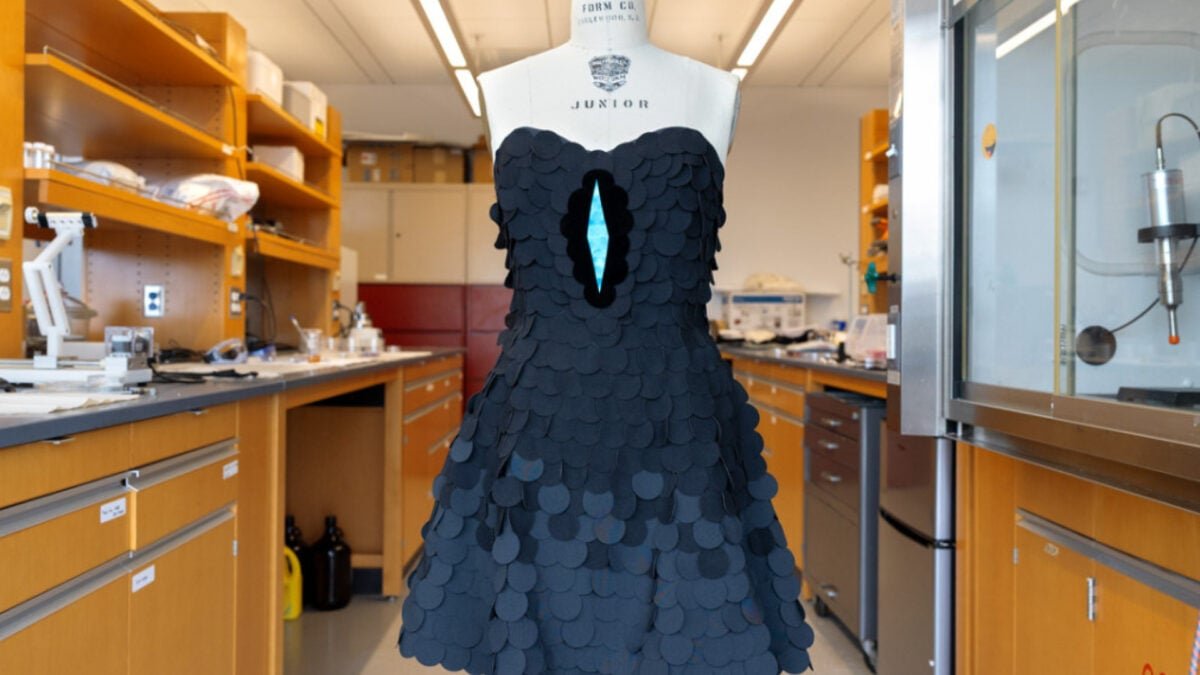
A team of designers, ornithologists and materials scientists from Cornell University have successfully developed a method of creating “ultrablack” clothing, described in a recent Nature Communications paper. The new technology, a two-step process, takes heavy inspiration from the feathers of majestic riflebirds. Their feathers contain melanin (a pigment) mixed with different structures that trap and absorb light.

This black cloth could eventually house cameras, solar panels and telescopes. However, for now, the team used it to create that classic black outfit, outfitted with iridescent blue to pay homage to the riflebirds that inspired the discovery. According to the paper, the new fabric has an average reflectance of 0.13%, making it the darkest fabric ever made.
What is “Ultrablack”?
In color theory, the terms “true black” or “true white” are often used in graphic design or when describing technology displays. Apple devices also advertise something called “True Tone”, which is intended to present clearer, more accurate colors to users.
However, “Ultrablack” in this context is none of these things. Rather, the term is used more as a measure of reflectivity, defined as a dark shadow that reflects less than 0.5% of the light falling on it. Many creatures have naturally black skin, scales, and feathers because it gives them a mating or survival advantage.
Apparently, scientists have tried to recreate ultrablack in the lab — with limited success. Although one experiment managed to create a tiny tube that reflected up to 0.005% of visible light, like most other attempts, it involved expensive techniques that produced fragile, toxic materials. As the paper states, these ultrablack materials would be “unsuitable as wearable or everyday textiles that require biocompatibility, breathability, and stretch.”
Taking lessons from the riflebirds
For the new fabric, the researchers collaborated with the Cornell Lab of Ornithology, which submitted riflebird feathers to them for analysis. The team then carefully analyzed how the position of the barbules – small, hook-like structures that hold birds’ feathers together – gave riflebirds their distinctive plumage.
They found that a tight hierarchy in the feather barbules, combined with melanin-based nanostructures, works to deflect light inward. As a result, riflebird feathers appear exceptionally black when viewed straight on, but look brighter at an angle.
To replicate these structures, the team first dyed a white merino wool fabric with polydopamine, a synthetic melanin. Then, they took the wool into a plasma chamber and carved it with spiky nanoscale structures mimicking nanofibrils, or barbules. The study reported that the final product had an average reflectance of 0.13% and remained ultrablack at wide angles.

“The light basically bounces back and forth between the fibers, rather than being reflected back — that’s what creates the ultrablack effect,” Hansdi Jayamaha, lead author of the study and a doctoral student in Cornell’s Department of Human-Centered Design, said in a release.
“From a design perspective, I think it’s exciting because a lot of the ultrablacks that exist aren’t really as wearable as ours,” said Larissa Shepherd, senior author of the study and a materials scientist at Cornell. “And it remains ultrablack even from wide angles.”
Shepherd said the team is eager to bring this technology to market and has already applied for provisional patent protection.
<a href