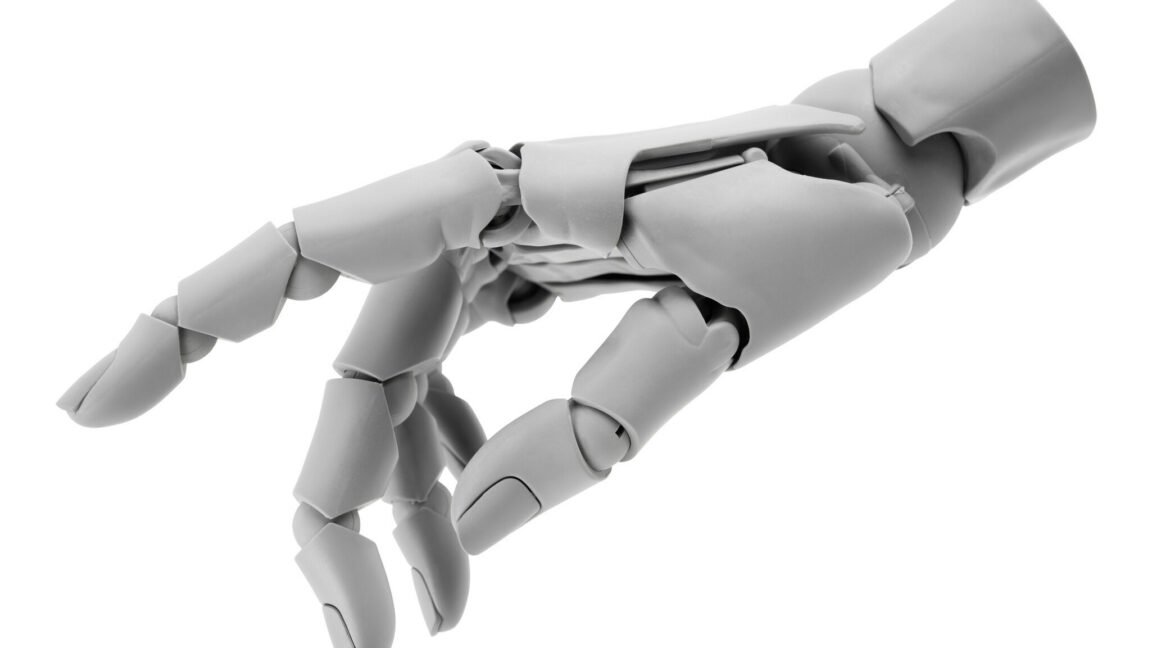
To test their AI-powered hand, the team asked intact and disabled participants to manipulate delicate objects: pick up a paper cup and drink from it, or pick up an egg from a plate and place it elsewhere. Without AI, they might have succeeded about once or twice in 10 attempts. With AI assistants turned on, their success rates increased to 80 or 90 percent. AI also reduced participants’ cognitive load, meaning they had to focus less on getting the work done at hand.
But we are still a long way from seamlessly integrating machines with the human body.
in the forest
“The next step is to actually take this system out into the real world and have someone use it in their home setting,” Trout says. Until now, the performance of the AI bionic hand was evaluated under controlled laboratory conditions, working with settings and objects specifically chosen or designed by the team.
“I want to put out a caveat here that this hand is not as dexterous or as easy to control as a natural, intact limb,” warns George. He believes that every small increase we make in prosthetics is allowing amputees to function more in their daily lives. Still, to reach Star Wars or cyberpunk technology levels where bionic prostheses are as good as or better than natural limbs, we will need much more than just incremental changes.
Trout says we’re almost there as far as robotics is concerned. “These prostheses are really dexterous, with a high degree of independence,” says Trout, “but there’s no good way to control them.” This comes in part because of the challenge of getting information in and out of users. “Skin surface electromyography is very noisy, so improving this interface using internal electromyography or nerve implants could improve the algorithms we already have,” Trout argued. That’s why the team is currently working on neural interface technologies and looking for industry partners.
“The goal is to combine all these approaches in one device,” says George. “We want to work with a company to create an AI-powered robotic hand with a neural interface that will take it to market in larger clinical trials.”
Nature Communications, 2025. doi: 10.1038/s41467-025-65965-9
<a href