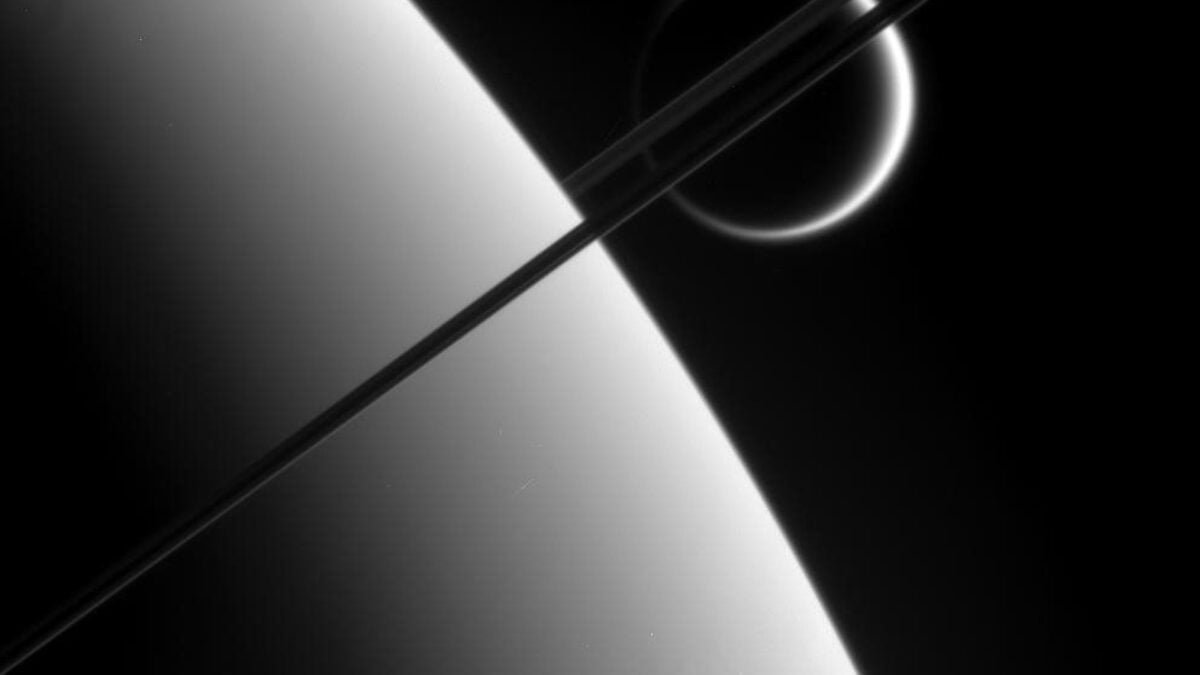
The study, accepted for publication in the journal Planetary Science, addresses a well-known mystery involving the unusually young age of Saturn’s rings as well as the asymmetry of Titan’s orbit. Researchers led by the SETI Institute are considering the possibility that Titan was born from the collision of two moons, the impact of which later created Saturn’s smaller rings. The paper is currently available as a preprint on arXiv.
Cassini’s outstanding questions
Humanity’s first close-up of Saturn, the sixth planet from the Sun, came in 1979 from NASA’s Pioneer 11 spacecraft. Voyager 1 and 2 made their respective flights a few years later.
But it was Cassini that really brought Saturn into clear focus. The spacecraft’s 13-year mission collected valuable data about Saturn, its rings and its moons for Earthbound scientists.
However, some of the data sent back by Cassini challenged some long-held beliefs of astronomers. For example, many of Saturn’s moons had odd, unbalanced orbits that did not exactly match the equations. Saturn’s rings were also much smaller than expected.
Furthermore, the planet’s internal mass was more concentrated at the center than astronomers had believed, suggesting a knowledge gap in the scientific consensus about Saturn’s orbital behavior.
what if an adventurer
In 2022, a team of astronomers proposed that these anomalies might make more sense if Saturn lost a moon about 100 million years ago, which is when Saturn’s small rings likely formed. The latest study tests this hypothesis, using computer simulations to investigate whether an additional moon could fly close enough to Saturn to form rings.
Of course, the impact of such a collision should be consistent with the distribution and characteristics of Saturn’s moons today, the team noted in the paper. Accordingly, what gave the researchers a good starting point was the persistent discrepancy in their simulations.
“The smallest of Saturn’s major moons, Hyperion, has provided us with the most important clues about the system’s history,” Matija Zuk, lead author of the study and a researcher at the SETI Institute, said in a statement.
In particular, the addition of an unstable extra moon drove Hyperion – the one moon we know is real – out of existence, letting researchers know something was up. The team also noted that Hyperion’s orbit was locked with Titan’s orbit, but the orbital lock of the two was also about a few hundred years old.
not one, but two

The team eventually arrived at a possible scenario. What if there were two previous moons, not one? If a so-called “proto-Titan” merged with a smaller “proto-Hyperion”, this would explain the general lack of impact craters on the Moon. If a small object intersected Titan’s orbit before the merger, it also made sense that Titan would have an eccentric orbit, the researchers said.
Then fragments near the Titan merger could have come together to form Hyperion – an unbalanced, lumpy moon whose appearance is perhaps consistent with such a wild, unusual origin story.
As for Saturn’s rings, researchers were surprised to find that, more often than expected, Titan’s eccentric orbit destabilizes the planet’s inner moons. This would destabilize the orbits of the smaller moons, causing them to move on extreme paths that would end in a massive collision, creating the rings.
All that being said, the team is now relying on NASA’s Dragonfly, an upcoming mission that will reach Titan in 2034, to delve deeper into the mystery. Since the new research focuses primarily on simulations, the fresh data from Dragonfly should allow them to test the hypothesis, he said.
<a href