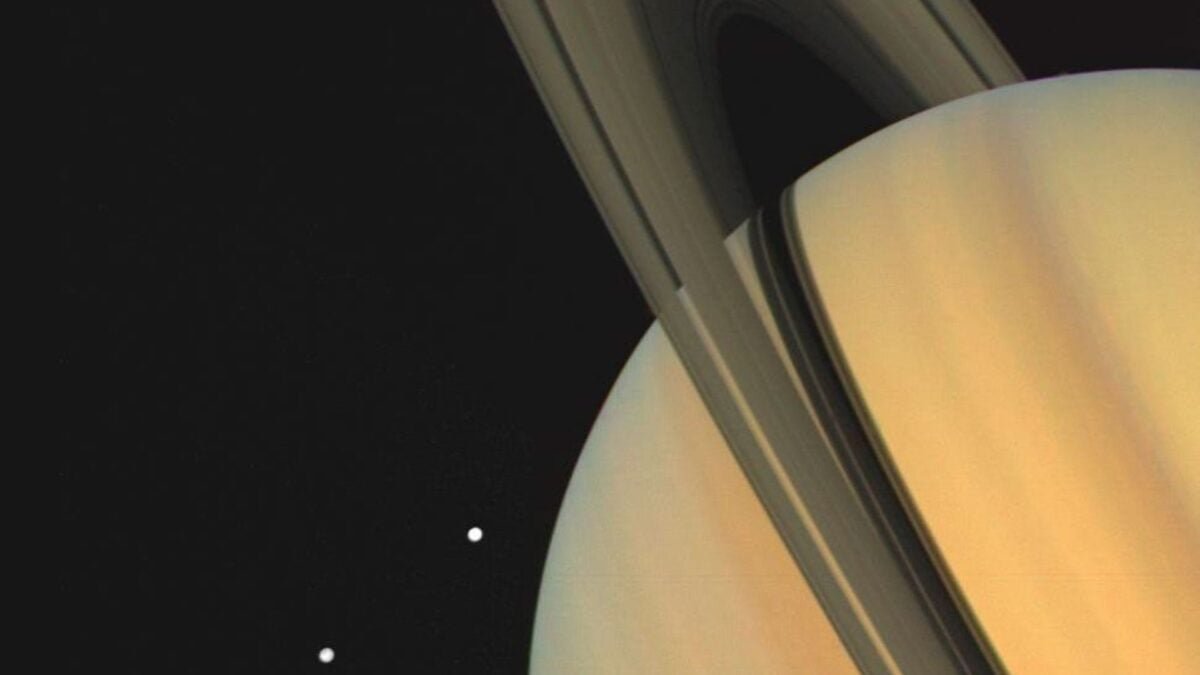

Stargazers with backyard telescopes may notice something is wrong with the night sky this weekend as a rare planetary alignment creates a mind-boggling optical illusion.
On Sunday, November 23, Saturn’s iconic rings will disappear almost completely. Don’t worry, the billions of pieces of rock and ice that surround this gas giant won’t actually disappear, but they will appear temporarily invisible to us Earthlings. This is because Saturn will align with Earth so that its rings are edge-on toward us. Since they are so thin, we will no longer be able to see them clearly.
This happens repeatedly as Saturn tilts at an angle of 26.7 degrees. This means that as it revolves around the Sun, its rings move up and down. When Saturn’s rings are visible from Earth — which they are most of the time — we’re looking at the flat plane of the rings tilted toward us, making them appear wide and bright in the night sky.
According to the New York Times, this weekend’s alignment won’t result in Saturn’s rings disappearing completely, but they will appear limited to less than 1% visibility before the two planets’ relative positions widen again.
a rare cosmic illusion
Saturn’s ring system extends 175,000 miles (282,000 kilometers) from the planet. Relative to that width, they are extremely thin, with the main rings having a vertical height of only 30 feet (10 m).
Edge-on alignments between Earth and Saturn occur every 13 to 15 years when Earth passes through Saturn’s ring plane. This is actually the second time this has happened this year, the first occurring on March 23.
During one of these events, Saturn’s rings are usually invisible for about a week. After their reappearance later this month, we won’t get to see this illusion again until October 15, 2038, according to NASA.
Although these periodic disappearing movements are nothing more than movements of the angles, Saturn is actually losing its rings, albeit very slowly. The material making up the rings is being pulled toward Saturn by its gravity in the form of a dusty rain of ice particles. Data collected by NASA’s Cassini spacecraft, which flew through Saturn’s rings in 2017, suggests that they may indeed disappear in 100 million years.
You definitely won’t be around to see it happen, but if you want to experience the ring plane crossing this weekend, here’s what you need to know.
how to see saturn naked
Saturn will be visible in the southeastern sky after sunset over the weekend, but you’ll have to use binoculars to see it without the rings. Any small backyard telescope will work.
According to the New York Times, the rings will appear thinnest at 7 p.m. ET on Saturday, but if you look before 3:30 a.m. local time on Saturday or Sunday, when Saturn will set from the night sky, you’ll be able to see the edge-on effect.
If you want to see the rings in their full glory, you’ll have to wait until the side effect wears off. They will gradually become wider over the coming months and reach their greatest apparent width in late 2027.