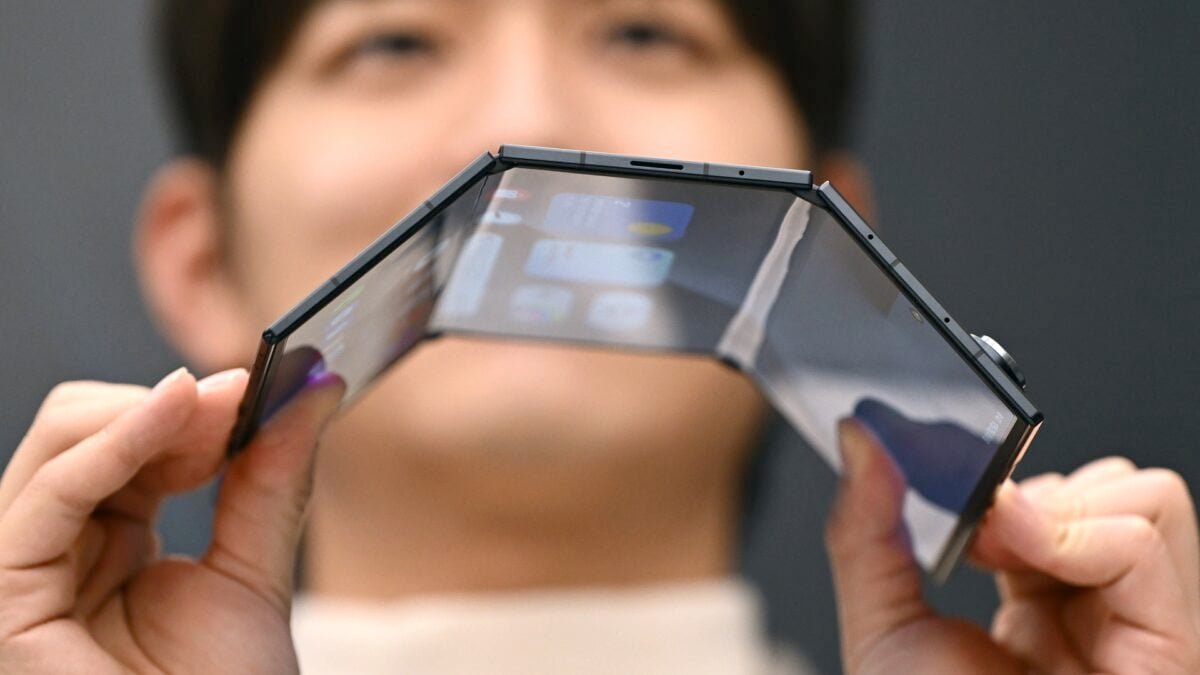
First, the Galaxy Z Trifold is launching in the US in Q1 2026, although pricing has not been announced. Second, holy moly, this damn thing is a mere 3.9mm at its thinnest point when unfolded. For comparison, the iPhone Air measures 5.6 mm, the Galaxy S25 Edge is 5.8 mm, and the Galaxy Z Fold 7 is 4.2 mm.

Previewed in late October, the Galaxy Z Trifold is an attempt by Samsung to provide an even larger foldable experience, presumably to differentiate its mobile lineup as Apple is reportedly preparing to launch a foldable iPhone next year. While the Galaxy Z Fold 7 is a book-style foldable with one hinge that folds the device in half, the Z TriFold has two hinges, both of which work to collapse three roughly 6.5-inch diagonal displays into a phone-sized device that’s 12.9 mm thick. Yes, that’s thick for a phone – the Galaxy S25 Ultra is 8.2mm, the iPhone 17 Pro is 8.75mm, and the Z Fold 7 is 8.9mm – but for a device that’s also a 10-inch tablet, it’s not too shabby.

As far as weight is concerned, Samsung says the Z Trifold weighs 309 grams. Again, to put this in perspective, the S25 Ultra is 218g, the iPhone 17 Pro Max is 233g, and the Z Fold 7 is 215g. Even the failed Red Hydrogen One, which was an actual tank of a phone, weighed less than 292 grams for the titanium model. Expect the Z Trifold to fit perfectly in your pants pocket.

Samsung has packed some surprising specs into the Z Trifold, so let’s highlight what we know. The 6.5-inch cover screen is AMOLED and has FHD+ resolution (2,520 x 1,080) with a 21:9 aspect ratio; It also has a 120Hz refresh rate and can reach a peak brightness of 2,600 nits. The 10-inch foldable screen is also AMOLED and has a QXGA+ resolution (2,160 x 1,584); It also has a 120Hz refresh rate, but it’s significantly less bright (just 1,600 nits at max brightness).
The chipset and five cameras are nothing out of the ordinary next to the regular Galaxy S25 Ultra. Samsung is using the Snapdragon 8 Elite for the Galaxy chipset, not the new Snapdragon 8 Elite Gen 5 chip that will power every major 2026 Android flagship. The Z Trifold comes standard with 16GB of RAM and 512GB or 1TB of storage.

As for the camera, there is a triple-lens camera at the back consisting of a 200-megapixel main, a 12-megapixel ultrawide, and a 10-megapixel 3x telephoto. Both the cover and the folding screen have a 10-megapixel hole-punch camera, although the latter has a wider field of view of 100-degrees versus 85 degrees.
Battery life is usually the weakest feature of foldables. The Z Trifold has a 5,600mAh battery. That feels big compared to the Z Fold 7 (4,400mAh), but it’s not as big as the Galaxy S25 Ultra, which has a 5,000mAh battery. At the very least, the Z Trifold can fast charge at 45W with a cable (up to 50% in 30 minutes), fast wireless charge at 15W, and also supports reverse wireless charging.

There’s no word on how durable or bend-proof the Z Trifold is, but Samsung shared that it’s got an IP48 rating, which is the same resistance to water and dust found on the Z Fold 7. Google’s Pixel 10 Pro Fold has all of Samsung’s foldables with a more protective IP68 rating.
Other features you’ll find on the Z Trifold include a capacitive fingerprint sensor (embedded in the power button), 5G, Wi-Fi 7, and Bluetooth 5.4.
First launching in South Korea

US customers will have to wait until Q1 2026 to purchase the Galaxy Z Trifold, as well, to get pricing information. South Korea will be getting the new foldable starting December 12, with a starting price of $3.59 million won, which is about $2,446 at the time of this writing.
The Z Trifold will also be available in China, Singapore, Taiwan, and the United Arab Emirates by the end of December. The price and exact launch dates have not been shared by Samsung yet.
$2,500 isn’t cheap for a phone, but considering that the Z Fold 7 goes for $2,000 and rumors suggest Apple may price its rumored iPhone foldable around $2,400, it’s not that bad. Last time I checked, Huawei’s own trifold phone, the Mate XT Ultimate, started at 3,499 euros, or about $4,060 at today’s exchange rates.
As always, I need to hold the Galaxy Z Trifold in my hands to really understand how it works. Are the two folds visible and distracting? How is its pocketability? Is 5,600mAh enough for such a big phone? I have so many questions.
<a href