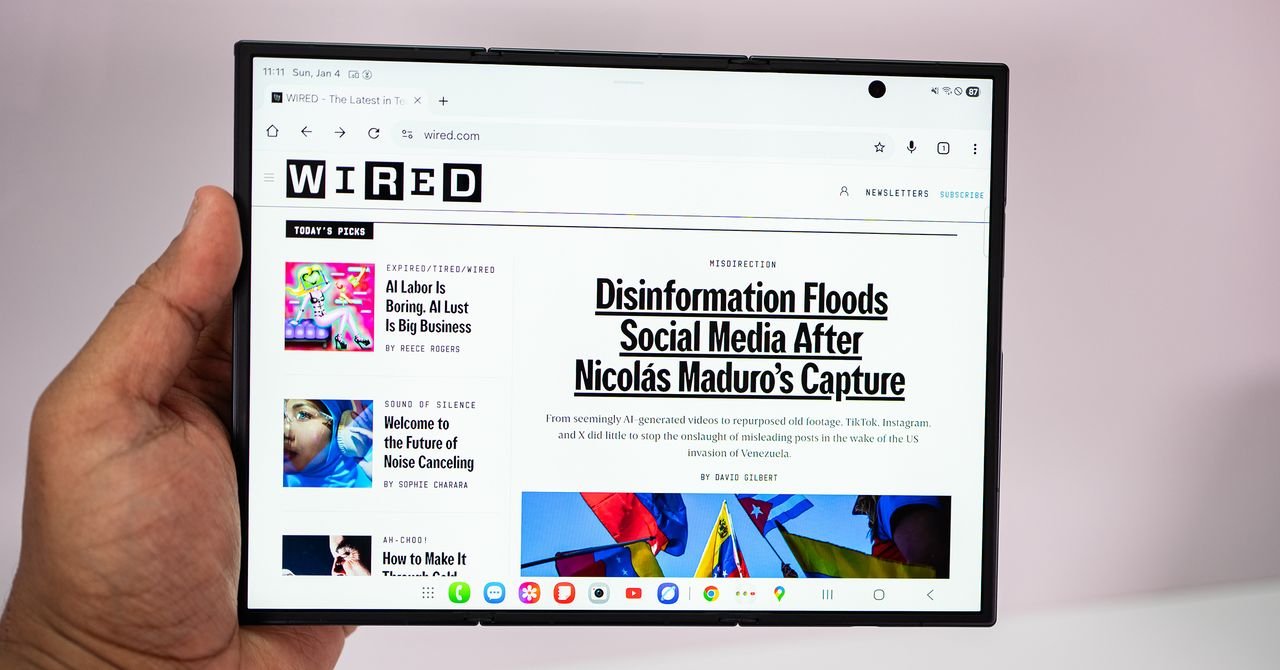
.jpg "Samsung Galaxy Z Trifold Hands On: This Is the Phone-Tablet Hybrid You're Looking For 2")
It has two titanium hinges, and they open three panels. You can place a full-sized app on each of the three panels, use a larger version of split-screen, or expand an app onto the giant display. These setups were easy to configure, and I can see myself taking advantage of having three apps open at once. It’s still a little hard to hold, but that’s not unusual for a 10-inch tablet. The Trifold is very thin in its unfolded state, which helps.
Fold it, and you’re looking at a thickness of 12.9 millimeters, which is just slightly larger than the Galaxy Z Fold6 (12.1 mm). The fact that it’s the same thickness as the previous generation Fold, yet with a dramatically larger screen, is impressive. This makes the bulk a little more delicious. There’s a right way to fold it and a wrong way. Thankfully, if you start turning it the wrong way with the right screen first, the phone starts ringing loudly, and you’ll see an alert on the screen asking you to turn the other screen first. However, I can still imagine someone ignoring it and just moving on.
The hardware is excellent, and the specs are top notch, close to the Samsung Galaxy S25 Ultra; There’s a 200-megapixel main camera on the back, and the phone is powered by Qualcomm’s Snapdragon 8 Elite. The displays are protected by ceramic glass, and even have an IP48 dust and water resistance rating.
<a href