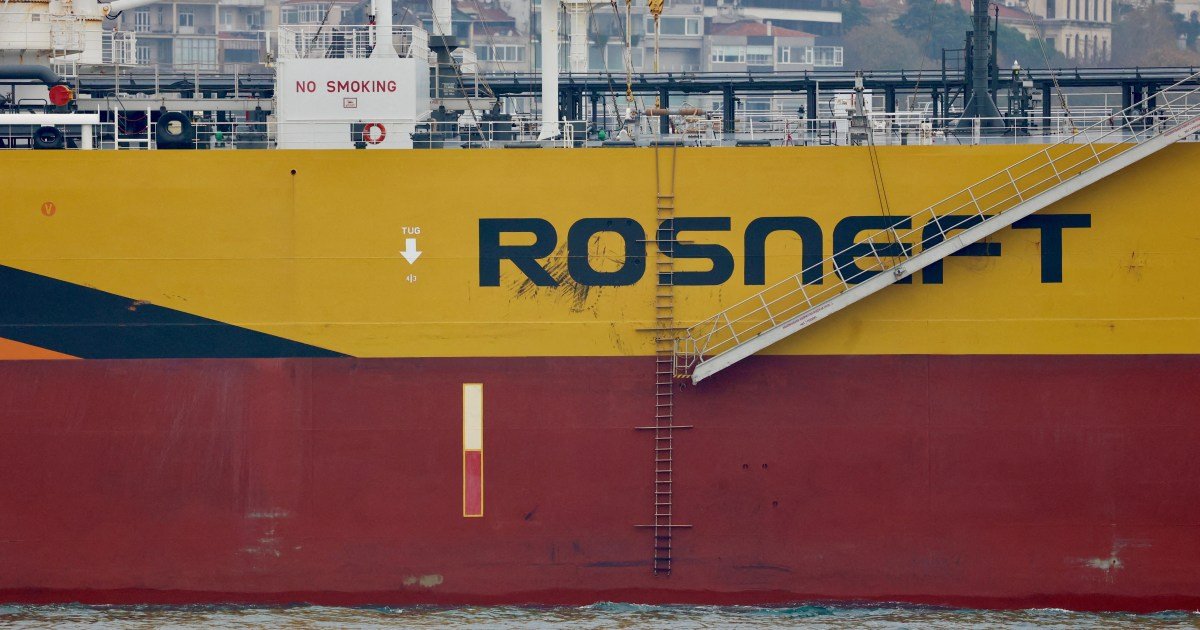
A total of 113 Russian ships have flown false flags in the first nine months of this year, transporting nearly 11 million tons of oil worth 4.7 billion euros ($5.4 billion), according to a report published Thursday by the Center for Research on Energy and Clean Air (CREA), a Helsinki-based think tank.
Recommended Stories
4 item listend of list
“The number of Russian shadow tankers sailing under false flags is now increasing at an alarming rate,” said report co-author Luke Wickenden.
“False flag vessels transported 1.4 billion euros ($1.6 billion) worth of Russian crude and oil products through the Danish Straits in September alone.”
Russia’s secret fleet transports sanctioned goods, especially oil, under non-Russian flags to avoid detection.
Every ship sailing on the high seas is required to fly a flag that grants it legal jurisdiction for its operations in international waters.
The United Nations Convention on the Law of the Sea allows countries to assign their nationality to ships and fly their flag.
Some countries offer open registries that allow foreign owned or controlled ships to use their flag, a practice favored by some shippers due to the lower regulatory burden and registration costs.
CREA said in its report that by the end of September this year, 96 sanctioned ships had flown a false flag at least once.
According to the think tank, a total of 85 ships recorded at least two flag changes six months after being sanctioned by the European Union, the United States Treasury Department’s Office of Foreign Assets Control (OFAC) or the United Kingdom.
According to CREA, six flag registries that had not flagged a Russian ship before Moscow’s full-scale invasion of Ukraine in February 2022 had at least 10 such ships in their fleets in September 2025, for a total of 162 shadow ships.
Co-author Vaibhav Raghunandan called on the EU and UK to reform their flag carrier rules and practices, saying, “In addition to the risks of false flagging, we also see ‘shadow’ ship operators taking advantage of the capacity limitations of economically weaker countries to obtain the right to distribute blood oil by exploiting their flags and existing regulations.”
CREA said it based its report on vessel ownership and flag registry records obtained from maritime security platform Equasys.
It said it had cross-referenced the data with the IMO Global Integrated Shipping Information System (GSIS), a global shipping industry database.
‘More avoidance techniques’
Rachel Ziemba, adjunct senior fellow at the Washington-based Center for a New American Security, said CREA’s findings are consistent with previous reports on Russia’s shadow fleet.
Ziemba said Moscow has resorted to “more evasive techniques” due to increased pressure from the EU as well as moves by China to block so-called “zombie ships” that use the registration numbers of retired ships.
While the US and EU continue to impose new sanctions on Russian oil, “there is an open question about enforcement,” Ziemba said.
He said as sanctions become more difficult to enforce due to rising illegal trade, countries will need to target shippers, middlemen and buyers to significantly curtail Russia’s oil sales.
“But it comes with costs,” Ziemba said, suggesting that China, a major buyer of Russian oil, could retaliate against countries that tighten sanctions.
He added, “Furthermore, actual enforcement could mean quasi-military stops of ships to check papers, something these countries may be wary of doing.”
<a href