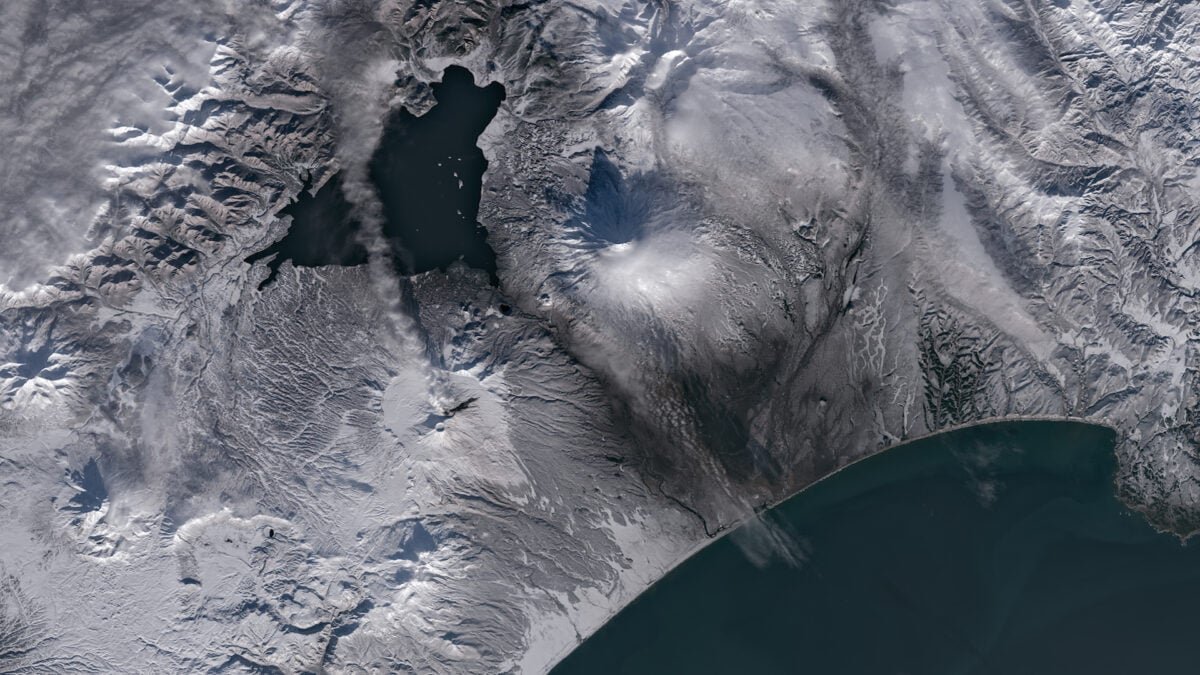
After being dormant for more than four centuries, the Krasheninnikova volcano erupted in August, spewing clouds of ash into the sky. Since then, volcanic plumes have continued to erupt from the site, spreading lava across Russia’s Kamchatka Peninsula.
NASA’s Earth observation satellite, Landsat 9, captured an overhead image of Krashennikova Volcano on November 14, revealing several months of ongoing activity. The image shows a volcanic vent erupting from one of Krasheninnikova’s craters and flowing northwest, as well as lava flows making their way across snowy slopes.

With the recent eruption, officials raised the aviation color code to orange, meaning the volcano is exhibiting extreme unrest.
reawakening
Krasheninnikova is located on the Kamchatka Peninsula in far-eastern Russia and is composed of two overlapping stratovolcanoes within a large caldera that extends about 6 miles (10 kilometers) across. Scientists believe the eruption that created the caldera, a large, bowl-shaped volcanic depression, is about 30,000 years old.
Before this year’s activity, the volcano’s most recent eruption is estimated to have occurred around 1550 AD based on geological evidence. After nearly 500 years of dormancy, the volcano erupted overnight on August 3, sending lava flowing from both summit cones.
This year’s eruption came five days after a massive 8.8-magnitude earthquake struck the peninsula, prompting tsunami warnings. Scientists at NASA’s Jet Propulsion Laboratory used a remote sensing technique, Interferometric Synthetic Aperture Radar (InSAR), to measure how much the ground moved in southern Kamchatka after the earthquake.
Using that data, JPL geophysicist Paul Lundgren analyzed the movement of magma in the Krashennikova eruption. Lundgren was able to detect deformation of the volcano’s surface that began after the earthquake but before the eruption, indicating magma coming close to the surface. “Considering a volcano that had not erupted or shown any signs of activity in nearly 400 years, I would consider this eruption to have been caused by a magnitude 8.8 earthquake,” he said.
The volcano is in a remote area inside the Kronotsky Nature Reserve and poses little harm to human settlements.